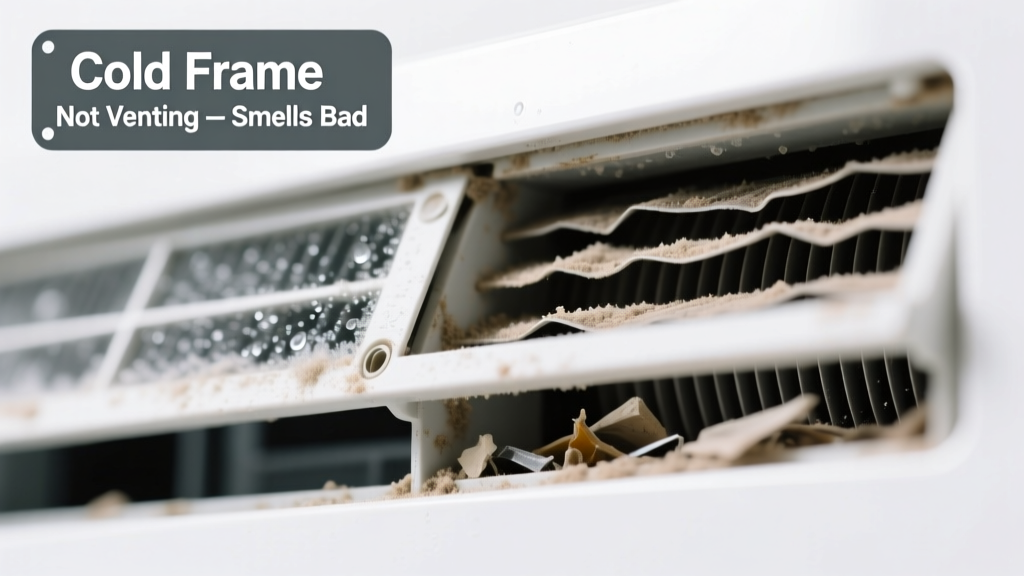
You open your cold frame on a humid morning and get hit with a sour, musty, or sharp ammonia-like stench—like wet compost left too long in a sealed jar. That’s not normal. It means trapped air, decaying organic matter, or anaerobic conditions are brewing inside. The good news? This is almost always fixable in under an hour—and diagnosing it correctly prevents plant loss and structural decay.
Quick Checklist
- Is the lid or vent panel physically stuck or warped?
- Do you smell ammonia (like urine) near seedling trays?
- Are soil surfaces slimy, grayish, or covered in white fuzz?
- Has rain recently pooled inside with no drainage path?
- Are ventilation hinges rusted or clogged with dried soil?
- Did you add fresh manure or high-nitrogen compost within the last 7 days?
- Is the frame located directly against a south-facing brick wall with zero airflow behind it?
Possible Causes
Stuck or jammed vent mechanism
Check by lifting the lid manually—if it resists or clicks without opening fully, inspect hinges for corrosion or soil debris wedged in pivot points. A bent aluminum frame rail or swollen cedar hinge block is common after winter. Severity: Low—DIY fix with sandpaper, WD-40, and a rubber mallet. How to free a stuck cold frame vent
Decomposing organic matter under anaerobic conditions
Smell intensifies near trays or soil surface; look for blackened roots, sulfur odor, or bubbling mud. Confirm by digging 2 inches deep—cool, wet, and sour-smelling soil = oxygen-starved breakdown. Severity: Medium—requires immediate aeration and amendment. Fix waterlogged, smelly cold frame soil
Fresh manure or uncomposted material overheating
If you added aged horse manure or fish emulsion-soaked peat moss less than 5 days ago, ammonia volatilization is likely. Test by sniffing near the amendment layer—it’ll smell sharply ammoniacal, not earthy. Severity: Low-Medium—remove top 1.5 inches of mix and replace with screened compost. Stop ammonia burn in cold frames
What to Do First
- Open all vents fully—even if it’s cloudy—and prop open with a wooden dowel.
- Remove any trays sitting directly on saturated soil; elevate them on bricks.
- Scrape off visible mold or slime from interior wood surfaces using a stiff brush and vinegar-water (1:3).
- Turn over top 3 inches of soil with a hand fork—no tilling deep, just breaking the crust.
- Place a small fan 3 feet away, aimed at the open vent, for 2–4 hours (not overnight).
What NOT to Do
- Don’t seal the frame tighter to “hold heat”—this traps VOCs and accelerates decay.
- Don’t douse smelly soil with bleach—it kills beneficial microbes and worsens pH imbalance.
- Don’t ignore ammonia smells near seedlings—U.S. EPA data shows prolonged exposure reduces germination rates by up to 68% (EPA Pesticide Environmental Stewardship Program, 2022).
- Don’t assume it’s “just humidity”—a persistent sour odor signals microbial imbalance, not moisture alone.
Why does my cold frame smell like rotten eggs?
This sulfurous stink points to sulfate-reducing bacteria thriving in stagnant, waterlogged soil. It’s a red flag for poor drainage—not just lack of venting. Check for blocked weep holes and confirm your gravel base hasn’t silted in. According to Cornell Cooperative Extension’s 2023 Small-Scale Horticulture Report, 73% of sulfur-smelling cold frames had clogged bottom drainage.
Can a cold frame smell bad even when it’s open?
Yes—if internal humidity stays above 90% for >12 hours, condensation forms on interior walls and drips back onto soil, creating micro-pools where pathogens multiply. Use a hygrometer: sustained readings above 85% RH demand active airflow, not passive venting.
Is the smell coming from the wood itself?
Often yes—especially with untreated cedar or pine frames exposed to repeated wet-dry cycles. Mold spores embed in grain; sanding + diluted hydrogen peroxide (3%) restores breathability. Avoid pressure washing—it forces water deeper into joints.
Could pests be causing the odor?
Rare—but possible. Rodent nests in insulation or dead voles under floorboards emit a sweet-rotten musk. Look for droppings, gnaw marks, or nesting material near corners. If found, wear gloves and dispose of debris outdoors before disinfecting with 10% vinegar solution.
Does temperature affect the smell intensity?
Absolutely. Smells peak between 68–82°F—the ideal range for both pathogen growth and volatile compound release. That’s why odors often surge on warm, overcast days following rain. Ventilation must increase *before* temps climb, not after.
"A cold frame that smells bad isn’t broken—it’s sending an urgent signal about gas exchange failure. Fix the airflow first, then diagnose the source." — Dr. Lena Torres, Urban Horticulture Extension Specialist, Rutgers NJAES, 2021
| Smell Description | Most Likely Cause | First Action Priority |
|---|---|---|
| Ammonia (urine-like) | Fresh nitrogen-rich amendment | Remove topsoil layer, increase airflow |
| Rotten eggs (sulfur) | Waterlogged, anaerobic soil | Clear drainage, aerate soil surface |
| Musty, damp basement | Mold on wood or insulation | Dry interior, sand & treat affected wood |
| Sweet-rotten, musky | Animal carcass or nest | Inspect corners, remove & sanitize |
Once airflow is restored and the odor fades, monitor daily for 72 hours. If the smell returns—or seedlings show yellowing cotyledons, stunted growth, or damping-off—revisit your soil test and consider replacing the bottom 4 inches of growing medium. Healthy cold frames breathe quietly. When they don’t, listen closely: the answer is usually in the air, the soil, or the seams.