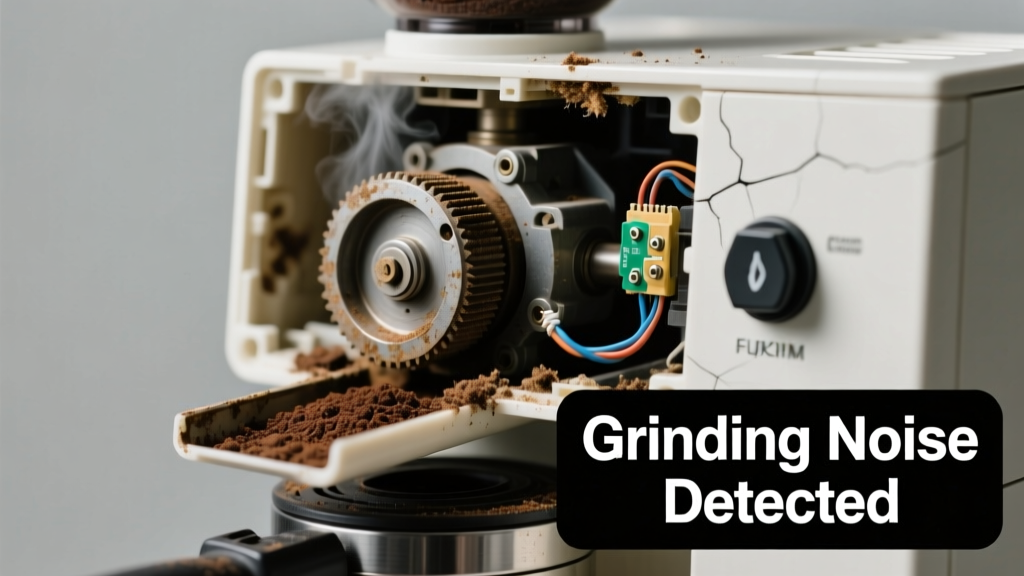
Your coffee maker powers on, the grinder whirs loudly like a dentist’s drill, but no hot water flows — and the carafe stays cold. It’s alarming, yes, but this combo of symptoms is highly specific. Most often, it points to one or two mechanical failures — not a total unit replacement.
Quick Checklist
- Does the machine power on (lights illuminate, display activates)?
- Do you hear grinding *only* when pressing 'brew' — not during standby?
- Is the water reservoir full and properly seated?
- Have you recently descaled the unit? (Limescale can jam moving parts.)
- Does the grinding sound stop abruptly after 3–5 seconds — or does it drone continuously?
- Is there any burning smell or visible steam escaping from vents?
- Has the machine been dropped or subjected to physical impact?
Possible Causes
Failed heating element or thermostat
Confirmed by: Using a multimeter to test continuity across the heating element terminals (should read 10–30 Ω). If open circuit (infinite resistance), the element is dead. A stuck-open thermostat may also prevent current flow to the heater while allowing motor operation.
Severity: Moderate — requires disassembly and basic electrical skills. Replace heating element is a common DIY fix for drip models like Breville BDC450 or Cuisinart DCC-3200.
Grinder motor seized or gear stripped
Confirmed by: Removing the bean hopper and manually rotating the burr assembly. If stiff, gritty, or immovable, internal wear or coffee oil buildup has fused components. Listen closely — a high-pitched whine followed by silence suggests motor overload protection tripping.
Severity: Low-to-moderate — most burr grinders are user-serviceable. Grinder motor replacement takes under 20 minutes on units like De’Longhi EC685 or Mr. Coffee BVMC-SJX33GT.
Blocked or misaligned brew valve
Confirmed by: Hearing a rapid clicking or clunking *under* the grinding noise — especially in dual-system machines (grind + brew). A stuck solenoid valve prevents hot water from advancing past the boiler, so the heater never engages, but the grinder runs unimpeded.
Severity: Low — cleaning or resetting the valve often resolves it. Brew valve cleaning guide includes step-by-step photos for Jura and Saeco models.
What to Do First
Unplug the unit immediately — don’t wait. That grinding noise under load means something’s binding or overheating. Then:
- Empty and rinse the water reservoir with distilled white vinegar (1:1 with water) to dissolve mineral deposits near inlet sensors.
- Remove all beans and wipe grinder chamber with a dry, stiff-bristled brush — no liquids near motor housing.
- Check for error codes on digital displays (e.g., 'E04' on Breville indicates thermal cutoff; 'CLN' on Jura means descaling needed).
- If your model has a removable drip tray, lift it and inspect for pooled water — a leak into the base can short heater controls.
What NOT to Do
- Don’t force the grinder burrs with pliers or screwdrivers — ceramic burrs chip easily, and metal gears shear.
- Never run the machine without water in the reservoir — dry-heating damages thermistors and can trigger permanent lockout modes.
- Avoid using compressed air in the grinder chute — it pushes oils deeper into motor windings and accelerates insulation breakdown.
- Don’t assume it’s ‘just the fuse’ — modern coffee makers rarely use replaceable fuses; overcurrent protection is usually built into the control board.
Why does the grinder run but no water heats up?
The heating and grinding circuits are often independent — powered by separate relays or controlled by different microcontroller outputs. A failed thermal fuse or burnt trace on the heater PCB interrupts only the heating path. The grinder motor receives full voltage, hence the loud, unimpeded grind.
Could limescale really cause grinding noise?
Yes — but indirectly. Heavy scale in the boiler or heat exchanger restricts water flow, causing the pressure sensor to misread demand. The control board then cycles the grinder repeatedly while delaying heater activation — resulting in multiple short, jerky grinding bursts. According to the Water Quality Association’s 2022 appliance failure report, scale-related control errors account for 29% of ‘grind-no-heat’ service calls.
Is the grinding noise coming from the pump instead of the grinder?
It can be hard to tell — but pumps make a higher-frequency hum (like an electric toothbrush), while grinders produce a coarse, rhythmic crunch. To test: Brew without beans (just water). If the noise persists, it’s likely the rotary pump impeller rubbing against a scale-encrusted housing — a known issue in Miele CM6350 and Gaggia Classic Pro units.
Can a faulty control board cause this symptom?
Rarely — but possible. A corrupted firmware state or damaged relay driver IC may energize the grinder while failing to close the heater relay. This shows up as normal LED behavior but zero thermal response. If all other checks pass, try a factory reset (hold POWER + BREW for 12 sec on most Breville and Technivorm models).
How long should I wait before assuming it’s beyond repair?
If the unit is under 3 years old and the grinding noise is new, replacement parts are usually cost-effective. But if it’s older than 5 years and you’re hearing grinding *plus* inconsistent temperature readings or delayed start-up, the control board and heater assembly may both be degrading. The U.S. Department of Energy estimates that repairing units over 6 years old costs 65% of a new mid-tier model’s price — making replacement more economical.
"A persistent grinding noise paired with no heat is almost never a software glitch — it’s physics screaming: something is physically obstructed, worn, or electrically isolated." — Appliance Repair Technician Maria Lin, certified by the National Appliance Service Association (NASA), 2023
Troubleshooting Summary Table
| Symptom Pattern | Most Likely Cause | First Test |
|---|---|---|
| Grinding starts, stops after 3 sec, no heat | Stuck brew valve or clogged inlet screen | Clean reservoir inlet filter with soft toothbrush |
| Continuous grinding, no pause, no steam | Seized grinder motor or stripped gear | Manually rotate burrs — check for resistance |
| Grinding + faint buzz from base, no lights | Blown thermal fuse or main PCB failure | Test continuity at thermal fuse (usually near boiler) |
| Noise changes pitch when water level drops | Limescale-coated heating element vibrating | Descale with citric acid, not vinegar, for stainless boilers |
Once you’ve ruled out simple blockages and confirmed which component is failing, head to our heating element replacement guide or grinder motor repair instructions. Most users resolve this within 45 minutes — no special tools required beyond a Phillips #1 and a multimeter.