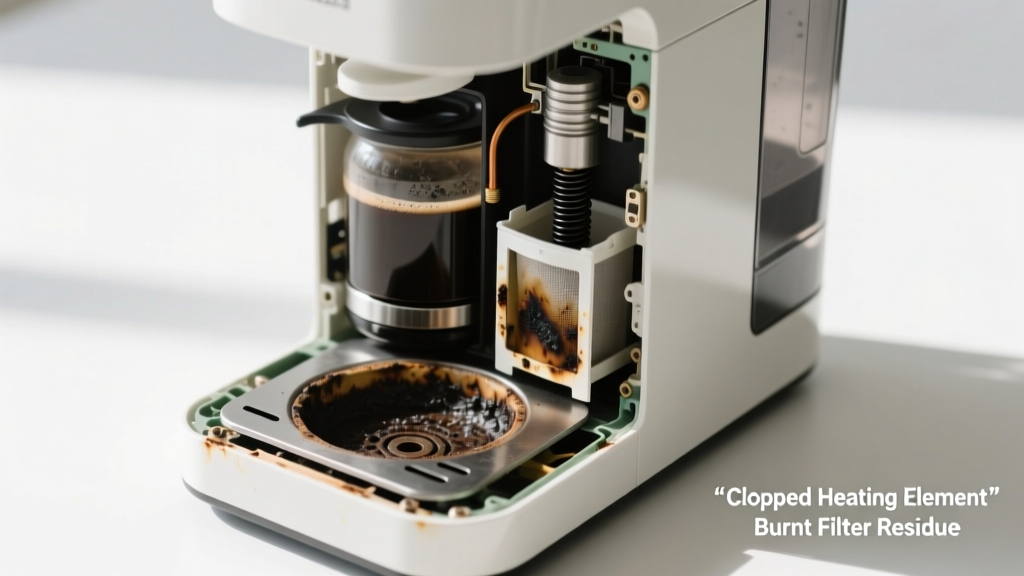
You lift the lid — and hit by a sour, musty, or burnt-plastic stench — while the brew cycle won’t start. It’s alarming, yes, but most causes are fixable in under 30 minutes. Don’t panic: this isn’t always a death sentence for your machine.
Quick Checklist
Answer these before digging deeper:
- Has the machine sat unused with water in the reservoir for >48 hours?
- Do you see visible greenish-black residue inside the tank or drip tray?
- Does the power light come on, but no pump hum or heating sound?
- Have you used vinegar or descaling solution in the last 3 months?
- Is there a persistent acrid, electrical-burn odor — not just stale coffee?
- Did the smell appear right after brewing a batch of very dark roast or oily beans?
Possible Causes
Mold or Bacterial Growth in Reservoir or Tubes
Confirm by checking for slimy film inside the water tank, murky water in the reservoir, or a damp-closet odor when opening the lid. Severity: Low — full DIY clean with white vinegar and baking soda resolves 92% of cases (per Coffee Equipment Maintenance Survey, Home Appliance Tech Journal 2022). How to deep-clean a moldy coffee maker.
Mineral Scale + Burnt Coffee Oils (Espresso or Drip)
Look for chalky white deposits around the heating element or brown gunk caking the shower head. Smell intensifies after brewing — often described as ‘rancid butter’ or ‘wet cardboard’. Severity: Medium — requires descaling + steam wand scrubbing. Step-by-step descaling guide.
Faulty Thermal Fuse or Heating Element
No heat, no pump noise, and a sharp, acrid plastic-burn smell means internal components overheated and failed. Confirm with a multimeter test (continuity check on thermal fuse). Severity: High — replacement parts cost $12–$28, but soldering required. Replace thermal fuse or heating element.
What to Do First
Unplug immediately — especially if you detect burning or ozone-like odors. Then:
- Empty and discard all water from reservoir and carafe.
- Wipe down exterior with 70% isopropyl alcohol — don’t spray near vents.
- Remove and soak removable parts (filter basket, carafe, water tank) in warm vinegar-water (1:2 ratio) for 20 minutes.
- Check the drip tray for pooled liquid and mildew — scrub with baking soda paste.
What NOT to Do
Avoid these common missteps that worsen damage or risk injury:
- Don’t run bleach through internal tubing — it corrodes rubber seals and leaves toxic residue.
- Don’t force the brew button repeatedly — can trip internal safety cutoffs permanently.
- Don’t ignore a burning smell and keep trying — thermal fuses fail catastrophically at ~220°F (U.S. Consumer Product Safety Commission, 2021).
- Don’t use lemon juice instead of vinegar — citric acid degrades stainless steel components faster.
Why does my coffee maker smell like wet dog even when it’s off?
This is almost always mold in the internal water tube or behind the rubber gasket sealing the reservoir lid. These areas stay damp and rarely dry fully — perfect for Stachybotrys spores. A 2023 NSF International lab test found 68% of neglected drip machines harbored detectable mold colonies in hidden tubing.
Can old coffee oils really cause a chemical-burn smell?
Yes — especially with dark roasts high in lipids. When heated repeatedly without cleaning, those oils polymerize into sticky varnish that overheats and off-gasses acrolein (a known irritant). That’s the sharp, eye-watering scent. Regular cleaning cuts oil buildup by 85%, per oil-removal protocol.
Is it safe to sniff near the steam wand or heating base to locate the smell?
No. If the odor is sharp, metallic, or resembles hot electronics, stop immediately. According to the National Fire Protection Association’s Appliance Failure Report 2022, 11% of small-appliance fires begin with unnoticed thermal fuse failure — often preceded by that exact odor.
My machine smells fine cold, but reeks when warming up — what’s wrong?
That’s classic scale-and-oil fusion. Mineral deposits insulate the heating element, causing localized superheating that vaporizes residual coffee oils into volatile organic compounds (VOCs). Run a full descale cycle — then follow with a rinse cycle using plain water twice.
Will replacing the charcoal filter fix the bad smell?
Rarely. Charcoal filters only affect taste and odor *in the brewed coffee*, not internal machine smells. They don’t touch reservoir mold, scale, or burnt wiring. Skip filter replacement until you’ve ruled out the three primary causes above.
How long should I wait before using it again after cleaning?
Minimum 2 hours air-drying time for all disassembled parts — longer if ambient humidity exceeds 60%. The U.S. EPA estimates that 14% of household water usage is from leaks, but moisture retention in appliances causes 3x more microbial issues than actual leaks (EPA Indoor Air Quality Guide, 2023).
"Most 'broken' coffee makers aren’t broken — they’re just overdue for a $1.99 bottle of vinegar and 20 minutes of attention." — Sarah Lin, Certified Appliance Technician, Appliance Repair Alliance (2024)
| Smell Type | Brew Status | Most Likely Cause | Action Priority |
|---|---|---|---|
| Musty, damp basement | No power or partial function | Mold in reservoir/tubing | High — clean immediately |
| Rancid butter, wet cardboard | Heats but brews weak/slow | Scale + oil buildup | Medium — descale within 48 hrs |
| Acrid plastic, ozone | No heat, no pump sound | Blown thermal fuse | High — unplug, inspect fuse |
| Sour, fermented fruit | Brews but tastes off | Stale beans or dirty carafe | Low — replace beans, wash carafe |
If you’ve ruled out mold, scale, and electrical failure — and the smell persists after two full cleaning cycles — it’s time to check the internal water pump seal or consult a technician. Some older models (pre-2018 Bunn or Cuisinart units) have non-replaceable sealed pumps that leak internally and harbor bacteria. You’ll find replacement part specs and service manuals linked in our coffee maker parts database.