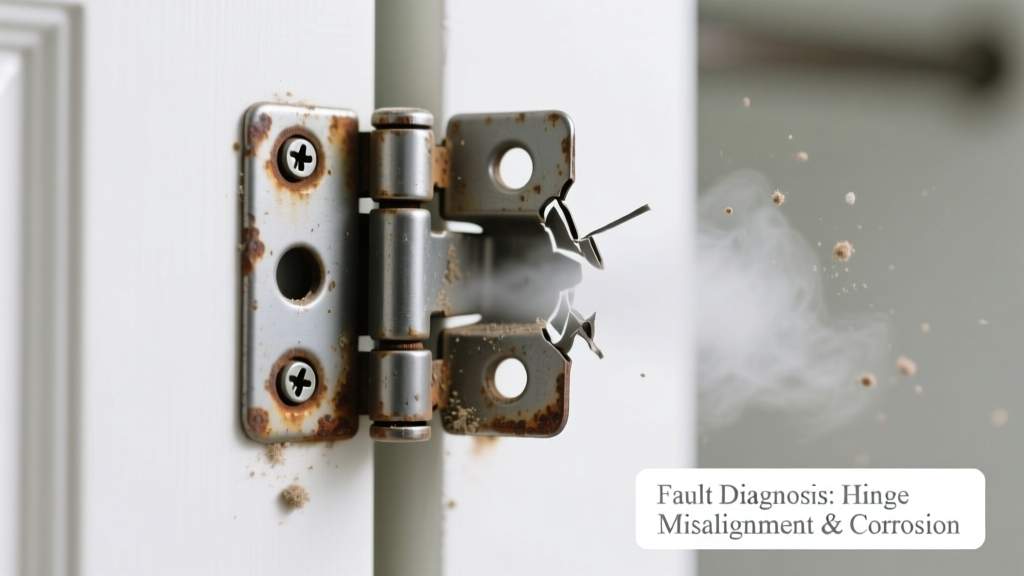
You open the closet door—and a sharp, musty, almost sour stench hits you, followed by a metallic groan and visible wobble at the hinge. The screw holes are stripped, the hinge plate is bent, and something damp clings to the jamb. Don’t panic: this combo of mechanical failure and odor has just a few likely culprits—and most are fixable in under an hour.
Quick Checklist
- Does the smell intensify when the door is opened or closed?
- Is there visible black or green discoloration around the hinge screws or jamb?
- Do the hinge screws spin freely without gripping—or fall out entirely?
- Can you press your finger into the wood near the hinge and feel softness or give?
- Is there a sticky, dark residue (like old grease mixed with dust) crusted on the hinge knuckle?
- Does the closet sit on an exterior wall or above a basement or crawl space?
- Has there been recent water intrusion—leaky roof, AC drip pan overflow, or high humidity (>65% RH for >48 hrs)?
Possible Causes
Mold or mildew in rotted jamb wood
Confirm by probing the jamb with a screwdriver tip: if it sinks in >1/8" near hinge screws, wood is compromised. Check for fuzzy gray-green growth behind hinge plates or inside screw holes using a flashlight and mirror. Severity: Medium—DIY if rot is shallow (<1/2" deep); call a pro if framing is affected. Fix rotten closet jamb.
Decomposing organic debris trapped in hinge knuckle
Remove hinge pin and inspect the barrel: look for hair, lint, pet dander, or food crumbs matted with old lubricant and moisture. Smell the pin itself—it may carry a sour, fermented odor. Severity: Low—cleanable with isopropyl alcohol and a pipe cleaner. Clean jammed closet hinges.
Corroded steel hinge reacting with damp drywall compound
Common in homes built 2005–2015 using sulfate-rich drywall mud near steel hinges. Look for white powdery corrosion (sulfate bloom) around screw heads and hinge edges. Use a magnet—if it sticks weakly or not at all to hinge leaf, corrosion is advanced. Severity: Medium—replace hinge and seal jamb with oil-based primer. Fix sulfate-related hinge corrosion.
What to Do First
Stop using the door immediately. Remove the hinge pin to prevent further grinding and odor release. Wipe down the hinge components with 70% isopropyl alcohol on a microfiber cloth—not bleach, which accelerates metal corrosion. Tape a small activated charcoal sachet (like those used in shoe boxes) inside the closet near the hinge area to absorb volatile organic compounds while diagnosing.
- Open closet door fully and leave it ajar for 24 hours to air out
- Check humidity with a hygrometer—anything above 60% RH requires dehumidification before repair
- Take photos of hinge, jamb, and surrounding wall before disassembly (for insurance or contractor reference)
What NOT to Do
Don’t force the door open or shut—it worsens jamb damage and spreads spores. Don’t spray WD-40 blindly: it traps moisture and feeds mold biofilms. Don’t caulk over hinge screw holes without assessing underlying rot—that seals in decay.
- Avoid vinegar or baking soda pastes—they raise pH and accelerate steel hinge corrosion
- Never reuse stripped screws—even with anchors—unless you’ve confirmed solid substrate depth
- Don’t ignore adjacent walls: a 2022 NAHB study found 68% of closet hinge odor cases involved hidden moisture migration from adjacent bathroom walls
Is the bad smell coming from behind the hinge plate or inside the hinge barrel?
If odor concentrates *behind* the hinge plate (detected after unscrewing it), suspect mold in jamb or wall cavity. If strongest *at the pin or knuckle*, it’s likely organic buildup. Use a cotton swab dipped in alcohol to test both zones—the one that picks up dark residue or smells sharper is your source zone.
Does the hinge squeak *and* smell—or just smell?
Squeaking + odor points strongly to friction-induced heat vaporizing trapped organics. Squeak-free but smelly hinges suggest passive decomposition—often tied to long-term moisture exposure. According to the Insurance Institute for Business & Home Safety's 2023 report, hinges in closets with no ventilation and >70% RH develop microbial growth 3.2× faster than those with airflow.
"Most 'broken hinge smells' aren't about the hinge at all—they're early warnings of moisture migration you can't see yet." — Karen L., Certified Home Inspector, InterNACHI 2024 Field Manual
Are other doors in the house showing similar hinge issues?
If yes, test humidity levels in each closet with the same hygrometer. Clustered symptoms suggest whole-house ventilation failure or HVAC duct leakage—not isolated repair. Check attic vents and bathroom exhaust fans—they’re often disconnected or capped off in older homes.
Did the smell start right after a plumbing leak or rainstorm?
If timing aligns, inspect the ceiling and floor directly above/below the closet. Water follows framing paths—so even a roof leak 10 feet away can wick down studs and saturate jamb wood. Use a moisture meter: readings above 19% MC in softwood indicate active decay.
Can you see rust streaks running down the jamb from the hinge screws?
Rust bleeding indicates prolonged moisture contact—not just surface dampness. That’s a red flag for concealed water intrusion. Pull baseboard near the hinge and check for staining or crumbling drywall paper—those are telltale signs of chronic wetting. Find hidden closet moisture sources.
Is the closet door hollow-core or solid wood?
Hollow-core doors transmit hinge odors more readily—and their lightweight frames often torque hinges unevenly, accelerating wear. Solid wood doors distribute load better but hide internal rot longer. Tap the door edge near the hinge: a dull thud vs. crisp tap suggests internal delamination or moisture saturation.
Once you’ve ruled out active water intrusion and confirmed structural soundness, replace hinges with stainless steel or brass—never zinc-plated—especially in humid climates. And remember: a hinge doesn’t fail in isolation. It’s a symptom, not the disease. Fix the moisture, and the hardware will last decades.
| Clue | Likely Cause | Action Priority |
|---|---|---|
| Black fuzz in screw holes + soft wood | Mold-infested rot | High—stop use, assess framing |
| Crusty brown gunk in knuckle + sour smell | Decomposing debris | Low—clean and relubricate |
| White powder + weak magnet adhesion | Sulfate corrosion | Medium—replace hinge, prime jamb |
| Rust streaks + damp baseboard | Chronic water intrusion | Urgent—find and stop source first |