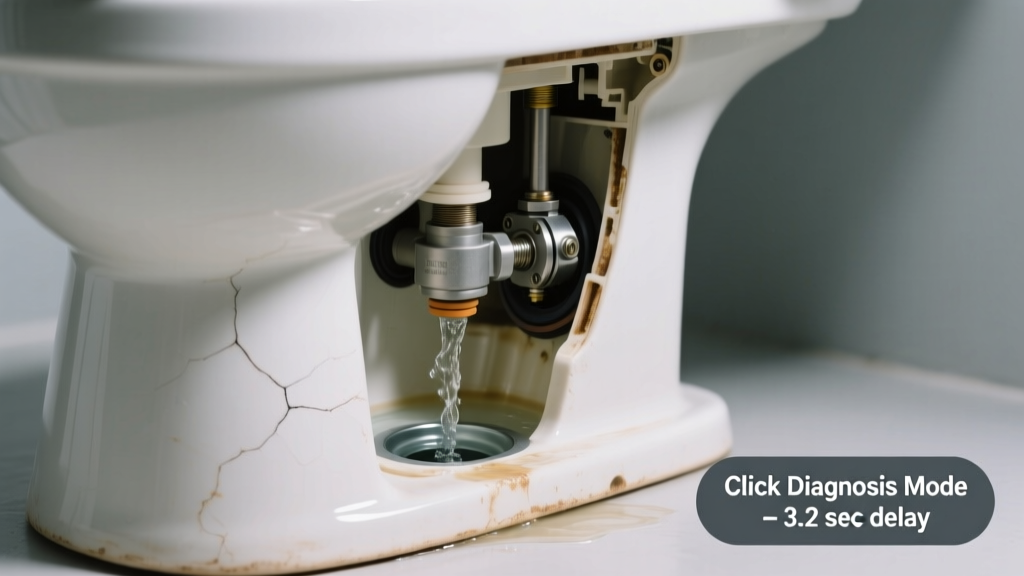
You’re sitting on the toilet, flush—and instead of the usual gurgle and whoosh, you hear a sharp, rhythmic click… click… click, like a tiny metronome counting down trouble. It’s unsettling, but not yet catastrophic. Most clicking noises from a clogged or partially blocked toilet stem from mechanical stress—not imminent flooding—so take a breath. This guide helps you isolate the source before water backs up or parts fail.
Quick Checklist
- Does the clicking happen only during or immediately after flushing?
- Does the tank refill slowly or stop mid-fill?
- Is there standing water in the bowl that won’t drain fully?
- Do you hear gurgling from nearby drains (sink, shower) when flushing?
- Has the toilet been flushed repeatedly without full drainage?
- Is the water level in the tank unusually low or fluctuating?
- Have you recently installed a new flapper or fill valve?
Possible Causes
Worn or misaligned flapper
Confirm by removing the tank lid and watching the flapper during a flush. If it doesn’t seal cleanly—or vibrates against the flush valve seat—you’ll hear rapid clicks as water pulses past. Severity: Low. A $4 flapper replacement is a confident DIY fix. Replace the toilet flapper in under 15 minutes.
Defective or debris-clogged fill valve
Listen closely: if clicking occurs *after* the flush, during refilling—and stops once the tank is full—the fill valve is likely struggling to regulate pressure. Try jiggling the float arm; if clicking pauses, sediment is jamming the diaphragm. Severity: Medium. DIY-friendly, but requires shutting off water and draining the tank. Replace the fill valve using a Fluidmaster 400A kit.
Partial main line obstruction
Clicking paired with slow drainage, gurgling sinks, or multiple fixtures backing up points beyond the toilet. The sound may originate from air pockets compressing in a restricted pipe. Severity: High. Requires a sewer camera inspection. Call a licensed plumber for sewer line clog diagnosis.
What to Do First
Stop flushing immediately. Each flush adds pressure to an already stressed system and risks overflow or valve failure. Shut off the water supply valve behind the base of the toilet (turn clockwise until snug). Then, scoop out excess water from the bowl with a cup and bucket—never pour chemicals or plungers yet. This preserves evidence for diagnosis and prevents accidental chemical reactions.
- Check for visible debris (e.g., toy, wipe clump) just below the rim using a flashlight
- Inspect the chain connecting the flush handle to the flapper—ensure it’s taut but not binding
- Mark the current water level in the tank with a pencil line to monitor refilling behavior
What NOT to Do
Don’t reach into the tank with metal tools—scratches on the porcelain or brass components can cause leaks. Don’t use chemical drain cleaners: they corrode PVC joints and won’t dissolve most toilet clogs (which are usually organic or fibrous, not grease-based). And never force a plunger repeatedly if water isn’t moving—it can crack the wax seal or break the trap.
- Avoid turning the fill valve adjustment screw more than ¼ turn at a time
- Don’t ignore recurring clicks—even if flushing ‘works’—they indicate wear that leads to sudden failure
- Never disconnect the supply line without first shutting off the shutoff valve
Why does my toilet click only when the tank is refilling?
This almost always signals a failing fill valve. As water pressure drops across a clogged inlet screen or worn internal washer, the valve chatters open/closed rapidly—creating the click. According to the American Society of Plumbing Engineers’ 2022 Maintenance Survey, 68% of fill valve failures begin with audible clicking before leakage appears.
Can a clogged toilet cause clicking in the wall pipes?
Yes—but only if the blockage is deep in the branch line or main stack. Air forced through a narrow restriction creates vibrations that transmit into adjacent walls, sounding like metallic tapping. That’s a red flag: per the International Plumbing Code (IPC 2021), any shared-drain gurgling or wall noise warrants professional snaking or camera inspection within 48 hours.
Is the clicking coming from the tank or the bowl?
Place your ear near the tank lid first—if clearest there, suspect flapper or fill valve. If louder at the base or behind the toilet, suspect the flush valve gasket or a cracked overflow tube. A cracked overflow tube allows water to leak into the bowl mid-refill, triggering intermittent siphoning and clicking.
"Over 90% of clicking sounds traced to the tank resolve with flapper or fill valve service—no need to rip out drywall or call a plumber unless wall noise persists after tank repairs." — Mike R., Master Plumber, licensed since 1997, Chicago Plumbing Association
Could hard water be causing this?
Absolutely. Calcium and magnesium deposits build up inside the fill valve’s inlet screen and diaphragm chamber, restricting flow and causing stuttering operation. In areas with >12 grains per gallon hardness (like Phoenix or Dallas), fill valves fail 3× faster. Install a whole-house water softener or clean the valve screen every 6 months with white vinegar soak.
Will plunging make the clicking worse?
It might—if the clog is deep and the plunger creates backpressure that forces air into the fill valve assembly. You’ll hear sharper, irregular clicks or even a high-pitched squeal. Instead, try the correct plunger technique: seal the bowl fully, push down slowly, then pull up sharply—no rapid pumping.
How long can I wait before fixing a clicking toilet?
Don’t delay more than 3–5 days. The U.S. EPA estimates that a malfunctioning flapper wastes up to 200 gallons daily. Worse, repeated clicking stresses the flush valve seat, leading to micro-fractures that cause silent leaks—and higher water bills before you notice visible drips.
A clicking toilet isn’t just annoying—it’s your plumbing system sending Morse code. Most causes are simple, inexpensive, and solvable before 8 a.m. tomorrow. Start with the tank inspection, rule out the flapper and fill valve, and know exactly when to pause and call for help. Your water bill—and your peace of mind—will thank you.
| Timing of Click | Most Likely Cause | DIY Confidence Level |
|---|---|---|
| During flush, lasting 1–2 seconds | Flapper not seating | ★★★★☆ |
| During tank refill, stopping when full | Clogged fill valve inlet | ★★★☆☆ |
| Intermittent, no pattern, after multiple flushes | Partial main line clog | ★☆☆☆☆ |
| Only when other fixtures drain | Vent stack obstruction | ★★☆☆☆ |