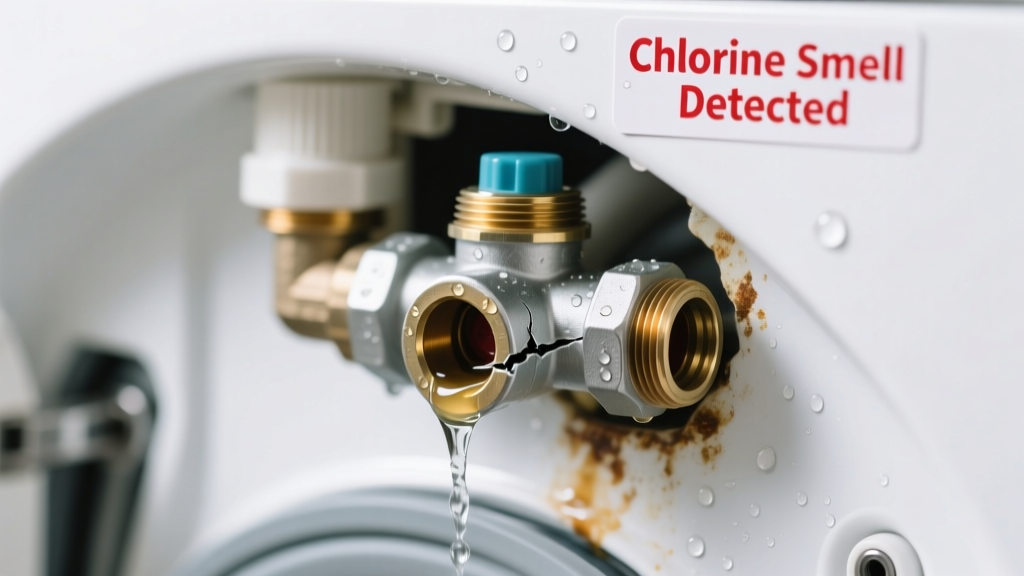
You catch a sharp, swimming-pool-like chlorine smell — then spot damp drywall near your basement floor, a puddle under the water heater, or wet carpet beside an outdoor spigot. Your nose is sounding the alarm before your eyes fully register the leak. This combo isn’t normal tap water behavior — it’s a signal pointing to a specific type of plumbing failure, not just a worn washer.
Quick Checklist
- Does the smell intensify when you run hot water?
- Is the leak near the water heater, pressure relief valve, or expansion tank?
- Do you have an in-ground pool or spa with underground supply lines?
- Is the water visibly cloudy or yellowish when it leaks?
- Did the smell start shortly after city maintenance or a water main break nearby?
- Is the leak occurring only when the irrigation system runs?
Possible Causes
Leaking Chlorinated Pool or Spa Supply Line
Underground PVC or PEX lines feeding chlorine-treated water to pools or spas can crack or separate at fittings. When they leak, chlorinated water saturates soil and wicks upward through slabs or foundation cracks — carrying that unmistakable odor into basements or garages. Confirm by checking for wet spots along known line paths, especially after pump cycles. Severity: Moderate — requires excavation and pipe replacement. Fix leaking pool line.
Failing Water Heater Anode Rod or Internal Corrosion
When the magnesium or aluminum anode rod depletes, the steel tank lining erodes. Chlorine in municipal water accelerates this, causing hydrogen sulfide (rotten egg) or chlorine-like odors — and pinhole leaks near the tank base or T&P valve. Confirm by testing water from the heater’s drain valve: if it smells strongly of chlorine and leaves white residue, corrosion is likely. Severity: High — tank replacement needed. Fix water heater leak.
Municipal Backflow or Cross-Connection Issue
A faulty backflow preventer at an irrigation system, pool fill line, or commercial booster pump can allow chlorinated water to siphon backward into domestic cold lines — then leak from faucets, valves, or supply connections. Confirm by shutting off all outdoor water sources and retesting indoor taps; if smell disappears, suspect cross-connection. Severity: Critical — violates code and risks contamination. Call a licensed backflow tester immediately.
What to Do First
Act within the first hour to limit damage and exposure:
- Shut off the main water supply — not just the heater or fixture valve.
- If the leak is near electrical outlets or panels, turn off the circuit breaker for that zone.
- Soak up standing water with towels or a shop vac — never a household vacuum.
- Open windows and run fans to disperse chlorine vapors (OSHA notes airborne chlorine above 0.5 ppm irritates airways).
- Test water from multiple fixtures using a free chlorine test strip — compare readings to your local utility’s reported residual (typically 0.2–4.0 ppm).
What NOT to Do
- Don’t ignore it “until the weekend” — chlorine accelerates metal corrosion and drywall degradation.
- Don’t use bleach-based cleaners near the leak — mixing chlorine compounds can generate toxic chloramine gas.
- Don’t wrap leaking joints with tape or sealant as a permanent fix — it masks ongoing corrosion.
- Don’t assume it’s “just the water heater” without checking irrigation or pool lines first — misdiagnosis leads to repeated failures.
Why does my cold water smell like chlorine but only when it leaks?
Chlorine odor becomes noticeable when water stagnates in a confined space — like behind drywall or under flooring — allowing volatile compounds to concentrate. Intact pipes deliver water under pressure, diluting and dispersing odor; leaks create low-flow pockets where chlorine off-gasses. According to the U.S. EPA’s 2022 Drinking Water Regulations, chlorine residuals are intentionally maintained to prevent pathogens — but leaks turn that safety feature into an indoor air quality hazard.
Can a chlorine smell mean mold is growing behind the wall?
Rarely. Chlorine itself inhibits mold growth. However, prolonged moisture from any leak — even chlorinated — can degrade organic materials (wood framing, paper backing on drywall) once chlorine dissipates. If the smell fades but dampness remains for >48 hours, mold risk rises. The CDC recommends drying affected areas within 24–48 hours to prevent colonization.
Is it safe to drink water if it smells like chlorine but looks clear?
Yes — if the odor matches your municipality’s typical residual level (check your annual Consumer Confidence Report). But if the smell is new, stronger than usual, or accompanied by metallic taste or discoloration, it may indicate pipe corrosion releasing copper or iron — or a failing water softener resin tank. Flush cold lines for 5 minutes and retest.
My pool line leaked once — now it’s dry but the smell lingers. Why?
Chlorinated water soaks into concrete, brick, or soil, where it reacts with minerals and organics to form chloramines — compounds that off-gas slowly for days or weeks. A 2021 study in Journal of Water and Health found chloramine persistence in porous substrates averaged 17 days post-leak. Ventilation and dehumidification speed dissipation.
Could this be a sign of a failing water softener?
Unlikely — softeners don’t add chlorine. But if yours uses sodium hypochlorite for resin bed sanitization (some commercial units do), a cracked brine tank or failed injector could leak diluted bleach solution into the house supply. Check the softener’s service history and look for white crystalline residue near its discharge hose.
"Chlorine odor paired with leakage almost always traces to either a compromised barrier between treated and potable systems — or accelerated corrosion inside aging steel tanks. Don’t treat the symptom; map the path the water traveled." — Licensed Master Plumber, Plumbing Code Institute Field Manual (2023)
| Clue | Most Likely Cause | Next Step |
|---|---|---|
| Smell strongest near water heater, leak at base | Anode rod failure / tank corrosion | Drain & test heater water; inspect T&P valve |
| Smell outdoors near sprinkler head or valve box | Irrigation cross-connection or leak | Shut off irrigation main; check backflow device certification |
| Smell appears only after city flushes mains | Municipal hyperchlorination event | Wait 24–48 hrs; flush cold lines for 3 mins |
| Damp spot in garage slab with no visible pipe | Under-slab pool/spa line leak | Hire infrared thermographer or acoustic leak detector |
Chlorine isn’t just a smell — it’s chemistry in motion. That sharp scent means oxidizers are actively reacting with something: pipe metal, soil minerals, or organic matter behind your walls. Pinpointing where that reaction starts gives you control — not just over the leak, but over what happens next.