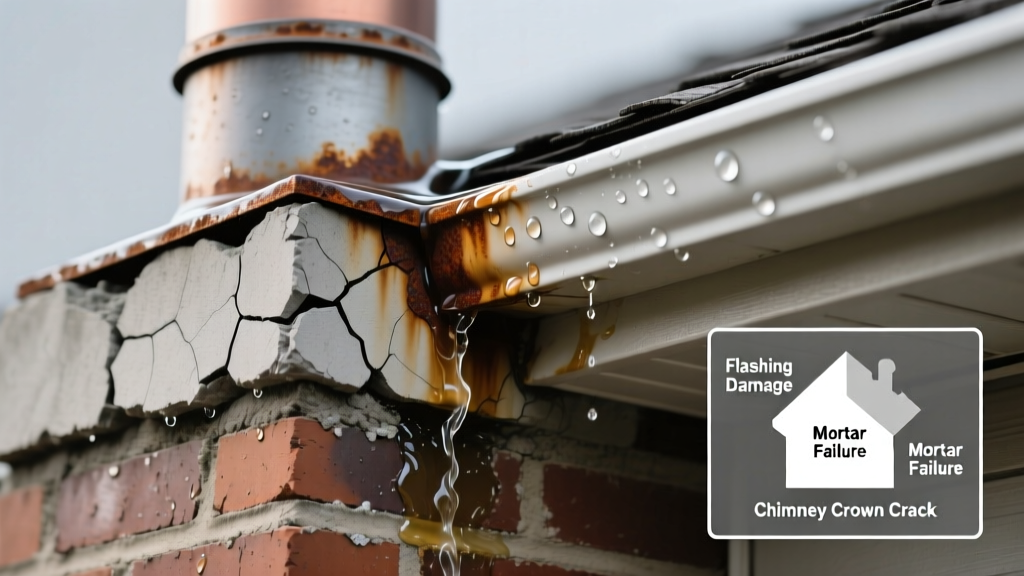
You spot a dark, damp stain spreading across your ceiling near the fireplace. A musty odor lingers in the living room after rain. Water pools on the hearth or drips from the damper — not condensation, but actual liquid leaking down the flue. This isn’t just annoying; it’s a red flag for structural moisture intrusion that can rot framing, rust metal components, and encourage mold growth within weeks.
Quick Checklist
Answer these yes/no questions to narrow the source:
- Did the leak appear only during or immediately after heavy rain?
- Is water coming from the top of the chimney (crown or cap), not inside the firebox?
- Do you see cracked or missing mortar joints on the exterior chimney stack?
- Has the chimney cap been missing, damaged, or never installed?
- Is there visible rust or white efflorescence (chalky residue) on brick or mortar near the crown?
- Does water drip *inside* the firebox when it rains — even with the damper closed?
- Have you noticed loose or cracked flashing where the chimney meets the roof?
Possible Causes
Cracked or deteriorated chimney crown
Over 70% of chimney water leaks originate at the crown, according to the Chimney Safety Institute of America’s 2022 Field Survey. Look for hairline cracks, spalling concrete, or gaps between crown and flue tile. Tap the crown with a screwdriver handle — hollow sounds indicate delamination. Severity: Moderate. DIY repair possible for minor cracks using elastomeric crown coating (chimney crown repair), but full replacement requires masonry expertise.
Missing, damaged, or improperly sized chimney cap
A cap prevents rain, animals, and debris from entering the flue — yet nearly 40% of inspected chimneys lack one or have caps with undersized flue openings (CSIA 2023). Confirm by climbing onto the roof (safely) or using binoculars: check for rust holes, bent mesh, or gaps >¼" between cap base and flue tile. Severity: Low. Replace with a UL-listed, multi-flue cap sized to your flue dimensions (chimney cap installation).
Failed or corroded flashing
Flashing failure accounts for 22% of roof-to-chimney leaks (Roofing Contractors Association, 2021). Inspect the step flashing along the sides and counterflashing embedded in mortar joints. Look for lifted edges, rust stains, or gaps >1/8" where metal meets brick. Severity: High. Requires roofing and masonry coordination — chimney flashing repair is rarely a safe DIY.
What to Do First
Stop further saturation immediately:
- Place buckets or towels under active drips — don’t rely on absorbent rugs (they trap moisture underneath).
- If safe and accessible, temporarily cover the chimney top with a heavy-duty tarp secured with non-marring straps — never nails or staples.
- Run a dehumidifier in the affected room (aim for ≤50% RH) and open windows for cross-ventilation on dry days.
- Document everything: take timestamped photos of stains, drips, and suspected problem areas — critical for insurance claims or contractor estimates.
What NOT to Do
Avoid these common missteps that worsen damage or mask the real issue:
- Don’t caulk around flashing or crown edges — it traps moisture behind surfaces and accelerates decay.
- Don’t ignore interior staining — even small ceiling spots often signal 6–12 inches of wet insulation or rotted roof sheathing above.
- Don’t use interior sealants like Drylok on flue walls — they prevent vapor escape and can blister or spall under heat and humidity.
- Don’t delay inspection if water enters the firebox — that often means flue liner cracks or severe crown failure requiring Level 3 CSIA-certified evaluation.
Is the leak coming from the chimney crown or the flue liner?
Perform the “hose test”: with someone watching inside the firebox, spray water slowly over the crown for 5 minutes using a garden hose on mist setting. If water appears inside, the crown or flue tile joint is compromised. If no interior drip, the leak is likely elsewhere — like flashing or cap.
"A single 1/8-inch crack in a chimney crown can channel over 2 gallons of rainwater into masonry per inch of length during a moderate storm." — National Chimney Sweep Guild Technical Bulletin, 2020
Why does my chimney leak only during wind-driven rain?
Wind pressure forces water horizontally into gaps too small for vertical rain entry — especially at crown-to-flue tile joints, cracked mortar, or degraded flashing end dams. This is why leaks may skip light showers but erupt during nor’easters or thunderstorms with gusts over 25 mph.
Can a chimney leak cause mold behind drywall?
Absolutely. The U.S. EPA estimates that untreated chimney leaks contribute to 12% of residential mold cases in homes older than 25 years. Moisture migrates laterally through framing, saturating insulation and drywall paper — ideal conditions for Stachybotrys growth within 48–72 hours. If you smell earthy mustiness near the chimney chase, inspect attic insulation and wall cavities behind adjacent rooms.
Is it safe to use the fireplace while the chimney is leaking?
No. Water exposure compromises flue liner integrity and can cause steam explosions in hot clay liners. It also increases creosote condensation, raising fire risk. Shut down fireplace use until a certified chimney sweep performs a Level 2 inspection (Level 2 chimney inspection).
How long can I wait before repairing a chimney leak?
Don’t wait more than 2 weeks after first noticing active leakage. According to the Insurance Institute for Business & Home Safety’s 2023 report, delaying repairs beyond 14 days increases the likelihood of structural wood decay by 300% — especially in humid climates or homes with poor attic ventilation.
Chimney leaks rarely fix themselves — and they almost always get worse faster than you expect. Catching the culprit early saves hundreds in drywall, insulation, and framing repairs. Start with the checklist, document what you find, and prioritize the fix based on severity. When in doubt, hire a CSIA-certified professional before the next storm hits.
| Source | Likelihood | First Sign Appears | Max Safe Delay |
|---|---|---|---|
| Chimney crown cracks | 72% | After first heavy rain post-winter | 10 days |
| Missing/damaged cap | 18% | Immediately after cap dislodgement (e.g., high winds) | 3 days |
| Flashing failure | 22% | Gradual staining over months, worsens with seasonal temperature swings | 7 days |
| Flue liner cracks | 9% | Water inside firebox during rain, even with damper closed | Immediate |