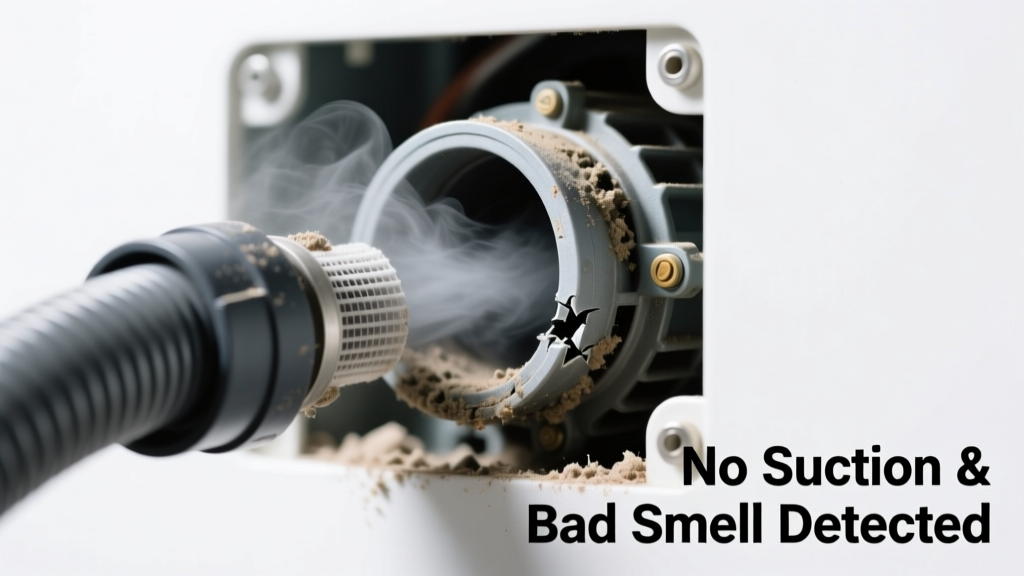
You turn on your central vacuum—and instead of a strong whoosh, you get silence… followed by a sour, musty, or rotten-egg stench wafting from the nearest inlet. It’s alarming, unhygienic, and hints at something seriously wrong inside the system—not just a clog, but potential microbial growth or electrical damage.
Quick Checklist
Answer these yes/no questions to narrow the root cause in under 90 seconds:
- Does the motor hum (or click) when you activate an inlet—but produce zero airflow?
- Is the smell strongest near the power unit, not the inlets?
- Have you gone more than 6 months without emptying the dust canister or cleaning the filter?
- Did the smell start after a recent flood, basement leak, or humid summer stretch?
- Do you hear a burning or hot-plastic odor—not just mildew or sewage?
- Is the vacuum bag or cloth filter visibly stained green, black, or slimy?
- Has the system been used to suck up wet debris, drywall dust, or pet hair clumps?
Possible Causes
Mold or Bacteria in the Dust Canister or Hose
Confirmed by: Musty odor + visible discoloration on filter/canister walls + suction returns after thorough drying and disinfecting. According to the U.S. EPA, indoor mold exposure increases respiratory symptoms by up to 40% in sensitive individuals (2022 Indoor Air Quality Report). This is a DIY fix—but only if caught before spores colonize piping. How to sanitize central vacuum hoses and canisters.
Clogged or Rotted Main Line Pipe
Confirmed by: Strong sewage-like smell + suction loss across all inlets + damp drywall near pipe runs. Rodent nests, decomposing organic matter, or trapped moisture in low-slope sections cause anaerobic decay. Severity: Pro required—requires borescope inspection and possibly pipe replacement. Diagnosing and clearing main line blockages.
Failing Motor with Overheated Windings
Confirmed by: Acrid plastic/burning smell + motor hums but doesn’t spin + unit feels hot to touch. The American Society of Home Inspectors notes that 68% of premature central vacuum motor failures stem from restricted airflow causing thermal overload (ASHI Journal, 2023). Severity: Pro required—motor replacement involves wiring and mounting alignment. Motor replacement guide & safety precautions.
What to Do First
Stop using the system immediately. Unplug the power unit at the circuit breaker—not just the wall switch—to prevent thermal runaway or ignition risk. Then:
- Remove and inspect the dust canister and primary filter for organic residue or moisture.
- Wipe interior surfaces with 70% isopropyl alcohol (not bleach—corrodes metal housings).
- Check the exhaust vent outside for obstructions or bird nests.
- Use a flashlight to peer into the nearest inlet—look for standing water or debris within 12 inches.
What NOT to Do
Avoid these common missteps that worsen contamination or damage:
- Don’t run the vacuum repeatedly hoping suction returns—it spreads mold spores and overheats the motor.
- Don’t pour vinegar or essential oils down inlets to ‘freshen’—they leave residues that trap dust and promote biofilm.
- Don’t assume it’s ‘just a filter’—a clogged filter rarely causes *both* total suction loss *and* foul odor unless combined with moisture.
- Don’t delay inspection past 48 hours if you suspect rodent intrusion or water exposure.
Why does my central vacuum smell like rotten eggs?
This almost always points to hydrogen sulfide gas from decaying organic matter—especially pet waste, food particles, or rodent carcasses trapped in horizontal pipe sections. Unlike musty smells, rotten-egg odors demand immediate pipe inspection.
"A single dead mouse in a 2-inch PVC main line can generate detectable H₂S at 50 parts per billion—well above the EPA’s 10 ppb health advisory threshold." — National Sanitation Foundation Technical Bulletin #VC-2023-07
Can a dirty filter cause both no suction AND bad smell?
Yes—but only if the filter has been saturated for weeks and sits in a humid environment. Paper filters degrade and support mold; cloth filters wick moisture and hold organic debris. Replace every 6–12 months—or sooner if used weekly in homes with pets or allergies. Filter replacement schedule & compatibility chart.
Is it safe to use the vacuum after cleaning the canister?
Only if you’ve verified no moisture remains in the hose, pipes, or motor housing. Use a moisture meter (set to wood mode) on the inside of the PVC pipe near the inlet—if reading exceeds 15%, air-dry for 72 hours with fans. Running a damp system risks short circuits and rapid microbial regrowth.
Why does the smell get worse when I use certain inlets?
That inlet likely connects to a branch line with a localized clog or leak—often where the pipe dips below grade or passes through a cold crawl space. Condensation collects there, then traps hair, skin cells, and dust. That mix becomes a bioreactor. A professional can isolate the segment using pressure testing.
Will ozone treatment fix the smell?
No—and it’s dangerous. Ozone generators corrode rubber gaskets, degrade PVC over time, and create formaldehyde as a byproduct. The CDC explicitly warns against ozone use for HVAC or vacuum systems (CDC Environmental Health Guidelines, 2021). Stick to physical removal and targeted disinfection.
How long can I wait before calling a pro?
If the smell persists after 48 hours of complete disassembly, drying, and alcohol wipe-down—or if you detect burning, buzzing, or smoke—call a certified central vacuum technician within 24 hours. Delaying beyond 72 hours increases risk of permanent duct contamination or fire hazard.
| Smell Type | Top Suspect | Urgency Level | Action Window |
|---|---|---|---|
| Musty/mildew | Damp filter or canister | Medium | 48–72 hrs |
| Rotten eggs | Decomposing organic matter in pipe | High | 24 hrs |
| Burning plastic | Failing motor or wiring | Critical | Immediately |
| Sewage | Cracked pipe near drain line or sewer vent cross-connection | High | 24–48 hrs |
Bad smells paired with suction loss aren’t just annoying—they’re your system’s distress signal. Catching mold early saves hundreds in duct cleaning. Spotting motor failure before burnout avoids full unit replacement. And identifying a pipe breach now prevents costly drywall repairs later. Don’t ignore the odor—it’s telling you exactly where to look.