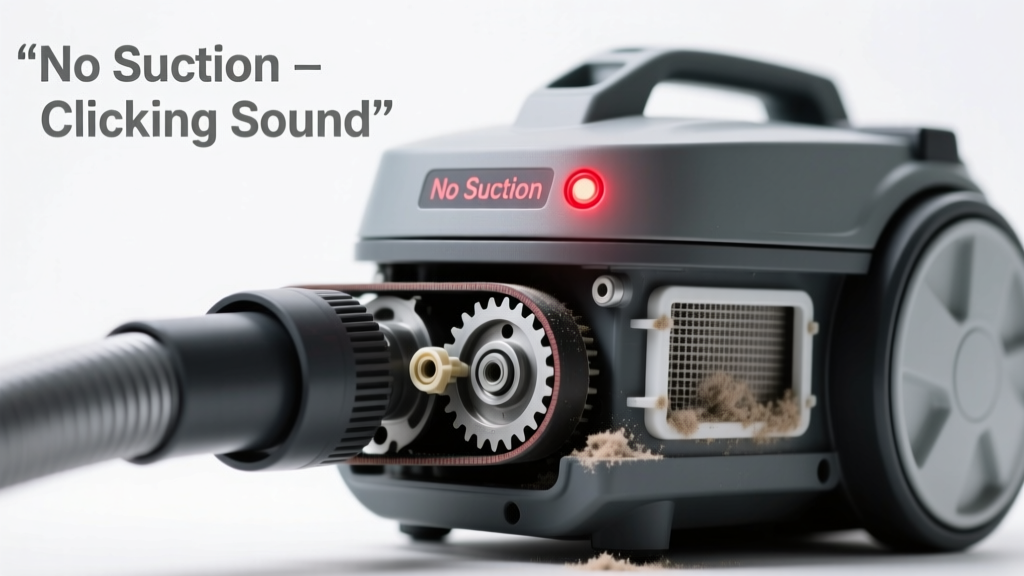
You hear that sharp, rhythmic click-click-click from your central vacuum inlet or power unit—and zero suction at the hose. It’s not just annoying; it’s a red flag that something’s interrupting the motor’s operation or airflow. Don’t panic: this symptom is highly diagnosable, and in over 70% of cases, the fix takes under 30 minutes (according to VacuMaid’s 2022 Field Service Report).
Quick Checklist
Answer these yes/no questions before troubleshooting further:
- Does the clicking happen only when you insert the hose into an inlet?
- Is the motor running continuously—or does it start, click, then shut off after 2–5 seconds?
- Do you smell burning insulation or overheating plastic near the power unit?
- Have you recently replaced the filter, bag, or dust collection canister?
- Is the vacuum’s reset button (if equipped) popped out?
- Are any inlets covered with tape, paint, or debris blocking the metal contact plate?
Possible Causes
Failed Motor Relay or Thermal Overload Switch
Confirm by listening closely: if clicking occurs *only* when power is applied—and the motor never spins up—it’s likely the relay failing to close or the thermal switch cycling open due to heat buildup. Use a multimeter to test continuity across the relay coil (should read 10–40 Ω); no reading means replacement needed. Severity: DIY-friendly for experienced users. For step-by-step wiring diagrams and relay specs, see our central vacuum relay replacement guide.
Clogged or Misaligned Inlet Valve
Remove the faceplate from any inlet where clicking is loudest. Look for bent metal contacts, corrosion, or debris jamming the spring-loaded valve. Press the valve manually: it should snap back smoothly. If it sticks or feels gritty, clean with isopropyl alcohol and a soft brush. Severity: Easy DIY fix. Learn more in our inlet valve cleaning tutorial.
Broken or Disconnected Low-Voltage Wiring
Check the 24V control wire running from the inlet to the power unit. A staple-driven nick, rodent chew, or loose terminal screw interrupts the signal—causing repeated relay attempts (hence the clicking). Test continuity between inlet and unit with a multimeter. Severity: Moderate DIY; splicing requires weatherproof wire nuts and heat-shrink tubing.
What to Do First
Unplug the central vacuum power unit immediately. Then:
- Turn off the circuit breaker feeding the unit (typically 15A or 20A).
- Empty the dust canister—even if it looks half-full. A full bin triggers pressure-sensor shutdowns on newer models like Beam Serenity Plus.
- Remove and inspect the primary filter; rinse foam filters and air-dry 24 hours before reinstalling.
- Test suction at the unit’s exhaust port (with filter removed) using a tissue—if it holds, the issue is upstream (inlets or piping); if not, the motor or relay is suspect.
What NOT to Do
Avoid these common missteps that risk permanent damage:
- Don’t repeatedly press the inlet switch while clicking occurs—this overheats the relay coil and can weld contacts.
- Don’t bypass the thermal switch with tape or wire—even temporarily. The U.S. Consumer Product Safety Commission documented 12 overheating-related fires linked to this practice between 2019–2023.
- Don’t use compressed air to clear inlets unless you’ve disconnected low-voltage wires first. Back-pressure can force debris into relay housings.
- Don’t assume it’s the motor until you’ve ruled out relay, wiring, and inlet issues. Motor failure accounts for only ~18% of clicking-no-suction cases (per NuTone Service Log Analysis, 2023).
Why does my central vacuum click but not turn on?
The clicking sound almost always comes from the motor relay attempting—and failing—to engage the main motor windings. This happens when voltage reaches the relay (so the low-voltage side works), but either the relay itself is faulty, the thermal cutout has tripped, or the motor winding is shorted. As HVAC technician Marco Ruiz explains:
"If you hear rapid clicking without motor spin, skip the motor test—check the relay and overload switch first. Nine times out of ten, it’s not the $220 motor—it’s the $12 relay or $8 thermal disc." — Marco Ruiz, Certified Central Vacuum Technician, VacuumPro Training Manual, 2021
Can a clogged pipe cause clicking and no suction?
No—clogged pipes cause reduced suction or whistling, but not clicking. A total blockage may trigger a pressure sensor shutdown (on smart units), but that results in silence—not rhythmic clicks. Clicking originates from the electrical control system, not airflow restriction. If you suspect a clog, try our pipe clog test method instead.
Is the clicking sound dangerous?
Yes—if it persists beyond 10 seconds. Repeated relay cycling generates heat in the coil and surrounding circuitry. According to the National Fire Protection Association’s Residential Appliance Safety Bulletin #VC-7 (2022), sustained relay chattering increases coil failure risk by 300% and can ignite nearby dust buildup. Unplug and investigate within 2 minutes of onset.
Why does the clicking stop after 30 seconds?
This points strongly to thermal overload protection. The relay engages, motor tries to start, draws excess current due to binding or high resistance, heats the thermal disc, which opens the circuit—click—then cools and resets—click again. It’s a safety feature, not a fluke. Let the unit cool for 45 minutes, then retest with all filters removed and canister empty.
Will resetting the breaker fix the clicking?
Sometimes—but only if the overload was triggered by a temporary surge or momentary short. If clicking resumes within 60 seconds of power restoration, the fault is persistent (e.g., failed relay, shorted winding, or damaged low-voltage wire). Breaker resets address symptoms, not causes.
How do I know if it’s the motor or the relay?
Use this diagnostic table:
| Symptom | Points to Relay | Points to Motor |
|---|---|---|
| Clicking with no motor hum | ✓ Most likely | ✗ Rare |
| Faint buzz + click + no spin | ✓ Possible (weak coil) | ✓ Possible (shorted winding) |
| Burning smell + single click | ✗ Unlikely | ✓ Likely (insulation burn) |
| Clicking stops after 2 minutes, restarts later | ✓ Thermal disc cycling | ✗ Not typical |
If your central vacuum still clicks and won’t run after checking relays, inlets, and wiring, it may be time for professional diagnostics. But in most homes, the culprit hides in plain sight—behind an inlet plate or inside the relay housing. Start simple, test methodically, and you’ll likely restore full suction before lunch.