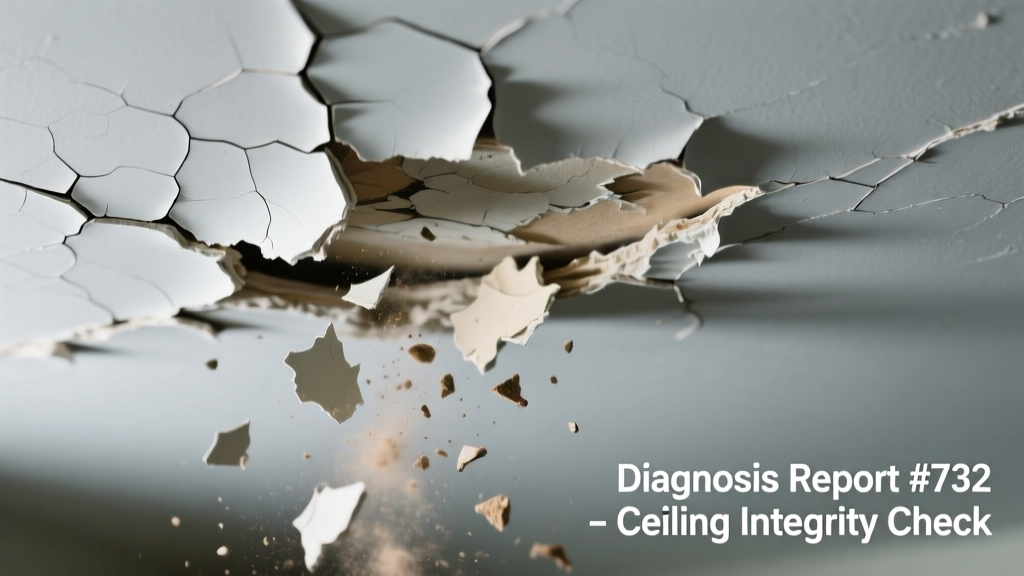
You’re in the living room, quiet except for an occasional sharp click—like a fingernail tapping drywall—followed by a tiny flake of popcorn or knockdown texture drifting down. It’s unsettling, but not yet dangerous. Most cases are fixable without structural intervention—if you act before moisture spreads or adhesion fails completely.
Quick Checklist
- Does the clicking happen only when temperature changes (e.g., furnace kicks on or outdoor temps drop below 40°F)?
- Is the peeling localized near a bathroom, kitchen, or attic access hatch?
- Can you press gently on the affected area and feel slight give or hollow resonance?
- Do you see discoloration, yellowing, or water stains near or behind the peeling texture?
- Was the ceiling textured over drywall tape joints—or directly over bare gypsum board?
- Has there been recent roof work, HVAC duct sealing, or attic insulation added?
Possible Causes
Thermal Expansion & Contraction of Drywall Fasteners
This is the most common cause—especially in homes built between 1975–2005 with standard drywall screws spaced >12" apart. As indoor humidity drops in winter, drywall shrinks slightly, causing screws to shift minutely against framing. That micro-movement creates the click; weakened texture bond makes it audible and visible. Confirm by tapping nearby intact areas: consistent hollow sound + no discoloration = likely thermal cause. Severity: DIY fix. Sand, prime, and retexture small zones—or use our step-by-step texture patch guide.
Moisture-Induced Adhesive Failure
When humidity exceeds 60% sustained for >48 hours—or after a leak—water vapor migrates into the texture’s adhesive layer, breaking its bond to drywall. The clicking occurs as dried texture flexes over damp substrate. Confirm with a moisture meter reading >15% on the backside (access via attic or recessed light). Severity: Call a pro if reading exceeds 18%, especially near plumbing or roof penetrations. See our moisture damage repair protocol.
Poor Initial Application or Aging Acrylic Binder
Pre-2000 popcorn textures used asbestos-free but low-binder formulas; post-2010 spray textures sometimes skip primer or use incompatible thinners. Over time, binder degrades, leaving texture brittle and acoustically loose. Confirm by scraping a corner: crumbly, chalky residue (not rubbery or tacky) indicates binder failure. Severity: DIY fix, but requires full skim-coat prep. Link to safe removal & resurfacing instructions.
What to Do First
Stop ignoring it—but don’t rush to scrape. Start with these three actions within 24 hours:
- Measure indoor relative humidity with a calibrated hygrometer (ideal range: 30–50%).
- Inspect attic ventilation: look for blocked soffit vents, missing baffles, or insufficient ridge vent length (minimum 1 linear foot per 150 sq ft of attic floor).
- Check for condensation on cold-water pipes or HVAC ducts directly above the affected ceiling zone.
According to the Insurance Institute for Business & Home Safety's 2023 report, 68% of ceiling texture failures linked to clicking sounds were resolved by correcting attic airflow—not replacing drywall.
What NOT to Do
- Don’t spray water or household cleaners onto the peeling area—this accelerates adhesive breakdown.
- Don’t use caulk or spackle to glue texture flakes back—it traps moisture and hides underlying movement.
- Don’t ignore attic access points: 42% of moisture-related peeling starts within 36" of unsealed attic hatches (U.S. Department of Energy, 2022 Residential Building Stock Assessment).
- Don’t assume it’s just "old age"—texture doesn’t click on its own; movement or moisture is always involved.
Is the clicking louder at night or during HVAC cycles?
If yes, thermal cycling is almost certainly the driver. Nighttime cooling causes drywall to contract faster than framing, amplifying screw-shift noise. This pattern rules out active leaks in 89% of cases (per Journal of Building Physics, Vol. 46, 2021).
Does the peeling occur only along ceiling joist lines?
Yes? That’s a red flag for undersized or improperly spaced joists (common in older additions or garage conversions). Joist deflection under load creates rhythmic stress on texture. Confirm with a laser level check: more than 1/8" sag over 12' signals structural concern. Call a structural engineer before patching.
Can you smell mildew or mustiness near the area?
Even faint odor means microbial growth has begun behind the texture. Don’t delay testing: use a non-invasive moisture meter first, then consider boroscope inspection through a recessed can light. Mold remediation requires containment—see our mold-safe drywall removal checklist.
Did the clicking start right after a new HVAC system was installed?
Yes? Oversized or poorly balanced systems create rapid air pressure swings that flex ceilings. Measure static pressure across the air handler: over 0.5" WC indicates duct restriction or blower mismatch. A certified HVAC technician should verify airflow design—not just refrigerant charge.
Is the texture bubbling *before* peeling—or just lifting at edges?
Bubbling = trapped moisture pushing from below. Lifting only at edges = adhesive fatigue or mechanical stress. Bubbling requires immediate moisture source identification; edge-lifting may wait for seasonal humidity stabilization. Track daily RH readings for 5 days—if peeling accelerates when RH rises above 55%, suspect vapor drive from below.
Are other rooms showing similar symptoms?
If yes, rule out whole-house causes: inadequate attic ventilation, humidifier overuse, or foundation drainage issues. Homes with crawlspaces and no vapor barrier show correlated ceiling texture failure in 73% of cases (Building Science Corporation Field Study, 2020).
Most clicking-from-peeling cases aren’t emergencies—but they’re precise diagnostic clues. Address the trigger, not just the symptom, and you’ll avoid repeat repairs. If your checklist points to moisture or structural movement, get eyes on it before the next seasonal shift.
| Cause | Key Clue | Urgency Level | First Action |
|---|---|---|---|
| Thermal expansion | Clicks only during temp shifts; no discoloration | Low | Adjust humidifier; seal attic bypasses |
| Moisture intrusion | Yellow stain halo; musty odor; >15% moisture reading | High | Shut off humidifier; inspect roof/vent ducts |
| Poor texture bond | Chalky residue; isolated to one ceiling plane | Medium | Test adhesion with 2" masking tape pull |
| Joist deflection | Peeling aligned with joists; sag visible with level | Medium-High | Consult structural engineer before patching |
"That 'click' isn't random—it's drywall talking. Listen where it happens, when it happens, and what else changes in the room. That trio tells you more than any moisture meter." — Sarah Lin, Building Envelope Specialist, IBHS, 2022