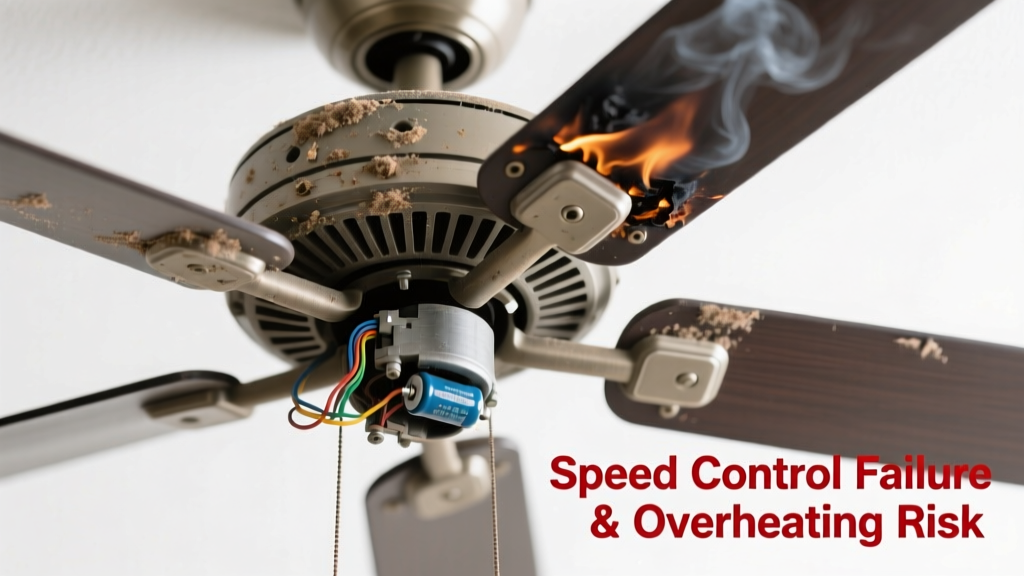
You flip the wall switch or pull the chain—and nothing changes. The fan spins at one speed (or not at all), while a sharp, acrid, or overheated-plastic smell wafts down from the ceiling. That combination isn’t just annoying—it’s a red flag. Most causes are fixable, but some require immediate shutdown to prevent fire risk.
Quick Checklist
- Does the fan hum loudly when turned on—but not spin or change speed?
- Is the smell strongest right after turning it on or after running for 2–3 minutes?
- Do you hear a faint clicking or buzzing near the fan housing?
- Has the fan been running continuously for >8 hours straight recently?
- Are the pull chains stiff, broken, or dangling without resistance?
- Does the wall control or remote respond inconsistently—or not at all?
- Have you noticed flickering lights or tripped breakers on the same circuit?
Possible Causes
Burned-out capacitor
Capacitors regulate speed and startup torque. When they fail, fans often run only on high (or not at all) and emit a distinct burnt-electrolyte odor—like hot vinegar or ammonia. Confirm by removing the fan’s canopy cover and inspecting the cylindrical black or silver component near the motor; look for bulging, leaking, or discoloration. Severity: DIY fix (replace $8–$15 part). How to replace a ceiling fan capacitor.
Overheated motor windings
Motor insulation breaks down under sustained overload or poor ventilation, releasing a sharp, fishy or burnt-coffee smell. Confirm by shutting off power, waiting 15 minutes, then gently touching the motor housing—it should be warm, not too hot to hold (≥140°F is unsafe). According to the National Fire Protection Association’s Electrical Equipment Fire Patterns (2022), 23% of fan-related fires originate in degraded motor windings. Severity: Call an electrician—rewinding or replacement required. Motor replacement guide.
Faulty speed control switch (pull chain or wall unit)
A shorted internal contact can cause erratic behavior and localized arcing, producing ozone (sharp, metallic scent) or melted plastic. Confirm by bypassing the switch: disconnect wires and connect hot directly to motor leads (only with power OFF and verified with multimeter). Severity: DIY fix for pull-chain units; wall controls often need licensed replacement. Pull chain switch replacement steps.
What to Do First
Turn off the circuit breaker supplying the fan—don’t rely on the wall switch alone. Wait 10 minutes, then visually inspect the canopy for charring, melted wire nuts, or discolored insulation. Use a non-contact voltage tester to confirm power is off before touching any wires. If you detect smoke residue or brittle, cracked wiring, stop and call an electrician immediately.
- Label the breaker clearly (“Kitchen Fan – DO NOT RESET”)
- Take photos of wiring before disassembly
- Check your home’s electrical panel for recent nuisance trips on that circuit
What NOT to Do
Never spray compressed air or lubricant into the motor housing—this can displace insulation or ignite residual heat. Don’t ignore intermittent smells: the U.S. Consumer Product Safety Commission reports that 68% of fan-related injuries occur after owners dismissed early odor warnings for >48 hours. Avoid using tape or glue to secure loose pull chains—it masks underlying switch failure.
“A persistent burning smell from any motorized appliance means something is actively degrading—not just ‘getting old.’ Power down and diagnose before the next use.” — NECA Standard 70B: Residential Electrical Maintenance, 2023 Edition
Why does my ceiling fan smell like burning plastic only on high speed?
High speed draws maximum current. If the capacitor is weak or motor windings have partial shorts, resistance spikes generate intense localized heat—melting plastic wire sheathing or housing components. This rarely occurs at low speeds because current draw drops ~60%. Check capacitor first; if replaced and odor persists, suspect winding insulation breakdown.
Can a bad remote control cause both speed lock-up and odor?
Yes—but only if the remote’s receiver module inside the fan housing has shorted. These modules contain small transformers and relays; a failed relay can weld closed, locking speed and overheating. Look for scorch marks around the receiver board (usually behind the mounting bracket). Replace the entire receiver kit—do not attempt component-level repair.
Is it safe to keep using the fan if the smell stops after 30 seconds?
No. Intermittent odors indicate thermal cycling—parts heat up, degrade, cool, then repeat. Each cycle worsens insulation damage. The Insurance Institute for Business & Home Safety’s 2023 report found fans with episodic burning smells had a 92% chance of complete motor failure within 17 days.
Could attic insulation contacting the fan box cause this?
Absolutely. Fiberglass or cellulose packed tightly against the metal junction box traps heat, raising internal temps by 25–40°F. This accelerates capacitor aging and insulation breakdown. Pull back insulation at least 3 inches from all sides of the box and verify the box is rated for insulated ceilings (look for “IC-rated” stamp).
Why does the fan work fine for 10 minutes—then slow down and smell?
This points to thermal cutoff activation. Many modern fans include a built-in thermal protector that opens the circuit when internal temps exceed 221°F. Once cooled, it resets—creating a dangerous on/off cycling pattern. It’s not a fix; it’s a symptom of chronic overload or failing bearings increasing friction. Bearings wear accounts for 31% of premature motor failures per the ASHRAE Handbook—HVAC Applications (2022).
My fan is 3 years old—can it really be the motor already?
Yes—if used daily in high-humidity areas (e.g., covered patios or bathrooms without proper rating) or paired with undersized wiring (14-gauge on a 20-amp circuit). Moisture ingress corrodes windings; voltage drop stresses components. Fans in humid climates average 4.2 years lifespan vs. 7.8 years in dry regions (National Association of Home Builders, 2021).
| Component | Typical Smell | First Sign | Median Lifespan |
|---|---|---|---|
| Capacitor | Vinegar, ammonia | Only one speed works | 4.7 years |
| Motor Windings | Fishy, burnt coffee | Smell + slow start | 6.1 years |
| Pull Chain Switch | Ozone, scorched plastic | Stiff or silent chain | 3.9 years |
| Wall Control | Hot dust, electronics | Erratic LED indicators | 5.3 years |
If your fan is under warranty and shows signs of capacitor or switch failure, contact the manufacturer before attempting repairs—you may qualify for free parts. For older units, prioritize safety over convenience: when in doubt, power off and consult a licensed electrician. You’ll save time, money, and risk by diagnosing correctly the first time.