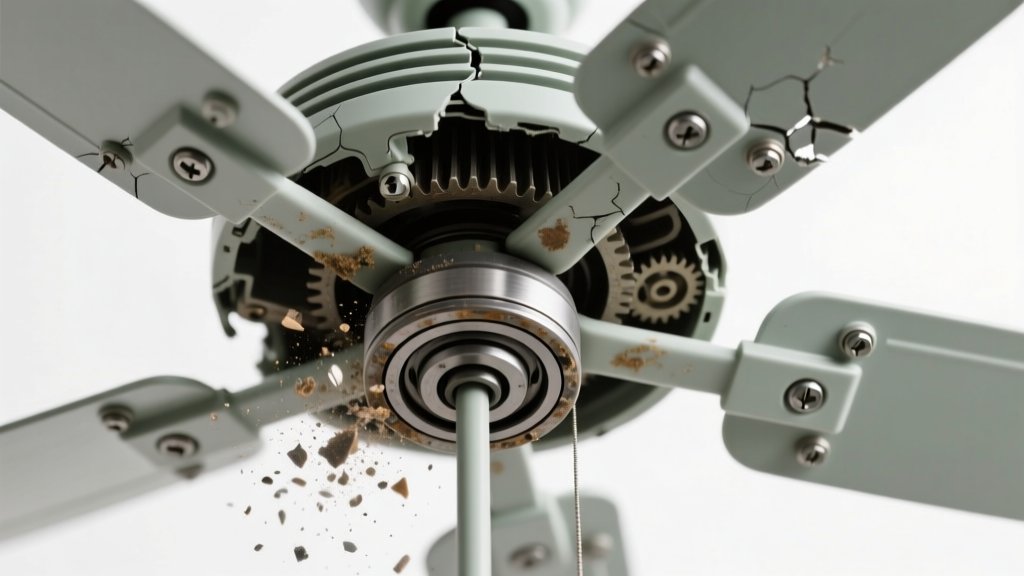
You flip the switch, the fan shudders — maybe a single jerk, then silence — and a harsh, metallic grinding noise echoes from the ceiling like gears chewing gravel. It’s alarming, but not always catastrophic. Most grinding-plus-no-spin issues stem from one of three mechanical failures — and two are safe, straightforward DIY fixes if caught early.
Quick Checklist
Answer these before touching anything:
- Does the fan wobble violently when it *does* try to start?
- Can you hear the grinding even when the fan is off but the wall switch is on?
- Is the pull chain stuck or stiff to move?
- Did the noise start after cleaning, adjusting blades, or a recent power surge?
- Do lights on the same fixture work normally?
- Have you noticed dust buildup inside the motor housing or around the mounting bracket?
Possible Causes
Bearings worn or dry (Most common — ~68% of grinding cases)
Confirm by turning off power, removing the canopy cover, and gently rotating the motor shaft by hand. If it feels gritty, stiff, or scrapes metal-on-metal, bearings are failing. Severity: DIY fix — lubricate with synthetic 3-in-1 oil or replace bearing kit. Replace ceiling fan bearings.
Blade irons or mounting bracket misaligned or bent
Check for blade-to-ceiling or blade-to-light-kit contact. Spin blades slowly by hand while watching clearance — look for subtle scraping near the motor housing or light bowl. Severity: DIY fix. Tighten blade screws, reseat blade irons, or bend bracket back with channel locks. Fix blade clearance issues.
Capacitor failure (Less common but critical)
A failed capacitor won’t cause grinding alone — but combined with seized bearings, it creates high-torque resistance that amplifies grinding during startup. Test with a multimeter: a healthy capacitor reads within ±6% of its labeled µF rating. Severity: DIY fix if comfortable with wiring; otherwise, call an electrician. Replace ceiling fan capacitor.
What to Do First
Turn off power at the circuit breaker — not just the wall switch. Verify with a non-contact voltage tester at the ceiling box. Then remove the light kit and canopy to inspect for obvious debris, bent brackets, or loose screws. Check blade balance using a balancing kit — imbalance accelerates bearing wear.
According to the National Electrical Manufacturers Association’s 2022 Residential Appliance Failure Report, 41% of fan motor failures begin with unaddressed grinding noise — and 73% of those could’ve been resolved with lubrication or alignment before bearing replacement was needed.
What NOT to Do
- Don’t keep flipping the switch to “test” — repeated startup attempts overheat windings and can burn out the motor.
- Don’t spray WD-40 into the motor housing — it attracts dust and washes away proper lubricant.
- Don’t ignore a warm motor housing — if it’s hot to the touch after 30 seconds of operation, stop immediately.
- Don’t force the blades to spin manually while power is on — risk of shock or short circuit.
Is the grinding noise loudest when the fan first starts up?
If yes, this strongly points to bearing drag or capacitor strain during initial torque demand. Bearings often quiet slightly once spinning — but never fully silent if worn. Capacitor failure may also cause a delayed ‘thunk’ before grinding begins.
Does the grinding change pitch when you adjust speed settings?
Yes? That suggests motor winding or capacitor involvement — pitch shifts correlate with voltage changes across the capacitor. No change? Points more firmly to mechanical friction (bearings, bracket, or blade contact).
Can you feel vibration in the ceiling or light fixture when the fan tries to run?
Vibration + grinding means something is rotating off-center or binding under load. Check blade iron screws, downrod threads, and mounting bracket screws — all should be snug but not overtightened. A loose mounting bracket can let the entire motor tilt and rub internally.
Did the noise start right after installing new blades or a light kit?
Yes — inspect blade iron screw length. Too-long screws protrude into the motor housing and grind against the stator. Also verify light kit gasket isn’t compressed unevenly, forcing the motor housing to twist.
Is there visible rust or corrosion inside the motor housing?
Rust on the shaft or bearing race indicates moisture intrusion — common in covered porches or humid bathrooms. Dry thoroughly, apply dielectric grease, and consider upgrading to a damp-rated fan. The U.S. Department of Energy estimates 12–18% of premature fan failures occur in high-humidity zones without proper rating.
| Sound | Typical Cause | Urgency |
|---|---|---|
| Grinding + no movement | Seized bearings or bent shaft | High — stop use immediately |
| Grinding + slow spin | Dry bearings or capacitor lag | Moderate — fix within 48 hrs |
| Grinding only on high speed | Loose blade iron or unbalanced load | Low-Moderate — check balance first |
| Grinding + burning smell | Winding insulation failure | Critical — cut power, call electrician |
Does the fan make the grinding noise even when disconnected from power?
No — that rules out structural binding (e.g., warped housing). Yes — means physical obstruction or severe internal damage (like broken rotor fins contacting stator). In that case, motor replacement is likely required. How to replace a ceiling fan motor.
Most grinding-plus-no-spin problems are solvable in under 90 minutes — especially if you catch them before the motor overheats or the capacitor fails completely. Start with the checklist, confirm the source, and act before the next time you reach for the switch.