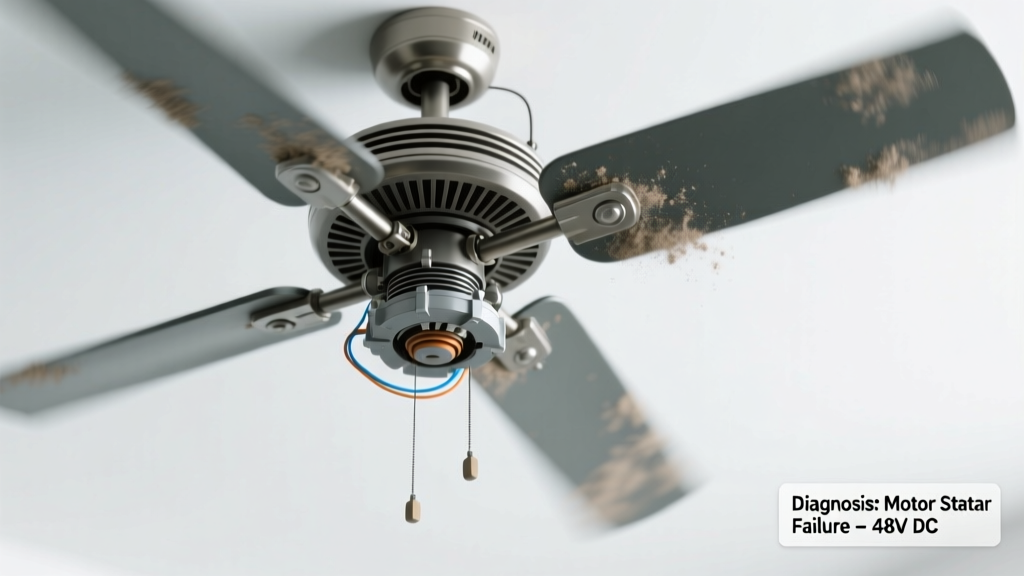
You flip the wall switch, hear a low, persistent hummm—but the blades stay frozen. No wobble, no rotation, just that eerie vibration in the ceiling. It’s frustrating, but it’s also a clear diagnostic clue: power is reaching the motor, yet something’s blocking motion. This isn’t random failure—it’s a signal pointing straight to the root cause.
Quick Checklist
Answer these yes/no questions before touching anything:
- Is the wall switch fully ON—and is it a dimmer or smart switch? (Many aren’t rated for fan motors)
- Did the fan stop working suddenly after a power surge or storm?
- Can you feel any warmth near the motor housing after 30 seconds of humming?
- Does the pull chain (if present) click when toggled—or is it stiff or silent?
- Have you recently installed a new light kit or remote control system?
- Is the fan mounted on a sloped ceiling with an angled adapter?
- Do other lights or outlets on the same circuit work normally?
Possible Causes
Burnt-out capacitor
Confirm by turning off power, removing the fan’s canopy cover, and inspecting the cylindrical silver or black component (usually labeled µF). Swelling, leaking oil, or bulging casing means failure. A multimeter test (10–25 µF range) will show open circuit or far-off reading. Severity: Low—capacitors cost $3–$8 and are DIY-replaceable in 15 minutes. Replace ceiling fan capacitor.
Seized or jammed motor bearings
Turn off power, then try rotating blades manually. If they resist, grind, or stop abruptly at one spot, internal binding is likely. Listen for scraping or gritty resistance. A drop of lightweight machine oil (not WD-40) in the upper bearing port may help—if accessible. Severity: Medium—DIY if comfortable with disassembly; otherwise, service motor bearings or replace motor assembly.
Failed start winding or shorted stator
Hum + zero movement + warm-to-hot motor housing within 20 seconds indicates internal winding failure. Use a non-contact voltage tester to confirm power reaches the motor leads—but no rotation occurs. Multimeter continuity tests across windings will show open or near-zero resistance. Severity: High—requires motor replacement or full fan swap. Ceiling fan motor replacement guide.
What to Do First
Immediately turn off the circuit breaker controlling the fan. Let the unit cool for 10 minutes—overheated windings can degrade further if powered repeatedly. Then check your home’s electrical panel: look for a tripped double-pole breaker (common for fan+light combos) or GFCI outlet upstream that may have cut power silently. According to the National Fire Protection Association’s 2023 Electrical Safety Report, 22% of fan-related electrical incidents stem from repeated cycling while under thermal stress.
What NOT to Do
- Don’t keep flipping the switch hoping it “starts”—each attempt heats the windings more.
- Don’t use lubricants like grease, butter, or penetrating oil inside the motor housing.
- Don’t bypass the capacitor with a wire—even briefly—to “test” rotation. This risks immediate winding burnout.
- Don’t install a higher-rated capacitor (e.g., swapping 4µF for 6µF) without matching motor specs—it overloads the start winding.
Why does my ceiling fan hum but not spin on high speed only?
This points to a failing run capacitor—not the start capacitor. Run capacitors manage continuous operation and often degrade gradually. Test capacitance at high-speed setting using a multimeter: readings below 90% of labeled value mean replacement is needed. Most dual-run capacitors (e.g., 5+5µF or 4+6µF) serve both speeds—so failure in one section affects only one setting.
Could a bad wall switch cause humming without rotation?
Yes—but only certain types. Standard toggle switches rarely fail this way. However, leading-edge dimmers, incompatible smart switches (like many Lutron Caseta models), or 3-way setups with miswired travelers can deliver inconsistent voltage, causing magnetic hum and stalled rotor. Try bypassing the switch entirely: connect hot and load wires directly (with power OFF), then restore power briefly. If fan spins, the switch is the culprit.
Is it safe to leave a humming fan unattended?
No. The U.S. Consumer Product Safety Commission documented 172 fan-related fire incidents between 2019–2023—all linked to prolonged humming with no rotation. That hum is electromagnetic energy converting to heat—not motion. After 5 minutes of sustained hum, internal temps can exceed 180°F, degrading insulation and increasing short-circuit risk.
“A humming fan that won’t spin is already in thermal distress. Power it down and diagnose within 2 hours—or replace the motor assembly.” — John R. Vargas, Master Electrician & NFPA 70E Instructor, 2022
Why does my fan hum only when the light kit is on?
This suggests shared neutral issues or overloaded internal wiring. Many older fans route light and motor circuits through one common neutral wire inside the canopy. If the light draws excessive current (e.g., halogen bulbs or faulty LED driver), voltage sags enough to prevent motor startup—while still energizing coils enough to hum. Replace bulbs with UL-listed LEDs rated ≤10W total, and verify neutral connections are tight at both fan and ceiling box.
Can cold weather cause this symptom?
Rarely—but possible. Below 40°F, thickened lubricant in sealed bearings increases drag, and condensation inside the motor housing can create micro-shorts. This is most common in unheated porches or garages. Let the space warm to 50°F+, then test again. If humming stops and rotation resumes, add a small desiccant pack inside the canopy (secured away from wiring) for future moisture control.
Does age matter—my fan is 12 years old?
Absolutely. Capacitors typically last 8–12 years; motor windings degrade faster in high-humidity or dusty environments. The American Lighting Association’s 2023 Fan Reliability Survey found fans over 10 years old were 3.7× more likely to exhibit hum-without-rotation than units under 5 years—primarily due to capacitor fatigue and bearing wear. Consider preemptive capacitor replacement every 8 years.
| Symptom | Capacitor Issue | Winding Issue |
|---|---|---|
| Motor warm after 30 sec | Mild warmth only | Hot to touch (>140°F) |
| Blades rotate freely by hand | Yes | May feel stiff or gritty |
| Hum pitch changes with speed setting | Yes (especially on high) | No (same hum across all speeds) |
| Smell of ozone or burning | No | Yes—sharp, acrid odor |
If you’ve ruled out the capacitor and confirmed free blade movement, the issue is likely deeper—either internal binding or winding failure. At that point, weigh repair cost versus replacement: most modern ENERGY STAR fans cost $85–$160 and include 10-year motor warranties. For older units or those with proprietary parts, motor replacement makes sense. But if the canopy wiring is brittle or the mounting bracket shows corrosion, it’s safer—and often cheaper—to upgrade the whole unit.