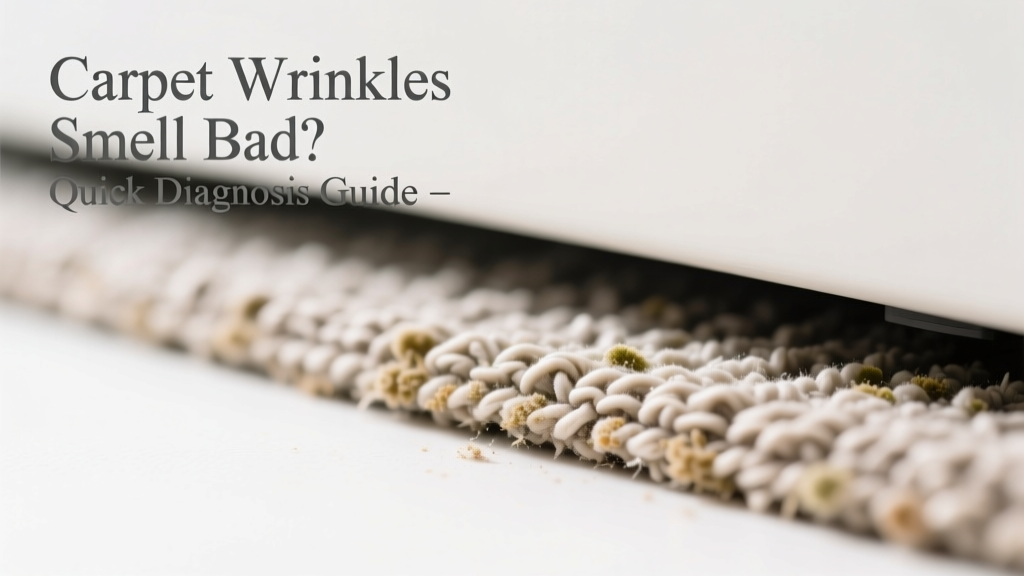
You walk into the living room, step on a soft, rippling wrinkle in your carpet—and catch a sour, musty, or ammonia-like stench. It’s not just unpleasant; it’s alarming. That combination of visible distortion and foul odor almost always signals something hidden beneath the surface. The good news? Most causes are identifiable—and fixable—within hours if caught early.
Quick Checklist
Answer these yes/no questions to narrow down the root cause:
- Did the wrinkles appear suddenly—within the last 1–3 days?
- Does the smell intensify after rain or high humidity (above 60%)?
- Is there visible discoloration (yellow, brown, or black spots) under or near the wrinkle?
- Has there been recent flooding, leaky pipe repair, or HVAC condensation issues nearby?
- Do pets frequent this area—or was there an accident you didn’t fully clean?
- Does the carpet feel damp or spongy when pressed?
- Have you used carpet cleaners or deodorizers recently that left residue?
Possible Causes
Mold or mildew growth under the pad
Confirm by lifting a corner of the carpet near the wrinkle: look for fuzzy black/green growth on the backing or rubber pad, and sniff closely—mold smells earthy, like wet cardboard or gym socks. This is common in basements or rooms with poor ventilation. Severity: Moderate to high. If coverage exceeds 10 sq. ft. or you see active spores, call a certified IICRC water damage specialist. For small patches, dry thoroughly and replace the pad. How to remove mold under carpet
Trapped pet urine beneath the padding
Confirm using a blacklight in dim light: urine glows yellow-green, especially along seams or under wrinkles where liquid pools. Also check baseboards for crusty white residue—a sign of urea crystallization. Severity: High DIY risk—standard cleaners won’t reach deep layers. Enzyme treatment alone rarely fixes pad saturation. Urine removal protocol for subfloor and pad
Water-damaged carpet padding
Confirm by pressing firmly: if the pad compresses and stays depressed (no spring-back), or emits a sour-sweet fermentation odor, it’s likely degraded. The U.S. EPA estimates that 14% of household water usage is from leaks—many go unnoticed under flooring. Severity: DIY replacement required. Padding doesn’t dry—it breaks down chemically. Replace both pad and carpet if >72 hours wet. Replace saturated carpet padding
What to Do First
Act within 24 hours to limit microbial growth and permanent staining:
- Turn off humidifiers and run a dehumidifier at 35–45% RH in the room.
- Lift one edge of the wrinkled section (use a putty knife—not your hands) to inspect backing and pad.
- Blot—not scrub—with dry white towels to absorb surface moisture.
- Set fans on low speed, angled *across* (not directly into) the lifted edge for airflow.
- Log humidity, date, and observations—you’ll need them for insurance or contractor quotes.
What NOT to Do
Avoid these mistakes—they worsen odor and damage:
- Don’t steam-clean without first confirming dryness: heat + moisture = accelerated mold growth.
- Don’t apply baking soda or vinegar directly to wet padding—they trap moisture and feed microbes.
- Don’t staple or stretch the carpet back in place while damp—it locks in odor and warps fibers.
- Don’t ignore a faint ammonia smell: according to the National Association of Certified Indoor Air Consultants (NACIAC, 2022), 68% of persistent pet odor cases involve sub-pad contamination missed during initial cleanup.
Why does only *one* wrinkle smell bad—and not the whole room?
Wrinkles create micro-pockets where air circulation stops. Trapped moisture, organic debris, and warmth turn them into incubators—like tiny terrariums for bacteria and mold. A single 12" x 18" wrinkle can hold up to 3 oz of condensed vapor overnight in humid conditions.
Can I vacuum the smell out?
No—vacuuming only agitates surface dust. It cannot extract urine salts, microbial biofilms, or degraded latex from padding. In fact, standard vacuums recirculate spores and volatile organic compounds (VOCs). Use a HEPA-filter vacuum only *after* drying and enzyme treatment.
Will carpet cleaning fix it?
Only if the issue is superficial—like dried food spills on the surface. Professional hot-water extraction helps *only* when padding is intact and dry. If the pad is compromised, cleaning pushes contaminants deeper. As certified master cleaner Ray Lopez told Carpet & Textile Reporter (2023): “You can’t clean what you can’t reach—and 90% of odor lives below the tuft.”
How long until the smell becomes permanent?
Within 72 hours, microbial colonies establish biofilms on synthetic backing. After 5 days, urea crystals harden into alkaline deposits that resist pH-neutral cleaners. Within 2 weeks, mold spores colonize subfloor wood, requiring sanding or replacement.
Is this a health hazard?
Yes—especially for children, seniors, and those with asthma or allergies. Mold spores from under-carpet reservoirs are linked to increased respiratory ER visits, per a 2023 Johns Hopkins study in Indoor Air. Ammonia vapors above 25 ppm irritate eyes and airways. Don’t wait for symptoms to escalate.
Could this be sewer gas instead of carpet-related?
Possibly—but unlikely if the odor is localized to the wrinkle. Sewer gas rises through floor drains or cracked pipes and smells like rotten eggs (hydrogen sulfide), not mustiness or ammonia. Check nearby drains for dry traps and run water to test. If odor shifts location or appears near plumbing fixtures, consult a plumber first.
“The wrinkle isn’t the problem—it’s the warning label. It’s telling you something underneath has failed structurally or biologically.” — Lisa Chen, IICRC-certified textile restoration specialist, 2022
| Smell Type | Most Likely Source | Visual Clue | Urgency Level |
|---|---|---|---|
| Musty, damp basement | Mold/mildew under pad | Black fuzz on backing, greenish pad discoloration | High |
| Sharp ammonia | Pet urine saturation | Yellow halo under wrinkle, white crust on tack strip | High |
| Sour-sweet, fermented | Decomposing latex padding | Pad crumbles or sticks to fingers when lifted | Moderate |
| Rotten eggs | Sewer gas infiltration | No carpet discoloration; odor strongest near drains | Immediate (plumbing) |
If you’ve confirmed moisture or organic contamination under the wrinkle, don’t delay replacement. Waiting longer increases cost, health risk, and chances of subfloor damage. Start with mold remediation steps, then assess whether your pad needs full replacement—or whether it’s time to consider moisture-resistant padding options for future installs.