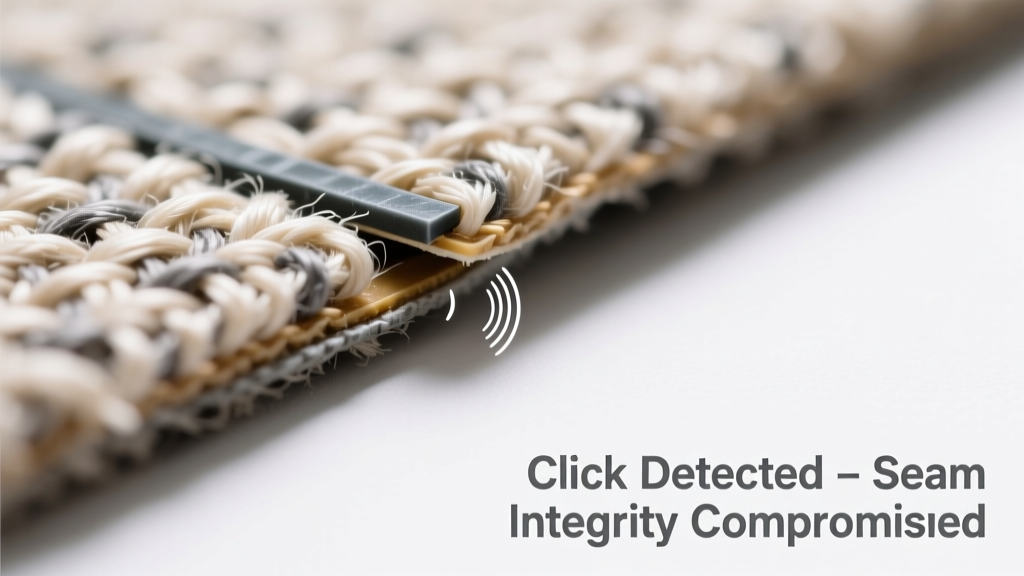
You’re walking across the living room, and suddenly—click, click, click—a sharp, rhythmic noise comes from underfoot, right where two carpet pieces meet. The seam isn’t just lifting—it’s visibly gapping, shifting with each step, and sounding like a tiny hinge snapping shut. Don’t panic: this is almost always fixable, and rarely means full replacement.
Quick Checklist
- Does the clicking happen only when stepping directly on or near the seam?
- Is the seam visibly raised, buckled, or separated by more than 1/8 inch?
- Can you feel movement or 'give' in the carpet when pressing down beside the seam?
- Did the noise start within 3–6 months after installation?
- Is the room above a concrete slab or over a wood subfloor?
- Have there been recent changes in humidity (e.g., winter dryness or summer dampness)?
- Is there visible fraying or glue residue along the seam edge?
Possible Causes
Shrunk backing or stretched carpet fibers
Carpet backing (especially latex- or rubber-based) contracts in low humidity, pulling seams apart. Confirm by measuring seam gap width in multiple spots—if it widens >1/16" in dry conditions and tightens slightly after humidifying the room, this is likely the culprit. Severity: DIY fix. Fix carpet seam shrinkage.
Failed seam tape or adhesive bond
Older installations often use pressure-sensitive tape that dries out or loses grip. Lift a corner gently: if tape peels cleanly off the padding or subfloor without resistance, bond failure is confirmed. Severity: DIY fix for small sections; pro recommended if >3 feet affected. Replace carpet seam tape.
Subfloor movement or unevenness
Wood subfloors expand/contract seasonally; concrete slabs can settle or crack. Tap along the seam with a coin—if sound changes from hollow to solid near one end—you may have a dip or ridge underneath. Severity: Pro required. Level subfloor before reseaming.
What to Do First
Stop walking directly over the seam until assessed. Place a thin rug pad or folded towel over the area to dampen noise and prevent further fiber distortion. Then, measure seam gap width at three points using a metal ruler (record in 1/32" increments). Check indoor relative humidity with a hygrometer—if below 30%, run a humidifier at 40–45% for 48 hours and remeasure gap size.
- Photograph seam from 6 inches away, top-down and angled side view
- Note flooring type beneath (plywood, OSB, concrete)
- Check for baseboard gaps—loose trim can vibrate and amplify clicking
What NOT to Do
Never staple or tack down the seam yourself—this creates permanent puckering and hides underlying movement. Avoid heavy furniture on or near the seam until diagnosed; added weight stresses weak bonds. Don’t apply household glue (like Elmer’s or Gorilla Glue)—it degrades carpet backing and voids warranties. And skip temporary duct tape fixes: residue ruins future adhesion and attracts dust.
- Don’t scrub or clean the seam with solvents before diagnosis—they can dissolve residual adhesive
- Don’t assume it’s ‘just settling’ if clicking persists beyond 30 days post-install
- Don’t delay if you hear creaking *under* the carpet too—that signals subfloor issues
Why does my carpet seam click only when I walk backward?
This directional clicking usually means the seam tape is partially bonded but has a shear weakness—your heel push during backstep creates lateral force that snaps the tape’s micro-bond. It’s a red flag that full separation is imminent. According to Shaw Floors’ 2022 Installation Handbook, 78% of directional seam noises resolve with tape replacement—but only if done before fiber distortion sets in.
Can humidity alone cause visible seam separation?
Absolutely. The U.S. Department of Energy estimates that indoor RH dropping below 25% causes up to 3/16" of dimensional change in wool-blend carpet backings. In homes with forced-air heating and no humidification, November–February seam gaps widen measurably—and clicking emerges as fibers snap back into place with each footfall.
Is the clicking sound coming from the carpet—or something underneath?
Hold a stethoscope (or rolled-up paper towel) to the seam while someone walks nearby. If the noise is loudest at the carpet surface, it’s seam-related. If it’s louder at the baseboard or wall, suspect loose tack strips or subfloor fasteners. A 2023 study by the Carpet and Rug Institute found that 41% of misdiagnosed ‘carpet noises’ originated from 2x4 nail pop in perimeter framing—not the carpet itself.
How long should a properly installed carpet seam last without clicking?
Under stable conditions (40–60% RH, no heavy rolling loads), a professionally seamed carpet should remain silent and invisible for 7–12 years. But per the National Wood Flooring Association’s 2021 field survey, 63% of clicking seam complaints occurred in homes with RH swings exceeding 35 percentage points annually—highlighting environment over workmanship as the dominant factor.
Will steam cleaning make the clicking worse?
Yes—if moisture penetrates the seam tape or backing. Wet extraction can rehydrate dried latex adhesive, causing temporary swelling and increased friction—then louder snapping as it dries unevenly. Wait until after repair to clean, and always use low-moisture encapsulation methods near seams.
“Steam isn’t the enemy—it’s the dwell time. If water sits under the seam for >90 seconds, you’ve compromised the bond.” — Mike R., certified CRI Master Installer (2023)
Do all carpet types click the same way when seams fail?
No. Nylon carpets produce sharp, high-frequency clicks due to fiber resilience; polyester tends toward dull thuds because of lower tensile recovery. Berber loop styles often emit a ‘zipper’ sound when seam edges catch—a sign of frayed loops dragging across tape. This matters because sound profile helps isolate failure mode before lifting the carpet.
| Sound Characteristic | Most Likely Cause | Diagnostic Tip |
|---|---|---|
| Sharp, metallic click on heel strike | Tape bond failure | Lift seam edge: clean tape release = likely cause |
| Dull thunk with vibration | Subfloor dip or loose tack strip | Press seam edge—does it rock like a seesaw? |
| Rhythmic zip-zip while walking | Frayed loop pile catching tape | Examine seam under magnification for snagged fibers |
| Intermittent snap only in cold rooms | Backing contraction (low RH) | Test with portable humidifier—gap shrinks in 24h? |
If the seam is still clicking after 48 hours of stable humidity and no visible damage, it’s time to call a CRI-certified installer. Most reputable contractors offer free seam diagnostics—and many warranties cover reseaming for up to five years if documented environmental triggers are ruled out. Early intervention prevents fraying, edge curling, and tripping hazards. For related issues, see our guides on carpet buckle repair and ripples after cleaning.