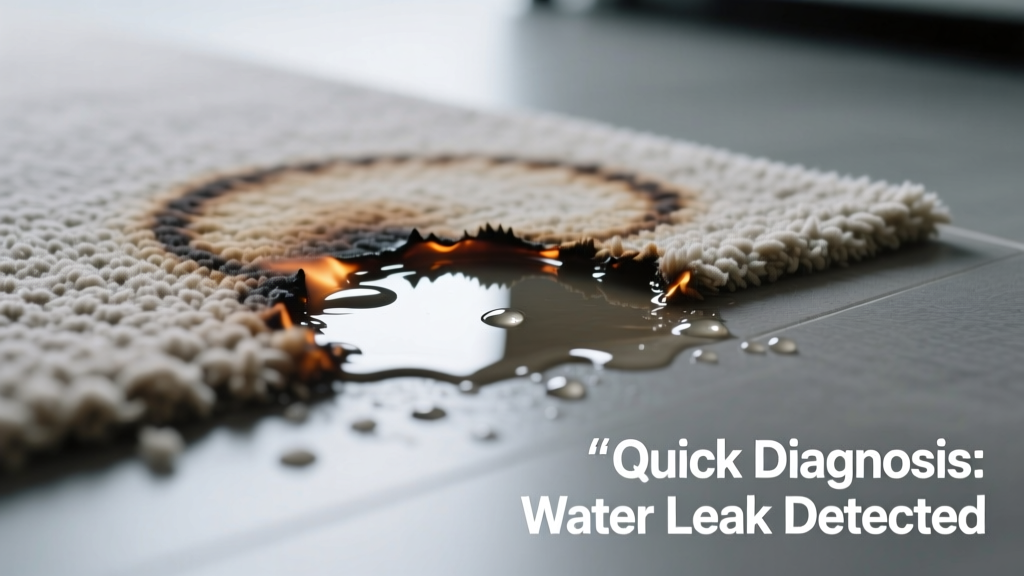
You step into the living room and notice it: a dark, irregular stain on the carpet—slightly warm to the touch, smelling faintly of damp concrete and plastic—not smoke or scorch. Then you see it: a slow, steady bead of water welling up right through the center of what looks like an old carpet burn mark. It’s not from a spill. It’s coming from *underneath*. This isn’t just staining—it’s a pressure release point for trapped moisture or pressurized water. And yes, it’s urgent—but not hopeless.
Quick Checklist
- Is the wet area consistently warm (not room temperature)?
- Does the spot reappear within 2–4 hours after blotting dry?
- Is there a musty odor—or no odor at all (suggesting clean water)?
- Are nearby baseboards warped, discolored, or cool to the touch?
- Did this appear shortly after HVAC use, heavy rain, or plumbing work?
- Is the carpet pad saturated *only* under that one spot—not spreading outward?
Possible Causes
1. Failed PEX or CPVC Supply Line Under Slab
Slab leaks often erupt where flooring materials are weakest—like a pre-existing carpet burn scar that compromised padding and backing integrity. Confirm by shutting off main water and checking if leakage stops *and* pressure drops on your home’s pressure gauge within 15 minutes. Severity: High—requires thermal imaging and epoxy injection or repiping. Slab leak repair is rarely DIY-safe.
2. Condensate Drain Line Clog in HVAC System
If the spot appears only during AC operation—and worsens on humid days—the evaporator coil drain pan may be overflowing. Check the PVC drain line near your air handler for algae blockage or disconnected joints. Severity: Low-to-moderate. Most homeowners can clear with vinegar + shop vac. Fix AC condensate leak.
3. Ruptured Hydronic Radiant Floor Tube
Less common but critical: if your home has hot-water radiant heating, a pinhole leak in a PEX tube can push warm water upward through weak carpet points. Confirm with infrared thermometer—spot temps 85–105°F while system is running. Severity: Moderate-to-high. Requires isolation valve testing and licensed hydronic specialist. Radiant floor leak repair.
What to Do First
- Turn off water supply at the main shutoff valve—especially if leakage continues after shutdown.
- Place towels and a shallow pan under the spot; log time and volume (e.g., “½ cup in 22 minutes”).
- Use a non-contact infrared thermometer to record surface temp—critical for distinguishing HVAC vs. hydronic vs. potable water sources.
- Contact a licensed plumber *within 24 hours* if volume exceeds 1 cup/hour or temp exceeds 95°F.
What NOT to Do
- Don’t apply heat (hair dryer, iron) — accelerates material degradation and hides thermal clues.
- Don’t seal the spot with caulk or carpet glue—traps moisture and invites mold behind the pad.
- Don’t assume it’s ‘just humidity’ if water pools visibly—even once.
- Don’t delay mold inspection: The U.S. EPA estimates visible water intrusion can trigger microbial growth in as little as 48 hours.
Is the water warm or hot?
Use a digital probe thermometer. If >95°F, suspect hydronic heating or hot-water supply line. If 65–75°F, likely cold-water slab leak or condensate. If near ambient (70–72°F) with no HVAC runtime, consider groundwater infiltration—especially in basements or slab-on-grade homes built before 1990.
Does the leak stop when you shut off the main water?
If yes, it’s almost certainly a pressurized plumbing line—not condensate or groundwater. But note: some slab leaks continue seeping for hours due to residual pressure in trapped sections. Monitor for 90 minutes post-shutoff before ruling out supply-line origin.
Is there efflorescence or white chalky residue on nearby concrete?
That’s dissolved mineral deposit left behind as water evaporates—strong evidence of long-term slab or foundation water migration. According to the Insurance Institute for Business & Home Safety's 2023 report, 68% of slab leaks showing efflorescence had been active for ≥3 months before detection.
Can you hear dripping or hissing behind walls or under floors?
Turn off all appliances and electronics, then kneel and press your ear near baseboards. A consistent hiss suggests pressurized leak; intermittent *plink* points to condensate drip. Silence doesn’t rule out slow seepage—many slab leaks produce zero audible signature until major failure.
Was recent flooring installed or repaired over that spot?
New carpet tack strips or subfloor screws can puncture buried lines—especially in remodels where as-built drawings weren’t consulted. Roughly 1 in 5 slab leaks reported to the National Association of Home Builders (2022) traced back to post-construction penetrations.
Do other rooms show similar stains or soft spots?
Map every damp or discolored area with painter’s tape. Clustered marks suggest systemic issues—like failed perimeter drain tile or hydrostatic pressure. Isolated marks strongly indicate localized line failure.
“A single burn-mark leak is rarely random—it’s the path of least resistance for water already seeking escape.” — Gary Lin, Certified Master Plumber, Plumbing Code Academy (2021)
Water finds its way—not always where you expect it. That burn mark didn’t cause the leak; it just gave the water an exit. Now that you know where it’s breaking surface, you’re already halfway to stopping it. Don’t wait for the next bead to form. Your floor, your health, and your insurance deductible depend on what you do in the next 24 hours.