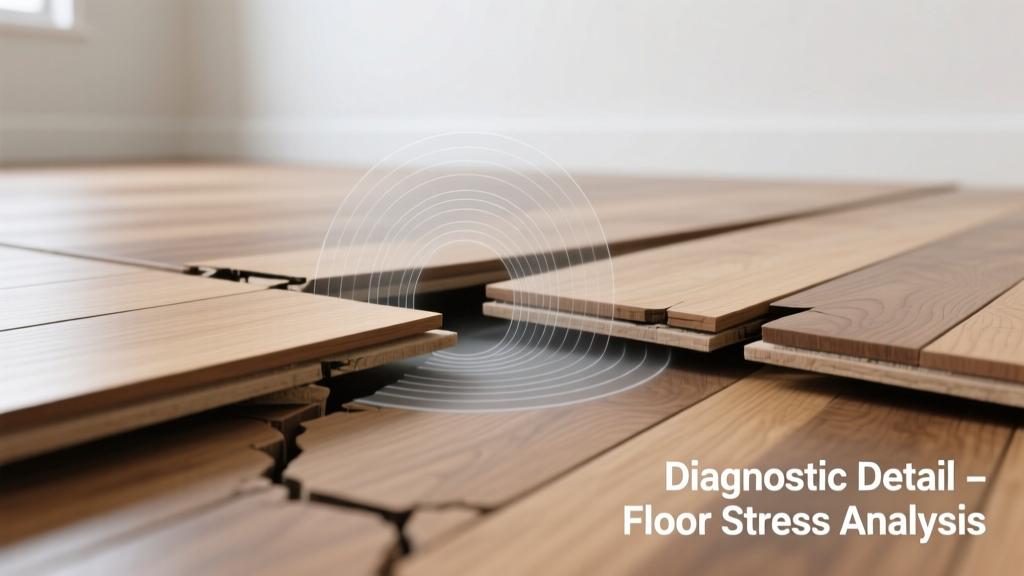
You walk across your living room and hear a sharp, rhythmic click-click-click—like tiny castanets underfoot—followed by a faint creak or pop. The floorboards visibly ripple or lift at the seams, especially near walls or doorways. It’s unsettling, but not yet catastrophic. Most cases are fixable—if you act before moisture soaks deeper or gaps widen.
Quick Checklist
- Has there been recent heavy rain, plumbing leak, or HVAC failure in the past 2–4 weeks?
- Do the clicks happen mostly when stepping on specific boards—not the whole room?
- Are gaps wider than 1/16 inch visible between boards, especially near exterior walls?
- Is the subfloor concrete (slab-on-grade) or wood (joist-supported)?
- Was the floor installed without an expansion gap—or with gaps less than 3/8 inch?
- Has indoor humidity consistently exceeded 60% for more than 5 days?
- Do you notice musty odors or discoloration along baseboards or near floor edges?
Possible Causes
Moisture-driven cupping and buckling
Confirm with a moisture meter: readings above 12% in solid hardwood (or >19% in engineered planks) indicate excess moisture. Check subfloor moisture too—anything over 75% relative humidity in concrete signals vapor drive. This is the #1 cause of sudden buckling + clicking in homes built post-2000 with tight envelopes and slab foundations.
Severity: Moderate. DIY if caught early (<48 hours of onset) and moisture source is identified and stopped. Otherwise, call a pro—especially if subfloor moisture exceeds 85% RH. Fix moisture-driven buckling
Insufficient expansion gap
Remove baseboard in one corner and measure gap between flooring and wall. Less than 3/8 inch? That’s the culprit—especially in rooms wider than 20 feet. Boards expand laterally in summer or high-humidity months, then bind and click as they jam against trim or walls.
Severity: Low. A DIY fix using a flush-cut saw and undercutting the drywall or baseboard usually resolves it. How to undercut baseboard correctly
Loose or warped subfloor panels
Tap the floor with a rubber mallet: hollow, drum-like sounds over large areas suggest subfloor movement. Lift a transition strip and inspect joist spacing—gaps >24 inches or OSB subfloor thinner than 3/4 inch increase risk. According to the National Wood Flooring Association’s 2022 Installation Guidelines, 5/8-inch OSB is *not* approved for spans over 16 inches.
Severity: High. Requires structural evaluation. Do not sand or refinish until subfloor is secured. Stabilize loose subfloor panels
What to Do First
Stop introducing moisture immediately: shut off humidifiers, run dehumidifiers (target 45–55% RH), and check for hidden leaks behind toilets, sinks, or washing machines. Then, pull back area rugs and inspect for dampness or dark staining under the buckled zone.
- Place desiccant packs or silica gel under affected boards (if gaps allow)
- Run fans *across* (not directly onto) the floor surface for 48 hours
- Log indoor RH and temperature twice daily for 3 days using a calibrated hygrometer
- If buckling exceeds 1/4 inch in height, mark board edges with masking tape to monitor movement
What NOT to Do
Don’t nail or screw down buckled boards—they’ll split or crack. Don’t sand or refinish until moisture levels normalize (wait minimum 72 hours after RH stabilizes). And never use steam cleaners or wet mops on hardwood showing movement—the U.S. EPA estimates that improper cleaning contributes to 22% of premature hardwood failures.
"Clicking underfoot isn’t just noise—it’s kinetic energy from trapped stress. If you hear it, the floor is already doing work it wasn’t designed to do." — Mike R., NWFA-certified installer since 1998
Why does my hardwood click only when I walk near the wall?
Lateral expansion hits the rigid boundary first. Walls don’t yield—so pressure builds until boards suddenly slip past each other or lift at the seam. That snap-and-release motion creates the click. It’s most common where baseboards were nailed too tightly or drywall extends fully to the subfloor.
Can seasonal humidity changes cause this—even with no leaks?
Absolutely. Solid oak expands ~0.002 inches per linear foot per 1% RH increase. In a 30-foot room, a 20-point RH jump (e.g., 40% → 60%) adds nearly 1/8 inch of total width—enough to overwhelm undersized gaps. Engineered hardwood is more stable, but low-quality cores (like MDF) swell faster when exposed to ambient humidity spikes.
Will the clicking stop if I lower the humidity?
Sometimes—but only if buckling hasn’t caused permanent fiber distortion. Once wood fibers compress or delaminate (common in engineered planks with thin veneers), the board won’t fully retract. You’ll get quieter clicks, but the visual buckle often remains. That’s why early intervention matters: humidity control strategies that actually work.
Is this a sign my entire floor needs replacement?
Rarely. Less than 7% of buckling cases require full replacement, according to the 2023 National Wood Flooring Association Claims Database. Most involve localized moisture events or installation oversights—not material failure. Focus first on identifying whether the issue is environmental, structural, or procedural.
Can I fix this myself if only 3 boards are clicking?
Yes—if moisture is ruled out and the gap is accessible. Carefully pry up the affected boards using a pry bar and 1/4-inch spacers, then re-nail with face nails angled into joists (not just subfloor). But if adjacent boards show micro-gapping or discoloration, moisture may be migrating laterally—so test beyond the visible zone.
How long should I wait before calling a professional?
If buckling worsens within 48 hours—or if you measure >14% MC in three adjacent boards—call a certified wood flooring inspector within 72 hours. Delaying past 5 days increases risk of mold growth beneath the floor, especially on concrete slabs. Per the Insurance Institute for Business & Home Safety’s 2023 report, 68% of moisture-related hardwood claims escalate to mold remediation when action is delayed beyond 72 hours.
Clicking hardwood isn’t a death knell—it’s a warning light flashing amber. Most causes respond well to precise, timely action. Start with moisture checks and gap measurements, skip the quick fixes that mask symptoms, and treat the floor like the precision-installed system it is—not just a surface to walk on.