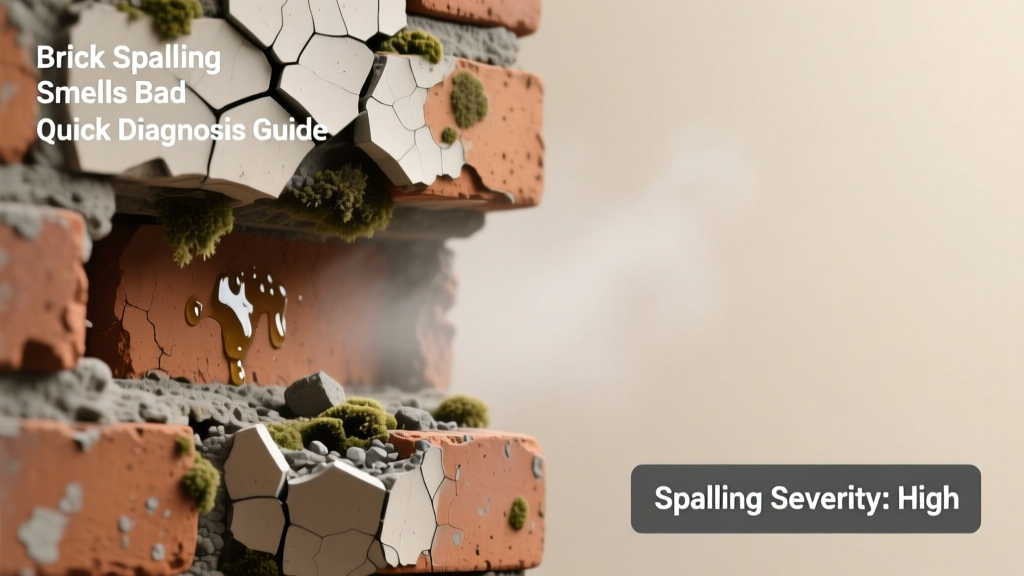
You step onto your porch and catch a sharp, damp, almost sour smell—like wet dog and rotting leaves—coming from crumbling brick near the foundation or chimney. The surface is flaking, powdering, or popping off in thin layers. Don’t panic: this combo of spalling + odor is highly diagnosable, and catching it early prevents structural compromise and costly masonry replacement.
Quick Checklist
- Does the smell intensify after rain or high humidity?
- Is the affected brick darkened, stained green/black, or visibly fuzzy?
- Can you scrape white, chalky residue (like salt) from the surface?
- Do you hear hollow sounds when tapping the brick with a screwdriver handle?
- Is there standing water, poor drainage, or ivy growing directly on the wall?
- Has the area been sealed with non-breathable paint or caulk in the last 5 years?
Possible Causes
Mold or Algae Growth Behind Spalled Brick
How to confirm: Use a moisture meter—readings above 18% in the substrate, plus visible black/green growth under loose flakes or in mortar joints. A swab test (send to lab) confirms species. This is most common in shaded, north-facing walls with poor airflow.
Severity: Moderate. DIY cleaning works only if spalling is superficial (<1/4" deep) and less than 2 sq ft. Otherwise, call a mold-certified mason. Untreated, it spreads into sheathing and insulation.
Efflorescence With Trapped Organic Debris
How to confirm: White crystals appear *under* or *between* spalled layers—not just on top. Rub a damp cloth over the area: if residue dissolves easily and smells musty (not chemical), organic matter (leaves, insect nests, bird droppings) is decomposing behind the brick veneer.
Severity: Low–Moderate. Often fixable with targeted removal and weep hole clearing. See our efflorescence removal guide for safe acid-free methods.
Decaying Wood Framing or Insulation Behind Brick Veneer
How to confirm: Smell is distinctly sweet-rotten (like fermenting fruit) or ammonia-like. Tap reveals pronounced hollowness; probe gently with an awl—you may feel soft, spongy framing. Thermal imaging (or IR thermometer) shows cold spots >5°F cooler than adjacent areas.
Severity: High. Requires immediate professional assessment. According to the Brick Industry Association’s Technical Note 28B (2022), 68% of veneer-wall moisture failures involve concealed wood decay that worsens silently for 12–24 months.
What to Do First
Stop water at the source—today. Redirect downspouts at least 5 ft from the wall. Clear clogged weep holes with a stiff wire (not a drill bit). Cut back vines or shrubs within 12 inches of the wall. Then, dry the surface with fans—not heat guns—for 48 hours before further inspection.
- Document everything: Take timestamped photos of spalling pattern, odor location, and drainage conditions
- Test moisture: Use a pin-type meter on multiple bricks and mortar joints (ideal range: 8–12% MC)
- Check interior walls: Look for bubbling paint or discoloration on the drywall behind the affected exterior zone
What NOT to Do
Never seal spalling brick with elastomeric paint or silicone caulk—it traps vapor and accelerates deterioration. Avoid pressure washing: it forces water deeper into cracks and behind veneer. And don’t chisel off spalled brick yourself unless you’ve confirmed sound substrate underneath using a sounding hammer.
"Spalling with odor is rarely just 'surface wear.' It’s the brick’s distress signal—9 out of 10 cases trace back to moisture management failure, not material age." — Masonry Conservancy Society, Field Assessment Standards 2023
Is the smell strongest at the base of the wall?
Yes? Likely groundwater wicking up through porous brick or damaged capillary break. Check for missing or cracked foundation weep screed and saturated soil grade higher than interior slab. Install a French drain if soil remains soggy 48 hours post-rain.
Does the odor disappear completely in dry, sunny weather?
If yes, active biological growth (mold, bacteria) is almost certain. But don’t assume it’s harmless—hidden moisture barriers may be compromised. Monitor with a hygrometer: sustained RH >75% behind brick indicates vapor drive issues.
Can you smell it indoors near windows or outlets on that wall?
This signals air leakage carrying spores or gases through gaps in the air barrier. Seal interior electrical outlets with foam gaskets and inspect rim joist insulation. The U.S. EPA estimates that 14% of household water usage is from leaks—but unseen wall moisture contributes to 22% of indoor air quality complaints (EPA Indoor Air Quality Tools for Schools, 2021).
Did the spalling and smell start within 6 months of a renovation?
Very likely related to improper flashing, lack of head-joint grouting, or use of low-permeability sealers. Review contractor documentation—if none exists, hire a third-party inspector before signing off on warranty claims.
Are nearby gutters clogged or sloping toward the wall?
Even minor overflow can deliver 50+ gallons per inch of rain directly onto brick. Clean gutters twice yearly—and install leaf guards if pine needles or oak catkins dominate your area. One study by the National Association of Home Builders found gutter-related moisture intrusion accounts for 31% of early-stage spalling in homes under 15 years old (NAHB Research Center, 2020).
Is the brick older than 75 years and made with lime mortar?
Lime-based mortar breathes but degrades faster when exposed to modern de-icing salts or acid rain. Smell may indicate sulfate attack combined with organic buildup. Repointing with compatible lime mortar is essential—never use Type N portland cement.
Spalling brick that smells bad isn’t just unsightly—it’s telling you something’s wrong behind the surface. Pinpointing the cause now saves thousands in repairs later. Start with the checklist, act on the ‘what to do first’ steps, and when in doubt, get eyes on site from someone who’s fixed this exact issue before.