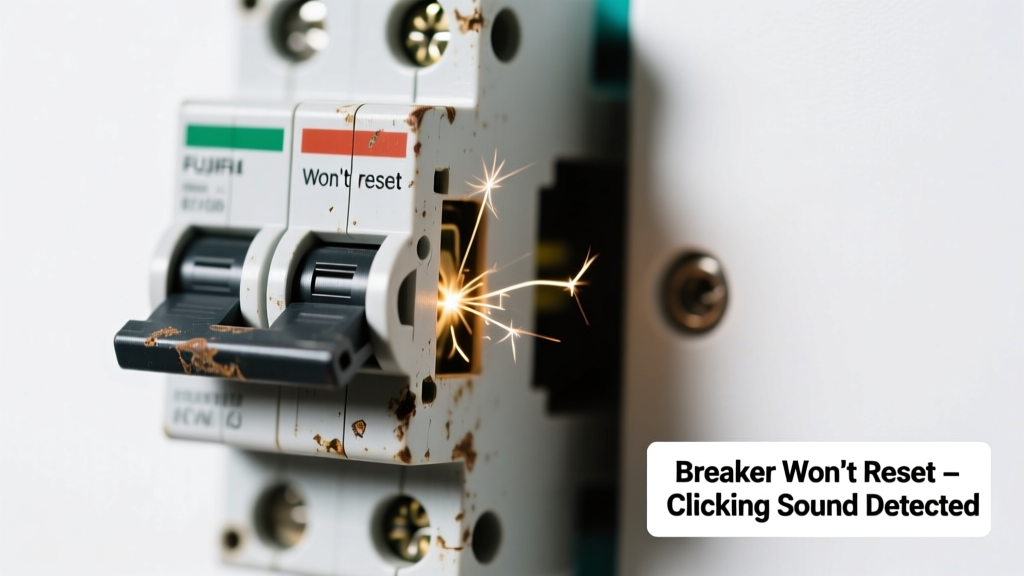
You flip the breaker back on, hear a sharp click, and watch it instantly trip again — sometimes repeatedly, like a stubborn door latch refusing to catch. It’s unnerving, but not always an emergency. Most often, this clicking-and-tripping pattern points to a clear, identifiable issue — not a doomed panel.
Quick Checklist
Answer these yes/no questions before digging deeper:
- Did the breaker trip during or right after using a specific appliance (e.g., space heater, air conditioner, or power tool)?
- Does the clicking happen only when you push the lever fully to the 'ON' position — not just when toggling?
- Can you smell burning, plastic, or ozone near the panel or outlet circuits?
- Is the breaker warm — even hot — to the touch at the handle or faceplate?
- Has this happened before with the same breaker, or is it new since recent wiring, renovation, or appliance addition?
- Are other breakers in the same panel behaving normally (no flickering lights, tripping, or buzzing)?
Possible Causes
Overloaded Circuit
Confirm by unplugging all devices on that circuit, then resetting. If it holds, plug items back in one at a time — the last device added likely pushed it over capacity. According to the National Fire Protection Association’s 2023 Electrical Safety Report, overloaded circuits account for 21% of residential electrical fires.
Severity: Low — DIY fix if load management resolves it. Link to how to fix an overloaded circuit.
Short Circuit in Wiring or Device
Look for charring on outlets, melted cord insulation, or sparks from switches. Use a multimeter to test continuity between hot and neutral (with power OFF) — any reading below 1 MΩ suggests a short. A true short will often cause immediate, violent tripping — not just clicking.
Severity: High — call a licensed electrician. Do not restore power. Link to how to locate a short circuit.
Faulty Breaker
Swap the suspect breaker with an identical, known-good one from a non-essential circuit (e.g., garage lighting). If the problem moves with the breaker, it’s defective. The U.S. Consumer Product Safety Commission reports ~12,000 home fires annually linked to failing breakers (2022 data).
Severity: Medium — replacement is DIY-able *only* if you’re comfortable turning off main power and verifying no voltage with a tester. Otherwise, hire help. Link to how to replace a breaker safely.
What to Do First
Turn off the main breaker immediately — especially if you smell burning or see discoloration. Then:
- Unplug every device on the affected circuit.
- Inspect outlets, switches, and cords on that circuit for physical damage.
- Check your panel’s labeling — confirm which rooms or appliances are tied to the tripping breaker.
- Wait 5 minutes before attempting a reset — heat buildup can prevent engagement.
What NOT to Do
Avoid these common missteps that escalate risk or mask real issues:
- Don’t tape or wedge the breaker in the ON position. This bypasses critical safety protection.
- Don’t replace with a higher-amp breaker (e.g., swapping a 15A for a 20A) — it risks overheating existing wiring.
- Don’t ignore repeated clicking after resetting. Each click stresses internal contacts and increases arc-flash risk.
- Don’t assume it’s "just the breaker" without testing the load first. Over 68% of misdiagnosed breaker issues stem from unverified loads (Electrical Safety Foundation International, 2023).
Why does my breaker click but not stay on?
The click is the internal solenoid or thermal-magnetic mechanism engaging — but failing to latch. That failure means either excessive current (load/short), mechanical wear, or internal contact damage. It’s the panel’s way of saying, “I sensed danger and refused to commit.”
Can a bad outlet cause a breaker to click and trip?
Yes — especially if the outlet has loose backstab connections, corroded terminals, or internal arcing. A failing GFCI or AFCI outlet downstream can also send false fault signals. Test outlets with a $12 receptacle tester first; if it shows “open ground” or “hot/neutral reverse,” that’s your starting point.
Is it safe to keep resetting a clicking breaker?
No. Each reset attempt forces current through compromised components. According to the Insurance Institute for Business & Home Safety’s 2023 report, repeated forced resets increase internal arcing risk by up to 400% — raising fire probability significantly.
"If your breaker clicks more than twice in succession without holding, stop resetting it. That’s not hesitation — it’s a hard stop signal." — Master Electrician Lena Torres, NECA Certified Trainer (2022)
How long should I wait before trying to reset a tripped breaker?
At least 2–5 minutes — longer if the panel feels warm. Heat causes bimetallic strips to remain flexed and prevents proper latching. Rushing resets often leads to repeated clicking and accelerated wear.
Will a surge protector prevent this clicking behavior?
No. Surge protectors guard against voltage spikes — not overloads, shorts, or breaker failure. They won’t stop a breaker from clicking due to internal fault or sustained overcurrent. In fact, a failing surge protector can itself become a load source.
What’s the difference between a ‘click’ and a ‘buzz’ from a breaker?
A sharp, singular click on reset usually indicates mechanical engagement failure. A continuous buzz or hum points to arcing, loose busbar connection, or failing internal coil — both demand immediate de-energizing and professional inspection.
| Cause | Key Clue | DIY Safe? | Time to Resolve |
|---|---|---|---|
| Overloaded circuit | Trips only under load; holds with nothing plugged in | Yes | 10–30 min |
| Short circuit | Burning smell, visible damage, or meter confirms continuity | No | Hours to days (pro required) |
| Faulty breaker | Problem follows breaker to another slot; no load issues elsewhere | Conditional* | 30–60 min |
| Ground fault (GFCI/AFCI) | Affected circuit includes bathroom/kitchen/outdoor outlets | Yes (test/reset GFCIs first) | 5–15 min |
If the clicking persists after isolating load and confirming no visible damage, the issue lies inside the panel — and that’s where experience matters most. Don’t gamble with your home’s electrical backbone. When in doubt, find a licensed electrician near you. Your breaker isn’t broken — it’s doing its job. Listen to it.