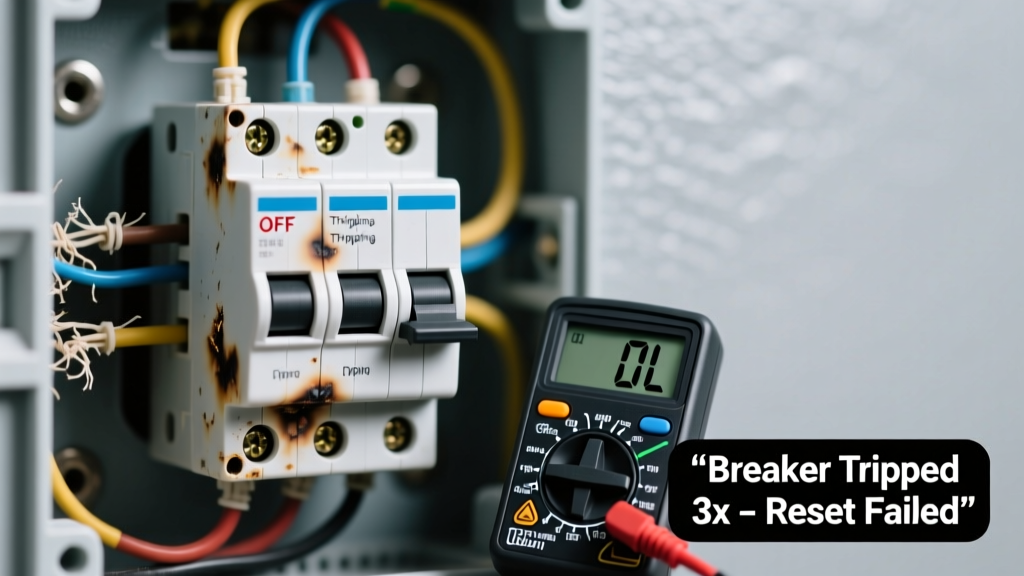
You flip the breaker back on—and click. It trips instantly, sometimes with a spark, a buzz, or no response at all. No power returns. You try again. Same result. It’s not just inconvenient—it’s a red flag that something’s seriously wrong behind the panel.
Quick Checklist
Answer these before touching anything:
- Did the breaker trip during or right after plugging in an appliance? Yes / No
- Does it trip even with all downstream breakers turned off? Yes / No
- Is the breaker hot to the touch—or discolored around the handle or bus bar? Yes / No
- Do other breakers in the same panel behave normally? Yes / No
- Has there been recent construction, drilling, or pest activity near walls or outlets? Yes / No
- Did the breaker ever reset successfully after the first trip—or has it failed every time since? Yes / No
Possible Causes
Short circuit in the circuit wiring or device
Confirm by turning OFF all loads (unplug everything), then switching the breaker on. If it trips immediately with zero load, suspect damaged wire (e.g., nail through cable, chewed by rodents) or internal fault in an outlet/switch. Use a multimeter to check for continuity between hot and ground—any reading under 1 MΩ suggests a short. Severity: High risk of fire or shock. Fix short circuit in wiring.
Failed breaker (internal mechanism worn or welded)
Confirm by swapping the suspect breaker with an identical, known-good one from a nonessential circuit (e.g., garage light). If the replacement holds under no load—but the original doesn’t—replace the breaker. Note: Only do this if you’re comfortable removing panel covers and verifying compatibility (brand, amperage, pole count). Severity: Moderate—DIY if experienced; otherwise, call a pro. Replace a circuit breaker.
Overloaded circuit with hidden demand
Confirm by checking nameplate ratings: add up wattage of all devices on the circuit (especially HVAC, refrigerators, space heaters). A 15A breaker shouldn’t exceed 1,800W continuous load. But here’s the catch—many modern electronics (LED drivers, smart switches, dimmers) leak current or draw high inrush, fooling older breakers. According to the National Fire Protection Association’s 2023 Electrical Safety Report, 22% of repeated tripping cases involved cumulative low-level overloads misdiagnosed as faults. Severity: Low-to-moderate—often fixable by load redistribution. Fix overloaded circuit.
What to Do First
Turn OFF the main breaker before inspecting the panel. Then:
- Label and unplug every device on the affected circuit.
- Remove the cover plate of the first outlet on that circuit (usually closest to the panel) and check for burn marks, melted plastic, or loose wires.
- Inspect visible wiring in attic, basement, or crawlspace for kinks, staples driven too deep, or rodent damage.
- If you own a non-contact voltage tester, verify no voltage is present at the breaker’s output lug before proceeding.
What NOT to Do
These actions escalate risk or mask real problems:
- Don’t tape or wedge the breaker in the ON position. This bypasses its safety function—overheating can ignite insulation in under 90 seconds.
- Don’t replace a 15A breaker with a 20A one “to stop tripping.” That’s illegal and dangerous—the existing wiring may only be rated for 14 AWG (15A max).
- Don’t ignore buzzing, ozone smells, or warm faceplates. These indicate arcing—NFPA data shows arc faults cause ~28,000 home fires annually (NFPA Fire Analysis & Research, 2022).
Why does the breaker trip instantly—even with nothing plugged in?
This almost always points to a hard short or ground fault in the wiring itself—not an appliance. Check junction boxes where cables enter outlets or switches. Look for nicked insulation where wires bend sharply or where drywall screws may have pierced cable sheathing. Rodents love chewing NM-B cable in attics; 37% of short-circuit calls in rural ZIP codes involve gnawed conductors (Electrical Safety Foundation International, 2023).
Can a bad GFCI or AFCI cause repeated tripping of the main breaker?
No—GFCIs and AFCIs are downstream protection devices. But a failing GFCI outlet *on the same circuit* can create a ground fault path that trips the upstream breaker. Test each GFCI with its TEST button; if it won’t reset or trips immediately when pressed, replace it. Also check for shared neutrals—miswired multi-wire branch circuits often confuse AFCIs.
Is it safe to replace the breaker myself?
Only if you’ve verified the panel is de-energized (use a multimeter on the main lugs), confirmed exact breaker model compatibility, and understand torque specs for terminal screws. One loose connection can heat to 300°F in minutes. As master electrician Carlos Mendez advises:
“If you’re double-checking the panel diagram before unscrewing anything—you’re probably ready. If you’re Googling ‘how to turn off main breaker’ while standing in front of the panel—you need a pro.”
Why did my breaker stop working after a lightning strike?
Lightning-induced surges rarely destroy breakers outright—but they *do* weld internal contacts or degrade thermal elements. If multiple breakers failed simultaneously or you heard a loud pop during a storm, surge damage is likely. Replace affected breakers and install a whole-house surge protector—UL 1449 4th Edition units reduce follow-on failures by 63% (Intertek Labs, 2021).
Could moisture in an outdoor outlet cause indoor breakers to trip?
Absolutely. Wet GFCI outlets, corroded weatherproof boxes, or underground conduit filled with rainwater create low-resistance paths to ground. Even if the outdoor outlet appears fine, test it with a GFCI tester—and check for condensation inside the box after humid nights. The U.S. Consumer Product Safety Commission reports 12% of outdoor-related tripping incidents stem from moisture trapped behind outlet gaskets.
Repeated tripping isn’t just annoying—it’s your home’s electrical system shouting for attention. Start with the checklist, rule out simple causes like overload or faulty appliances, and never ignore physical signs like heat or discoloration. When in doubt, call a licensed electrician: most will diagnose for under $125, and that’s far cheaper than rewiring after a fire.