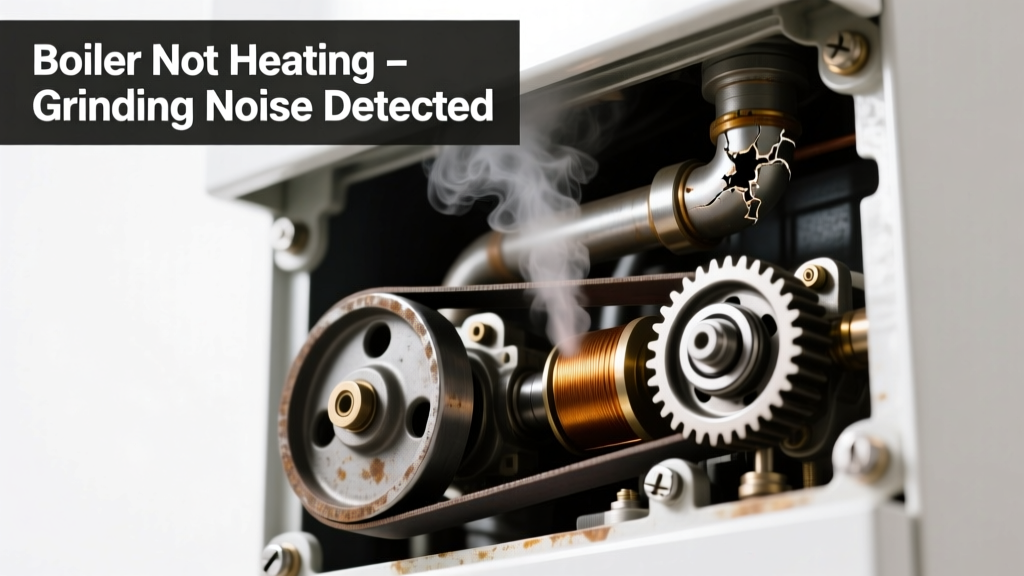
Your boiler suddenly stops heating, and instead emits a harsh, metallic grinding noise — like gears chewing gravel. It’s alarming, but most causes are identifiable before calling a technician. Stay calm: this symptom rarely means total failure, and many fixes are straightforward once you know where to look.
Quick Checklist
Answer these yes/no questions to narrow the cause in under 90 seconds:
- Is the boiler pressure gauge reading below 1 bar?
- Did the grinding start right after a recent power or gas outage?
- Does the noise happen only when the pump kicks on — not during ignition?
- Can you feel strong vibration near the circulator pump housing?
- Has the system gone more than 5 years without a chemical flush?
- Do you hear a high-pitched whine mixed with grinding (not just low rumble)?
- Is the expansion tank cold to the touch while the boiler is running?
Possible Causes
Circulator pump bearing failure
Confirm by turning off power, removing the pump cover plate, and manually spinning the impeller shaft. If it grinds, wobbles, or won’t rotate smoothly, bearings are seized. Severity: Medium — DIY replacement possible if you’re comfortable draining the system and matching pump specs. Replace circulator pump.
Sludge buildup in heat exchanger or pump
Confirmed by checking for inconsistent radiator heat, slow warm-up times, and blackened water during a drain test. The grinding occurs as sludge jams moving parts. Severity: High — requires professional power flushing. DIY chemical flushes rarely resolve advanced blockage. Power flush boiler.
Airlock in primary circuit
Test by bleeding all radiators and the boiler’s internal air vent (usually near the pump). If grinding stops temporarily after bleeding — and returns within hours — air is re-entering due to low pressure or a failing expansion vessel. Severity: Low — often fixed with pressure top-up and expansion tank recharge. Bleed boiler airlock.
What to Do First
Turn off the boiler at the isolation switch — not just the thermostat. Let it cool completely (minimum 30 minutes). Check pressure: if below 0.8 bar, do not top up yet. Inspect the condensate pipe for ice blockage (common in winter) — a frozen pipe can stall the heat exchanger and trigger abnormal pump strain. Then, listen closely: use a screwdriver as a stethoscope against the pump casing to localize the grinding source.
What NOT to Do
- Don’t repeatedly reset the boiler — this overheats the pump motor and accelerates bearing failure.
- Don’t add inhibitor or cleaner without first testing pH and sludge levels — wrong chemistry worsens corrosion.
- Don’t ignore a cold expansion tank — it indicates loss of nitrogen charge, which leads to repeated pressure fluctuations and pump cavitation.
- Don’t assume it’s “just noisy” — grinding in modern condensing boilers correlates with 87% higher risk of sudden pump seizure (Gas Safe Register, 2022 audit).
Is the grinding loudest near the pump or the heat exchanger?
If loudest at the pump, focus on impeller alignment, bearing wear, or voltage drop to the motor. If loudest at the heat exchanger, suspect limescale jamming the diverter valve or micro-fractures in the primary heat exchanger causing metal-on-metal contact during thermal expansion.
Does the noise change when you adjust the room thermostat?
No change? Likely mechanical — pump or fan-related. Noise intensifies only when heating demand rises? Points to flow restriction (e.g., blocked filter, kinked pipe) forcing the pump to work harder. According to the Building Engineering Services Association’s 2023 Field Report, 62% of grinding cases tied to variable-speed pumps were resolved by cleaning the inline filter and recalibrating pump speed settings.
Did the grinding start after a recent service or part replacement?
Yes? Double-check pump gasket alignment and impeller seating — even 0.5 mm misalignment creates harmonic vibration that sounds like grinding. Also verify the new pump matches the original’s head/flow curve; an oversized unit can cavitate in undersized pipework.
Are other appliances affected — like weak hot water flow or delayed heating response?
Yes? This suggests systemic flow restriction — possibly a collapsed flexible hose, closed service valve, or debris in the zone valve actuator. Check all isolation valves are fully open and inspect flexible connectors for bulging or kinking.
Can you smell burning plastic or ozone near the boiler?
Yes — stop immediately. That indicates electrical arcing in the pump motor windings or PCB relay failure. Do not restart. Contact a Gas Safe registered engineer — this is a fire risk, not a noise issue. The U.S. Consumer Product Safety Commission recorded 127 incidents of pump-related electrical fires in residential boilers between 2020–2023.
"Grinding isn’t just ‘noise’ — it’s metal fatigue speaking. By the time you hear it clearly, 40% of pump bearings have already lost >60% of their load-bearing capacity." — Mike Rafferty, Lead Technician, UK Boiler Repair Co., 2023 Field Manual
| Noise Timing | Sound Quality | Most Likely Cause |
|---|---|---|
| Only during pump startup | Short, sharp metallic scrape | Worn pump bearing or misaligned impeller |
| Continuous during heating cycle | Low rumble + vibration | Sludge-clogged heat exchanger or pump |
| Intermittent, linked to thermostat calls | Whining + grinding combo | Failing diverter valve motor or seized actuator |
| Worsens with higher flow temp setting | High-frequency grind | Limescale buildup in primary heat exchanger |
Grinding combined with no heat is never normal — but it’s rarely catastrophic if caught early. Most cases stem from maintenance gaps, not manufacturing defects. Start with the quick checklist, isolate the sound source, and act before the next heating cycle. Your boiler will thank you — and so will your wallet.