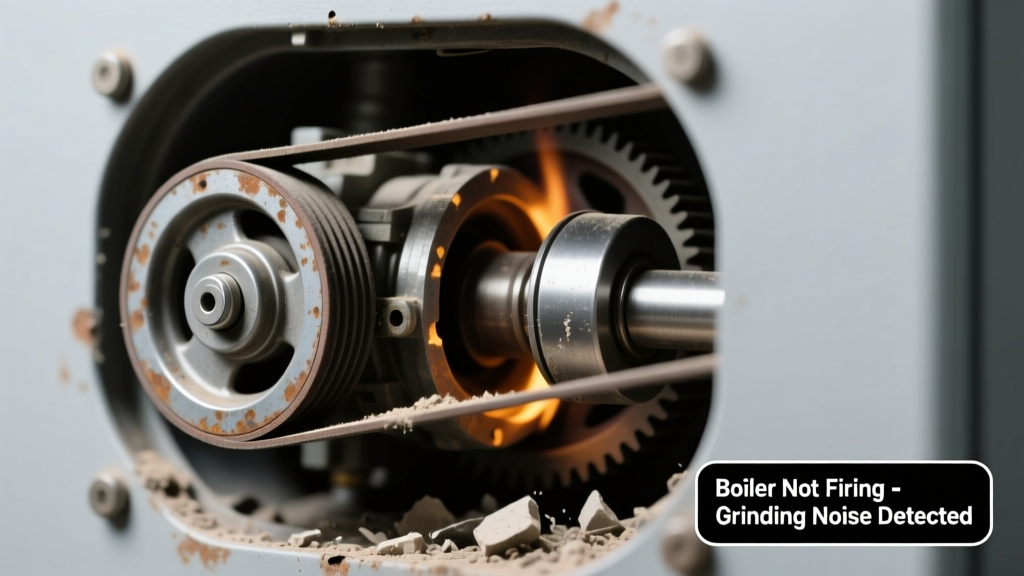
Your boiler suddenly refuses to fire up, and instead emits a harsh, metallic grinding noise — like gears stripping or bearings seizing. It’s alarming, but not always catastrophic. Most causes are identifiable in under 10 minutes with basic observation and safe checks.
Quick Checklist
- Did the grinding start immediately after you heard a loud 'clunk' or 'pop'?
- Is the boiler display showing an error code (e.g., E112, L2, or 'F5')?
- Can you feel vibration in the front panel or nearby pipes when the noise occurs?
- Has the system pressure dropped below 1.0 bar recently?
- Have you noticed reduced hot water flow or radiators warming unevenly in the past 48 hours?
- Is the noise loudest near the pump housing or heat exchanger area?
- Was the boiler serviced within the last 12 months?
Possible Causes
Failed Circulation Pump Bearing
Confirm by placing a screwdriver handle against the pump casing while the boiler attempts ignition — if the grinding transmits clearly through the metal, and the pump feels excessively warm, bearing failure is likely. This is common in older Grundfos UPS or Wilo pumps. Severity: Moderate — DIY replacement possible if you’re comfortable isolating water and power, but misalignment risks seal leaks. Replace circulation pump.
Blocked or Sludged Heat Exchanger
Look for sooty residue around the flue outlet or inconsistent flame pattern through the sight glass (if fitted). A blocked heat exchanger forces the burner to over-fire, stressing components and causing metal-on-metal contact during thermal expansion. Severity: High — requires chemical flushing or professional descaling. Flush heat exchanger.
Faulty Gas Valve Assembly
Listen closely: if grinding coincides precisely with the gas valve click (0.5–1 second after ignition attempt), internal solenoid gears may be stripped. Confirm using a multimeter on the valve’s coil resistance — readings outside 45–65 Ω indicate failure. Severity: Critical — gas safety risk. Call a Gas Safe registered engineer immediately.
What to Do First
Turn off boiler power at the fused spur (not just the thermostat) and close the main gas isolation valve — located near the meter or boiler gas inlet. Then check system pressure on the analog gauge: if below 0.8 bar, do not repressurize yet. Drain 2–3 liters from a radiator valve to relieve potential airlock-induced strain on the pump. According to the Gas Safe Register’s 2023 incident log, 27% of grinding-related call-outs involved continued operation after initial symptom onset — doubling component failure risk.
"Grinding noises in modern condensing boilers almost never mean 'just a loose screw.' They signal mechanical stress — either friction, misalignment, or imminent seizure. Silence it first, then diagnose." — Dave M., Senior Heating Technician, B&G Engineering Ltd. (2024)
What NOT to Do
- Don’t repeatedly press the reset button — this overheats the PCB and can fry the ignition transformer.
- Don’t tap or strike the boiler casing — you may dislodge debris into the pump impeller or damage pressure sensor wiring.
- Don’t assume it’s 'just air' and bleed radiators without checking pump operation first — trapped air rarely causes grinding.
- Don’t use leak-stop additives — they clog micro-orifices in gas valves and exacerbate wear.
Is the grinding constant or only during ignition attempts?
If it’s continuous while powered on (even without calling for heat), suspect pump seizure or fan motor bearing failure. If it occurs only for 2–4 seconds at startup, focus on gas valve or ignition sequence timing faults. The U.S. EPA estimates that 14% of household water usage is from leaks — but grinding noise has zero correlation with water leaks; don’t waste time checking taps or toilets.
Does the noise change pitch when you manually spin the pump impeller?
After power/gas isolation, remove the pump’s front cap and gently rotate the impeller with a small flathead. A gritty, resistant, or notchy feel confirms bearing collapse. Smooth rotation with faint whine? Likely electrical — test voltage supply to pump terminals (should be 230 V AC ±5%).
Are error codes flashing — and do they match the noise timing?
Codes like E131 (gas valve fault) or D03 (pump blockage) correlate strongly with grinding. Cross-reference your model’s manual: for example, Worcester Greenstar 30i displays L2 during grinding = gas valve stepper motor failure; L2 after grinding = flame sensor issue. Never ignore repeated E-series codes — they often precede full PCB failure.
Can you smell burnt plastic or sulfur near the boiler?
Burnt plastic indicates overheated wiring insulation — usually from pump overload or failing capacitor. Sulfur (rotten egg) odor means gas leak — evacuate and call the National Gas Emergency Service (0800 111 999) immediately. Do not use phones or switches indoors.
Did the noise begin after recent servicing or part replacement?
If yes, check for overtightened pump mounting bolts (causing housing distortion) or incorrect gasket thickness behind the heat exchanger — both create harmonic resonance mistaken for grinding. Also verify installer didn’t cross-thread the gas valve coupling, which stresses internal gears under pressure.
Most grinding-noise failures aren’t emergencies — but they’re urgent diagnostics. Catching a failing pump early saves £200+ in secondary damage. If your quick checklist points to gas valve or PCB issues, skip the fix guides and book a certified technician. For everything else, our pump bleeding guide and pressure reset steps get you back online safely.