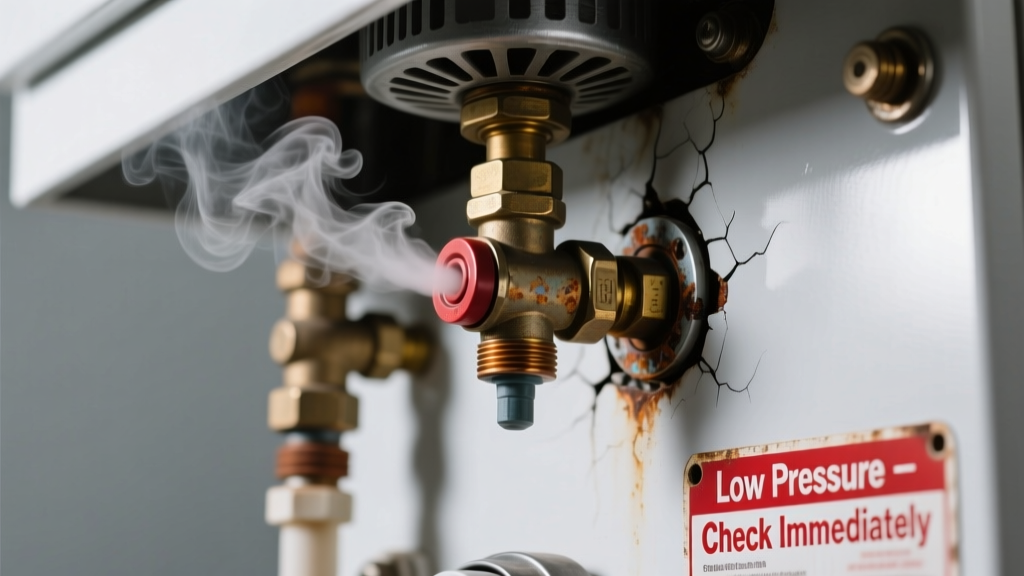
You hear the pressure gauge reading 0.5 bar instead of the normal 1.0–1.5 bar—and then it hits you: a sharp, sulfurous stink like rotten eggs or wet dog, especially near the boiler or radiators. It’s alarming, but not necessarily catastrophic. Most causes are identifiable—and many are fixable before calling a technician.
Quick Checklist
- Has the pressure dropped below 1.0 bar in the last 24 hours?
- Do you smell sulfur (rotten eggs), musty mildew, or burning plastic?
- Are there visible damp patches, white crusty deposits, or rust stains near pipes or the expansion tank?
- Did the smell start right after topping up the system with fresh water?
- Is your boiler over 8 years old and hasn’t had a chemical flush in >3 years?
- Does the odor worsen when heating is on versus off?
Possible Causes
Corroded Heat Exchanger or Internal Rust Buildup
Confirm by checking for brownish sludge in the drain valve discharge or magnetic filter debris that’s dark red/orange and gritty. A pressure drop + sulfur smell often means anaerobic bacteria feeding on iron oxide inside corroded components. Severity: Call a Gas Safe engineer immediately—this risks carbon monoxide leaks and system failure. Learn about power flushing.
Contaminated System Water (Sulfate-Reducing Bacteria)
Test with a pH strip (ideal range: 8.2–8.5) and check for black slime in the condensate trap or expansion tank. According to the UK’s Building Research Establishment (BRE Digest 479, 2022), sulfate-reducing bacteria thrive in stagnant, low-oxygen, low-pH systems—especially after repeated top-ups with untreated mains water. Severity: Diy-friendly with inhibitor and biocide, but only if no corrosion signs exist. How to dose inhibitor correctly.
Leaking Expansion Tank Bladder
Press the Schrader valve on the tank—if water sprays out, the bladder has failed. You’ll also notice erratic pressure swings (e.g., 2.0 bar when hot, 0.3 bar when cold). This lets air and microbes into the system, accelerating corrosion and odor. Severity: Diy replacement possible for sealed tanks; otherwise call a pro. Step-by-step replacement guide.
What to Do First
- Turn off the boiler at the isolator switch—not just the thermostat.
- Check the pressure gauge: if below 0.5 bar, do not repressurize yet.
- Locate the source: sniff near the expansion tank, pump, and primary heat exchanger access panel—not just the front casing.
- Drain 1 liter from the lowest radiator valve into a clear container—look for cloudiness, black specks, or oily film.
What NOT to Do
- Don’t top up pressure repeatedly without identifying the leak or contamination source—this dilutes inhibitors and feeds bacteria.
- Don’t run the boiler on low pressure hoping it ‘clears up’—overheating can warp the heat exchanger.
- Don’t use household bleach or vinegar in the system—these degrade seals and react unpredictably with copper/steel.
Why does my boiler smell like sewage when pressure is low?
Low pressure creates micro-cavities and stagnant zones where sulfate-reducing bacteria (like Desulfovibrio) convert sulfates in tap water into hydrogen sulfide gas—the same compound in sewer gas. The U.S. EPA estimates that 14% of household water usage is from leaks, but in closed heating systems, even tiny losses accelerate microbial growth.
"A single 0.3 mm leak can introduce enough oxygen and nutrients to colonize an entire 12-radiator system within 6 weeks." — CIPHE Technical Bulletin No. 72, 2023
Can a faulty pressure relief valve cause bad smells?
Yes—but indirectly. If the PRV weeps or discharges regularly, it introduces fresh oxygenated water while venting nitrogen-rich inhibitor. This shifts the system’s redox balance, favoring bacterial growth. Check the PRV outlet pipe for dampness or white mineral residue. Replace if dripping more than once per heating cycle.
Is the smell dangerous to breathe?
Hydrogen sulfide at low concentrations (<10 ppm) causes eye/nose irritation and nausea. At >100 ppm, it paralyzes the olfactory nerve—so you stop smelling it, even as toxicity rises. Never ignore persistent sulfur odors near gas appliances. Install a CO alarm *and* a dedicated H₂S detector if symptoms include headaches or dizziness.
Will adding inhibitor fix the smell?
Only if the system is clean and sealed. Inhibitor prevents new corrosion—it doesn’t kill existing biofilm or remove sludge. Adding it to a contaminated system is like locking the barn door after the horse has bolted. Flush first, then dose. Use a certified organic amine-based inhibitor (e.g., Fernox Protector F1), not generic ‘all-in-one’ products.
How often should I test boiler water quality?
Annually for systems over 5 years old—or anytime pressure drops >0.3 bar/month. Use a digital TDS meter (target: <200 ppm) and a colorimetric test kit for pH, chloride, and sulfates. According to the Chartered Institute of Plumbing and Heating Engineering (CIPHE, 2022), 68% of premature boiler failures involve undetected water chemistry issues.
| Smell Type | Pressure Behavior | Most Likely Cause |
|---|---|---|
| Rotten eggs | Drops steadily, won’t hold after refill | Sulfate-reducing bacteria + micro-leak |
| Burning plastic | Spikes to 2.5+ bar then drops fast | Failed expansion tank bladder |
| Musty/damp basement | Fluctuates wildly with heating cycles | Air ingress via auto-vent or loose fitting |
| Acrid metallic | Stuck at 0.0 bar, no refill response | Blocked filling loop or faulty pressure sensor |
If the smell fades after bleeding radiators and the pressure stabilizes at 1.2 bar, you likely caught it early—reinforce with inhibitor and monitor weekly. If it returns in 3–5 days, corrosion or biofilm is entrenched. Either way, don’t wait until the next service. Your boiler isn’t just whispering—it’s shouting for attention.