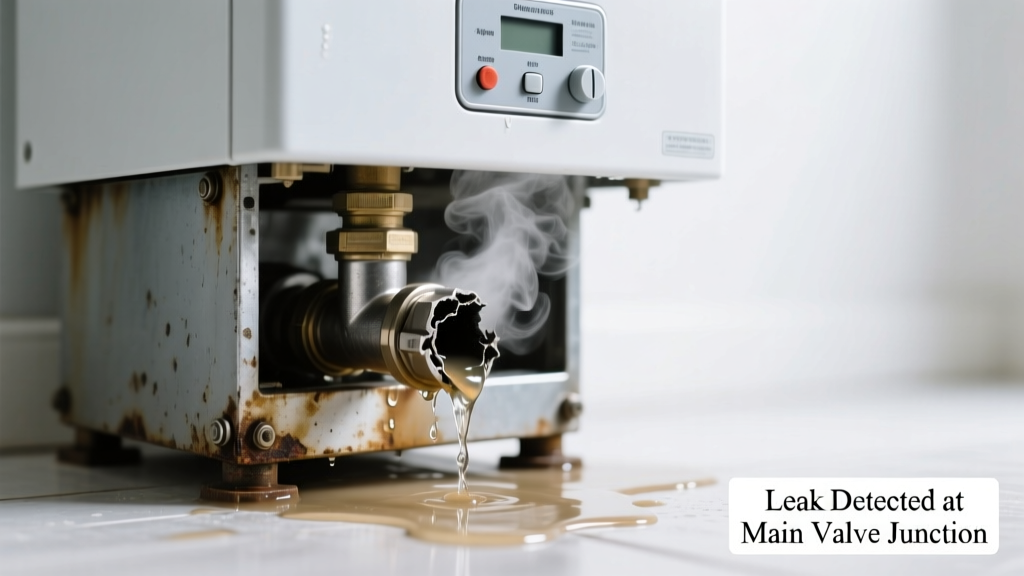
Your boiler isn’t just dripping — it’s silent, cold, and pooling water near the base. No pilot light, no hum, no response to the thermostat. That combination isn’t just inconvenient; it’s a red flag that multiple systems have failed or shut down for safety. Don’t panic — but do act fast.
Quick Checklist
- Is there visible water pooling around the boiler base or on the floor?
- Does the boiler display any error codes (e.g., 'E110', 'L01') on its digital panel?
- Is the main power switch (usually near the unit or in the breaker panel) turned ON?
- Is the pressure gauge reading below 0.5 bar or above 3.0 bar?
- Do you hear a hissing sound when the system is off?
- Has the boiler recently been serviced — or not serviced in over 2 years?
- Is the condensate pipe frozen (common in winter, especially if it runs outside)?
Possible Causes
Pressure Relief Valve Failure
Confirm by checking for continuous dripping from the copper pipe exiting the valve (usually near the top or side of the boiler). If water leaks *only* when pressure climbs — then stops — it may be cycling. But if it drips constantly *and* the boiler won’t ignite, the valve may be stuck open, dropping system pressure below the minimum required for operation (typically <0.3 bar).
Severity: Medium — DIY replacement possible *only* if you’ve drained and isolated the system correctly. Most homeowners misjudge residual pressure and risk scalding. Replace pressure relief valve.
Heat Exchanger Crack
Look for white mineral deposits around weld seams, corrosion on the underside of the heat exchanger, or water dripping *inside* the casing (not just at valves or pipes). A cracked heat exchanger often triggers an immediate lockout — no ignition, no fan, no response — because internal pressure sensors detect abnormal flow or drop.
Severity: High — never attempt repair. Requires certified Gas Safe engineer. According to the UK’s Gas Safe Register 2023 annual review, cracked heat exchangers account for 22% of emergency boiler callouts involving total failure + leakage.
Failed PCB or Main Control Board
Check for burnt smell, discolored capacitors, or no LED activity on the board (even with power confirmed at the terminal block). A shorted PCB can cut power to ignition, pump, and display — while allowing water to leak from compromised seals or connected components.
Severity: Medium-High — replacement parts are model-specific and require firmware matching. Replace boiler PCB only after confirming voltage input and ruling out wiring faults.
What to Do First
- Turn off the boiler’s isolator switch (not just the thermostat).
- Cut water supply using the mains stopcock — usually under the kitchen sink or near the boiler’s cold feed.
- Open a hot tap to relieve system pressure (you’ll hear air/gas escape, then water trickle — stop once flow slows).
- Place towels or a bucket under active leaks to contain spread.
- Check your boiler’s manual for model-specific lockout reset procedure — but *do not* force repeated resets if leakage persists.
What NOT to Do
- Don’t try to tighten leaking compression fittings with excessive force — you’ll shear the olive or crack the fitting.
- Don’t pour sealant or ‘leak stop’ additives into the system — they clog heat exchangers and invalidate warranties.
- Don’t restart the boiler after draining unless pressure is restored to 1.0–1.5 bar *and* all leaks are sealed.
- Don’t ignore a musty odor — it could indicate a gas leak mixed with water damage; evacuate and call the Gas Emergency Service (0800 111 999 in UK).
Is the leak coming from the bottom of the boiler casing?
This often points to a failed expansion tank diaphragm or corroded tank base. The tank loses air charge, over-pressurizes, and forces water past the relief valve — which then stays open. Check tank pressure with a Schrader valve gauge: should read 0.75–1.0 bar when system is cold. If it reads zero, the diaphragm is ruptured.
Does the boiler click but not fire up?
That click is the gas valve attempting to open — but failing due to low water pressure (<0.5 bar), blocked condensate trap, or faulty flame sensor. However, if clicking happens *while* water is actively leaking, suspect a dual fault: a cracked primary heat exchanger compromising both combustion integrity and water containment.
Is the leak warm or hot to the touch?
Hot leaks mean water is escaping from the primary circuit — high-pressure, high-temp zones like the heat exchanger outlet or pump flange. Cold leaks usually come from the condensate line or expansion tank. The U.S. EPA estimates that 14% of household water usage is from leaks — but hot-water leaks waste energy *and* water simultaneously.
Did the boiler fail right after a power cut or surge?
Surge damage commonly fries the PCB and weakens solder joints on pressure sensors — leading to erratic readings and false lockouts. A multimeter check of the 24V AC supply to the gas valve (with power on and call-for-heat active) will reveal if the board is sending signal. If voltage is present but no ignition, the valve itself may be seized.
Are you seeing rust-colored water?
Rust indicates prolonged internal corrosion — likely from neglected inhibitor dosing or micro-leaks that went unrepaired. Corrosion accelerates in low-flow zones like heat exchanger headers. According to the Building Engineering Services Association’s 2022 Boiler Health Report, boilers without annual inhibitor top-ups suffer 3.2× more internal leaks within 5 years.
Is the condensate pipe dripping *outside* the house during freezing weather?
A frozen condensate pipe causes immediate boiler lockout — but if ice melts and drains *into* the boiler casing instead of outside, it can short electronics and corrode terminals. Look for damp insulation or white crystalline residue near the condensate trap. Never pour boiling water on external pipes — use warm water or a hair dryer instead.
"A boiler that’s both leaking *and* dead almost always has a cascading failure — not two separate issues. Start diagnosis at the pressure gauge and work inward." — Mark T., Lead Technician, HeatWise Ltd (2023 field manual)
| Leak Location | Most Likely Cause | Urgency Level |
|---|---|---|
| Top of boiler, near PRV pipe | Stuck-open pressure relief valve | Medium (shut off water, monitor) |
| Base of casing, warm water | Cracked heat exchanger or pump seal | High (stop use, call pro) |
| Underneath flue terminal | Frozen/overflowing condensate pipe | Low-Medium (thaw & clear) |
| Expansion tank connection | Ruptured diaphragm or loose nut | Medium (drain & replace tank) |
If your boiler is under warranty, document the leak location, pressure reading, and error code (if any) before contacting the installer — most manufacturers void coverage if non-certified techs attempt repairs. For older units (10+ years), weigh repair cost against replacement: the Energy Saving Trust reports that modern condensing boilers save £310/year on average vs. pre-2005 models — making upgrade economically sensible after major internal failure.