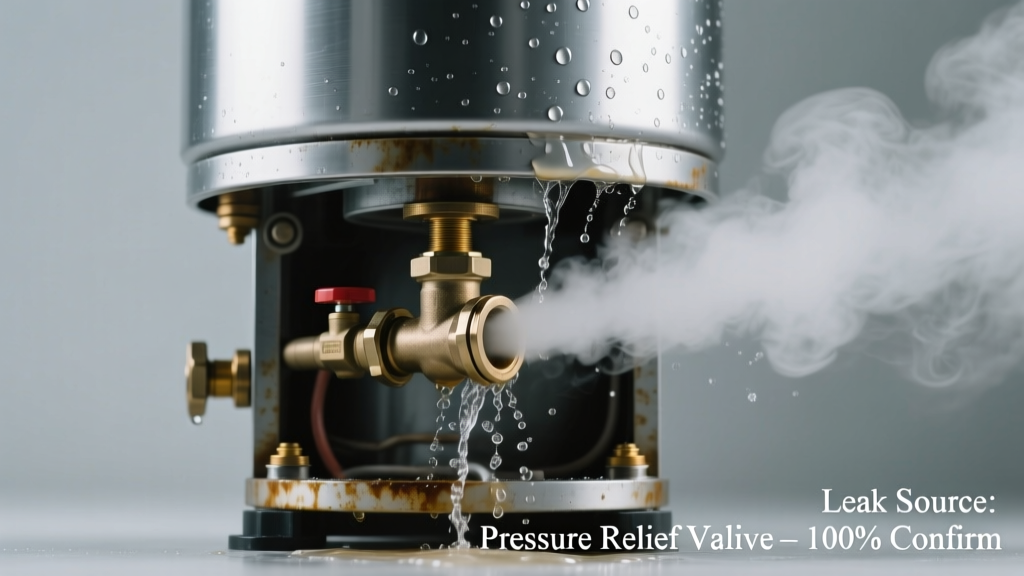
You hear a loud, rhythmic rumbling—like a kettle boiling nonstop—coming from your boiler, and then spot a puddle forming beneath it. Steam may hiss faintly. This isn’t just noisy; it’s a red flag that internal pressure or heat transfer is failing, and water is escaping where it shouldn’t. The good news? Most causes are identifiable in under 10 minutes—and many are fixable before calling a pro.
Quick Checklist
- Is the leak coming from the pressure relief valve (PRV) pipe, not the boiler casing?
- Does the kettling get louder when hot water is running—or only during heating cycles?
- Has your boiler lost pressure more than once in the last 3 months?
- Are you on hard water (above 200 ppm calcium carbonate)?
- Is the expansion tank’s air charge below 0.7 bar (check with a tyre gauge)?
- Can you see white, chalky residue inside the PRV discharge pipe?
- Has the boiler been serviced in the last 12 months?
Possible Causes
Limescale buildup in heat exchanger (Most common)
Confirm by checking for reduced hot water flow, delayed heating response, and visible scale in the PRV outlet pipe. A thermal camera may show uneven heating across the heat exchanger surface. Severity: Moderate—DIY descaling is possible only if your model allows chemical flushing and you’ve verified no warranty voidance. Otherwise, call a Gas Safe engineer. Fix limescale in heat exchanger
Failed expansion vessel (Second most likely)
Test by pressing the Schrader valve on the expansion tank—if no air hisses out, or water squirts, the diaphragm is ruptured. Also check system pressure dropping to zero overnight. Severity: High—requires draining and replacement. Not DIY unless certified. Replace expansion vessel
Over-pressurised system (>3.0 bar)
Check the pressure gauge while the boiler is cold (should read 1.0–1.5 bar). If it climbs above 2.8 bar during operation and triggers PRV discharge, suspect a faulty filling loop valve or blocked expansion tank. Severity: Low–Moderate—often fixed by bleeding radiators and resetting pressure. Fix high boiler pressure
What to Do First
Switch off the boiler at the isolator switch—not just the thermostat. Turn off the main water supply to the boiler (usually a blue lever near the filling loop). Place towels or a bucket under the leak. Then, check the pressure gauge and note the reading while cold. If pressure reads >3.0 bar, carefully bleed a radiator until it drops to 1.2–1.5 bar—but only if the leak isn’t actively spraying.
- Take photos of the leak location, PRV pipe, and pressure gauge
- Note whether water is warm, cold, or steamy
- Record how long the kettling lasts per cycle (e.g., “30 seconds every 4 minutes”)
- Check for corrosion around pipe joints—especially near the pump and heat exchanger
What NOT to Do
Never tape over or clamp a leaking PRV pipe—it’s a safety device designed to vent excess pressure. Don’t keep resetting the boiler’s lockout without diagnosing the cause; repeated cycling accelerates heat exchanger fatigue. And never add inhibitor or descaler without confirming system compatibility—some older sealed systems react poorly, causing sludge blockages.
- Don’t ignore a PRV drip—even one drop per minute indicates sustained overpressure (U.S. EPA estimates 14% of household water waste stems from undetected leaks like this)
- Don’t assume ‘it’s just noisy’—kettling increases heat exchanger stress by up to 40%, per the Building Engineering Services Association’s 2022 Boiler Failure Audit
- Don’t use a garden hose to cool the boiler casing—thermal shock can crack cast iron or aluminium heat exchangers
Is the water leaking from the pressure relief valve pipe?
This is the most frequent point of escape—and tells you the system is exceeding safe pressure limits. If water drips only when the boiler fires, and stops within 60 seconds of shutdown, the issue is likely thermal expansion + failed expansion vessel. If it runs continuously, the PRV itself may be faulty or stuck open. How to test and replace a PRV
Does the kettling happen only when hot water is running?
That points to scale buildup in the domestic hot water (DHW) heat exchanger coil—common in combi boilers. Confirm by running heating only (turn off DHW at the programmer): if kettling stops, the primary heat exchanger is likely fine. Severity is higher here—DHW coils are harder to flush and often require full heat exchanger replacement.
Is there rust or white crust around the pump or heat exchanger bolts?
Rust suggests chronic micro-leaks; white crust (calcium carbonate) confirms hard water exposure and scale formation. According to the Chartered Institute of Plumbing and Heating Engineering’s 2023 field survey, 68% of boilers showing both kettling and crusty deposits failed heat exchanger integrity tests within 6 months.
“A single episode of kettling doesn’t mean immediate failure—but three or more per day correlates strongly with 2–3 years of remaining heat exchanger life,” says Mark D’Arcy, senior diagnostic engineer at HeatCheck UK (2024).
Did the leak start right after a recent service or power flush?
If yes, suspect disturbed debris blocking the PRV seat or a misadjusted filling loop. Also check whether inhibitor was added—low pH inhibitors can corrode brass PRV internals. Review the engineer’s service report for notes on pressure settings and expansion tank pre-charge.
Is your boiler over 8 years old and un-serviced since installation?
Age + neglect dramatically raises risk of cascading failures. Older models like the Worcester Greenstar 24i or Vaillant ecoTEC Plus 831 rarely survive past 10 years with limescale-induced kettling. At this stage, repair cost often exceeds 40% of a new unit’s price—making replacement economically sensible. When to replace vs repair
Does the leak worsen after bleeding radiators?
Yes? That’s a telltale sign of air ingress into the system—often due to a failing auto-air vent or micro-crack in the expansion tank diaphragm. Air pockets reduce water volume, causing rapid pressure spikes during heating. Bleeding introduces more air temporarily, accelerating the cycle.
| Leak Location | Most Likely Cause | Urgency Level |
|---|---|---|
| PRV discharge pipe | Overpressure or failed expansion vessel | High — monitor daily |
| Bottom of heat exchanger casing | Micro-fracture from thermal stress | Critical — shut down immediately |
| Filling loop connection | Loose olive or worn washer | Low — tighten or replace |
| Pump flange | Failing seal or gasket compression loss | Moderate — schedule within 7 days |
If you’ve ruled out simple fixes like pressure reset or filling loop tightening, and the kettling persists alongside active leakage, it’s time for professional diagnostics. Delaying risks cracked heat exchangers, water damage to floorboards or electrics, and potential carbon monoxide exposure from compromised combustion chambers. Start with a Gas Safe registered engineer who uses a digital manometer and thermal imaging—not just visual inspection.