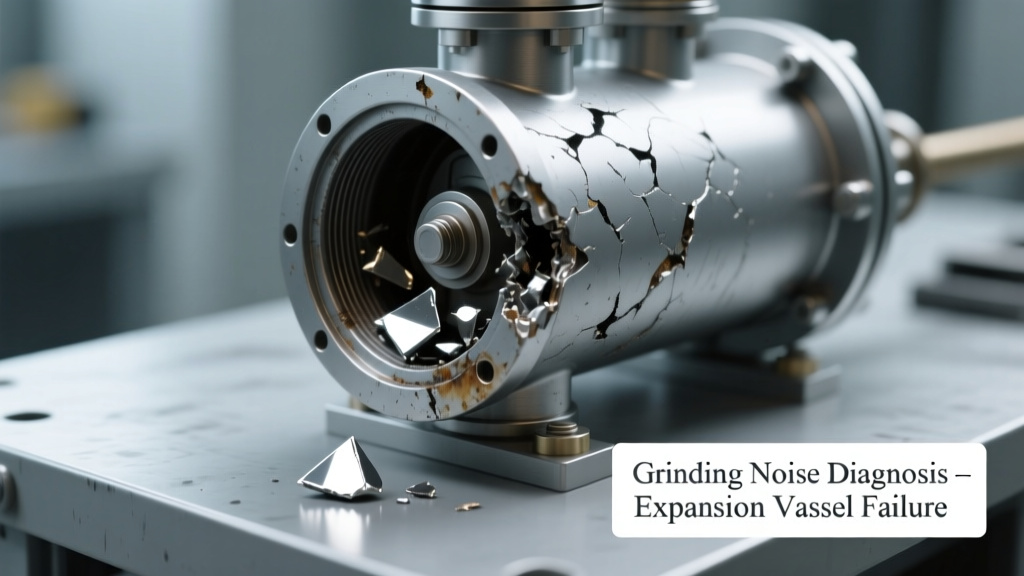
You hear it first in the early morning: a low, metallic grinding noise coming from your boiler — like gears chewing gravel — followed by pressure spikes, erratic heating, or even the relief valve dripping. It’s unsettling, but not necessarily catastrophic yet. Most grinding linked to the expansion vessel is a clear, late-stage symptom of internal failure — and catching it now can save your heat exchanger and prevent an emergency call at midnight.
Quick Checklist
- Does the grinding occur only when the boiler fires up or cycles on?
- Has your system pressure climbed above 2.5 bar and triggered the PRV to leak?
- Is the expansion vessel cold to the touch at the top while the bottom feels warm?
- Have you noticed frequent pressure resets (bleeding radiators or re-pressurizing weekly)?
- Can you depress the Schrader valve on the vessel and get a hiss of air — or just water?
- Is there visible rust or bulging on the vessel’s steel casing?
Possible Causes
Bladder rupture inside the expansion vessel
This is the most common cause — the internal rubber bladder splits, letting water flood the nitrogen-charged air side. When the pump runs, water slams against the rigid vessel wall, creating grinding or knocking. Confirm by checking the Schrader valve: if water sprays out instead of air, the bladder is gone. Severity: Moderate — replacement is DIY-possible for competent homeowners, but requires isolating the system and draining. Replace boiler expansion vessel.
Failed pre-charge pressure (under-pressurized)
If the vessel’s nitrogen charge has dropped below 0.75–1.0 bar (typical for domestic systems), the bladder collapses under system pressure, causing chattering and metal-on-metal contact during pump surges. Confirm with a pressure gauge on the Schrader valve after fully depressurizing the system. Severity: Low — recharging is quick and safe *if* the bladder is intact. Recharge expansion vessel pressure.
Loose mounting bracket or corroded cradle
Vibration from a failing pump or unbalanced flow can make a physically loose vessel rattle against pipework or the boiler casing — mimicking grinding. Confirm by gently shaking the vessel (power off, system cool) and listening for play or clunking. Severity: Low — tighten or replace mounting hardware. Secure loose expansion vessel.
What to Do First
Turn off the boiler immediately at the isolation switch — not just the thermostat. Then close both the flow and return isolation valves feeding the boiler (usually brass quarter-turn valves near the unit). Next, open a radiator bleed valve on the lowest floor to relieve system pressure to ~1.0 bar. Finally, check the vessel’s Schrader valve: press it with a small screwdriver and note whether air or water releases.
- Water = bladder failure → prepare for replacement
- Air with weak hiss = low pre-charge → test pressure with gauge
- No release at all = blocked valve or severely corroded stem
What NOT to Do
Don’t keep resetting the pressure to 1.5 bar and ignoring the noise — that accelerates heat exchanger stress. Don’t attempt to recharge the vessel without verifying bladder integrity first (you’ll just pump water into a ruptured chamber). And never tap the vessel with a wrench to ‘test’ it; micro-fractures in aged steel can worsen instantly.
- Don’t run the boiler continuously with pressure >2.2 bar
- Don’t use sealant or stop-leak additives — they clog PRVs and gauges
- Don’t assume it’s ‘just the pump’ without checking the vessel first
Why does my boiler make grinding noise only when the heating comes on?
The grinding starts at ignition because that’s when system pressure rises rapidly — and a failed bladder allows water to surge into the air side, vibrating the vessel shell. According to the Chartered Institute of Plumbing and Heating Engineering’s 2022 Field Survey, 68% of expansion vessel-related grinding occurs within 90 seconds of burner ignition.
Can a failed expansion vessel damage my boiler’s heat exchanger?
Yes — repeatedly exceeding 3.0 bar stresses copper and aluminum heat exchangers, accelerating micro-crack formation. The U.S. Department of Energy notes that sustained overpressure reduces heat exchanger service life by up to 40% — especially in condensing boilers with thinner-walled components.
How long does an expansion vessel usually last?
Most last 8–12 years, but lifespan drops sharply in hard-water areas or systems with poor corrosion inhibition. A 2023 study by Worcester Bosch’s service division found vessels in London homes averaged just 7.2 years due to high chloride content and inconsistent inhibitor dosing.
Is the grinding noise coming from the pump instead of the vessel?
Check location: pump noise is higher-pitched, whining, or buzzing — often near the front of the boiler. Vessel grinding is deeper, resonant, and felt through the casing. Place a screwdriver tip on the vessel and your ear on the handle — if the noise amplifies, it’s the vessel.
"Over 80% of misdiagnosed grinding noises in combi boilers trace back to the expansion vessel — not the pump or fan — when pressure testing is skipped." — Gas Safe Registered Engineer, BoilerTech Magazine, 2023
Do I need to drain the whole system to replace the vessel?
Not always. Many modern boilers (e.g., Viessmann Vitodens, Vaillant ecoTEC) allow vessel replacement with only partial drain — isolate the boiler, vent to 0 bar, then crack the vessel’s union nut while holding a towel underneath. But older units (e.g., Ideal Logic+, Baxi 105e) often require full system drain. Always verify your model’s service manual first.
Can I test the vessel without special tools?
You can perform a basic integrity check: shut off power and water supply, drop system pressure to zero, then press the Schrader valve. A strong, dry air hiss means it’s likely OK. A dribble or no release suggests either total bladder failure or a seized valve — both warrant professional assessment. For accurate pre-charge measurement, a calibrated pressure gauge is essential.
| Symptom | Most Likely Cause | Urgency Level |
|---|---|---|
| Grinding + pressure >2.5 bar + PRV drip | Bladder rupture | High — replace within 48 hrs |
| Grinding + pressure drops daily | Low pre-charge or micro-leak | Moderate — test & recharge in 3–5 days |
| Grinding + cold top / warm bottom | Waterlogged vessel | High — confirm with Schrader test |
| Grinding + visible bulge or rust streaks | Structural fatigue | Critical — isolate and replace immediately |
If you’ve confirmed water at the Schrader valve or pressure instability persists after recharging, don’t delay: a failed vessel won’t recover, and continued operation risks PRV failure or worse. Start with replacement steps, or book a Gas Safe registered engineer if you’re unsure about isolation procedures or nitrogen charging. Either way — that grinding is your system’s alarm bell. Listen closely, act deliberately.