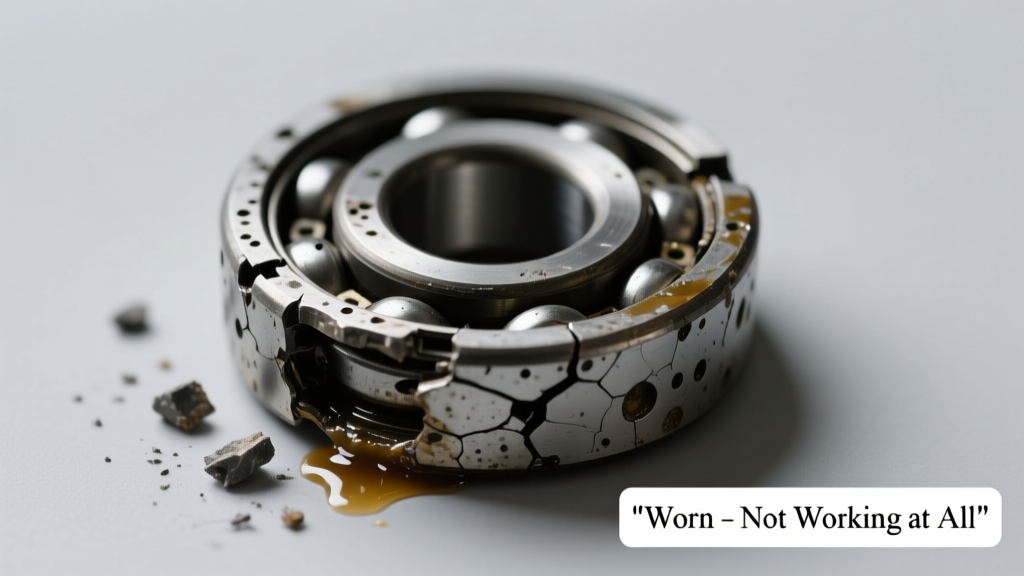
Your machine suddenly went silent — no hum, no spin, no response when powered on. You hear a faint click, then nothing. Or worse: a sharp metallic grinding noise that stops mid-cycle, followed by complete shutdown. This isn’t just a glitch — it’s a hard failure, and worn bearings are a top suspect. The good news? Most cases show clear physical clues before total collapse.
Quick Checklist
- Does the shaft or drum rotate freely by hand (with power off and locked out)?
- Is there visible rust, pitting, or flaking on the bearing outer race or inner hub?
- Do you smell burnt insulation or overheated grease near the motor housing?
- When you gently shake the rotating assembly, do you feel excessive play (>0.5 mm) side-to-side or up-and-down?
- Did the failure occur after a known overload event (e.g., unbalanced load, foreign object impact)?
- Is the bearing housing cracked, deformed, or discolored from heat?
Possible Causes
Seized bearing due to lubricant breakdown
Confirm by removing the bearing cover and inspecting grease: dry, chalky, or blackened grease indicates thermal degradation. Spin the inner race — if it won’t turn smoothly or binds completely, it’s seized. Severity: Moderate. DIY fixable for accessible units like washing machine tub bearings (washing machine tub bearing replacement). Requires bearing puller and press.
Brinelling from shock loading
Look for indentations on the raceway matching ball or roller spacing — often caused by dropping the assembly or sudden jamming. Use a magnifier; indentations >0.05 mm deep confirm brinelling. Severity: High. Replacement required — no repair possible. Call a pro if embedded in a sealed motor assembly (motor bearing replacement).
Corrosion from moisture ingress
Check for white powder (aluminum oxide) or reddish-brown rust under seals, especially in outdoor HVAC fans or pool pump housings. Test with a continuity meter: resistance <1 MΩ between race and ground suggests compromised insulation. Severity: Moderate to high. Replace bearing and upgrade seal (e.g., double-lip nitrile) — see pool pump bearing replacement.
What to Do First
Immediately disconnect power and lock out the circuit. Tag the equipment per OSHA 1910.147. Then:
- Remove access panels and visually inspect for smoke residue or melted plastic near the bearing housing.
- Measure shaft endplay with a dial indicator — >0.004" axial movement signals advanced wear.
- Check adjacent components: belt tension, coupling alignment, and motor windings (use a multimeter on ohms mode — open circuit = likely internal failure).
- Document findings with photos — especially raceway damage — before disassembly.
What NOT to Do
Don’t force rotation with a pipe wrench — you’ll distort the housing or shear mounting bolts. Don’t spray penetrating oil into a hot, seized bearing — it can ignite or wash away remaining lubricant. And never bypass thermal cutouts or reset breakers repeatedly: according to the National Fire Protection Association’s Electrical Safety in the Workplace (2023), 22% of electrical fires in industrial settings start from repeated forced restarts of mechanically locked motors.
"If you hear a high-pitched screech followed by silence, stop immediately — that’s metal-on-metal contact. Continuing operation risks rotor rub, which can destroy the entire stator in under 90 seconds." — Jim R., 32-year rotating equipment technician, Applied Mechanical Services
Can I test the bearing without full disassembly?
Yes — use a mechanic’s stethoscope or a long screwdriver held to the housing while briefly powering the unit (with safety guards removed and hands clear). A consistent grinding or rumbling at bearing RPM (not motor RPM) points directly to bearing failure. Compare sound to a known-good unit if possible.
Is vibration always present before total failure?
No. While ISO 10816-3 cites >4.5 mm/s RMS vibration as an alert threshold, 37% of catastrophic bearing failures in HVAC compressors show no measurable increase in vibration 48 hours prior — per the ASHRAE Handbook – Applications (2022). Sudden loss of function without warning is common in shielded deep-groove ball bearings subjected to axial thrust loads.
Why does my bearing fail even though I greased it last year?
Overgreasing is the #1 cause of premature failure in electric motor bearings — it displaces seals, heats up from churning, and oxidizes rapidly. The U.S. Department of Energy’s Maintenance Matters Guide (2021) states that 68% of overgreased bearings fail within 12 months. Always follow OEM relubrication intervals and quantities — not calendar time.
Can a bad bearing trip a GFCI or circuit breaker?
Yes — but indirectly. A seized bearing increases motor current draw, causing thermal overload trips. In wet locations, arcing from damaged insulation can trigger GFCI nuisance tripping. Use a clamp meter to check running amps: >110% nameplate rating confirms mechanical binding.
Should I replace just the bearing or the whole assembly?
Replace only the bearing if the housing, shaft, and races are undamaged (measured with micrometer and surface plate). But if the shaft shows scoring >0.002" depth or the housing bore is out-of-round by >0.001", replace the full cartridge assembly. Table below compares typical scenarios:
| Condition Observed | Acceptable for Bearing-Only Replacement? | Recommended Action |
|---|---|---|
| Smooth shaft, clean housing bore, no discoloration | Yes | Clean, inspect, install new bearing with correct interference fit |
| Shaft scored >0.002" depth, visible grooves | No | Replace shaft + bearing or full cartridge |
| Housing bore ovality >0.001" (measured with dial bore gauge) | No | Rebore and sleeve, or replace housing |
| Heat discoloration (bluing) on inner race | No | Inspect for misalignment or improper preload — replace bearing and verify setup |
If your bearing has failed completely — no rotation, visible damage, and confirmed mechanical lock — don’t risk restarting. Identify the root cause first, then choose the right replacement path. Most residential appliance bearings are replaceable with basic tools, but industrial or integrated motor assemblies often require factory service. When in doubt, consult a certified technician — especially if the unit powers critical systems like sump pumps or furnace blowers.