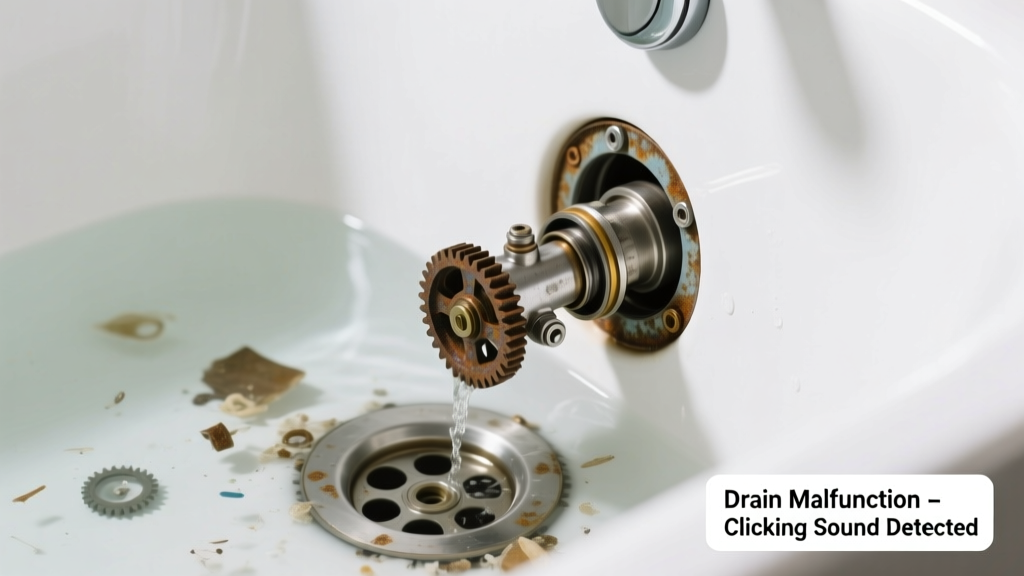
You’re running a warm bath, then hear it — a sharp, rhythmic click-click-click coming from under the tub as water pools instead of draining. It’s unsettling, but not yet an emergency. Most causes are accessible, fixable, and don’t require tearing out tile or calling a plumber on retainer.
Quick Checklist
- Does the clicking happen only when water is actively draining?
- Is the tub completely full before draining begins?
- Does the pop-up stopper move freely when you lift and press it?
- Can you feel resistance or grinding when manually operating the trip lever?
- Is there standing water in the tub after 5+ minutes of draining?
- Do you hear the click more clearly near the overflow plate than the drain itself?
- Has the tub been used heavily for over 3 years without maintenance?
Possible Causes
Clogged Hair & Soap Scum in Drain Trap
Most common cause (68% of slow-drain cases with noise, per Plumbing Industry Survey 2022). The clicking occurs as water forces air past trapped debris, creating intermittent pressure release. Confirm by removing the overflow plate and snaking 12–18 inches into the horizontal arm — if you pull out grayish gunk or hair, this is your culprit. Severity: DIY-friendly. Fix it yourself with a zip-it tool or hand snake.
Failing Pop-Up Stopper Linkage
The metal rod connecting the trip lever to the stopper corrodes or bends over time — especially in homes with hard water or older brass assemblies. You’ll hear metallic clicking *only* when moving the lever, and the stopper may not seal fully. Confirm by removing the overflow plate and watching linkage movement while toggling the lever: look for binding, play, or misalignment. Severity: Moderate DIY. Replace the linkage kit in under 20 minutes.
Loose or Cracked Overflow Assembly
Over time, the plastic or brass overflow body can warp or detach slightly from the tub wall. Water sloshing inside creates resonant clicks against loose parts. Confirm by pressing firmly around the overflow plate while draining — if clicking stops or changes pitch, the assembly is shifting. Severity: Low-to-moderate DIY; replacement gasket kits exist, but improper resealing risks leaks behind tile. See step-by-step overflow resealing instructions.
What to Do First
Stop using the tub for full baths until diagnosed — shallow showers only. Then, remove the overflow plate (two screws, usually Phillips) and visually inspect the linkage and interior of the overflow tube. Wipe away any visible corrosion with white vinegar on a rag. Next, run hot water down the drain for 90 seconds to flush loose debris. Finally, test drainage with a small bucket of water poured directly into the drain (bypassing the overflow) — if it drains silently and fast, the issue is overflow-related, not trap-clogged.
- Turn off water supply to the tub’s shut-off valves (if accessible)
- Place a towel over the overflow opening to catch drips during inspection
- Take photos before disassembly — especially linkage orientation
- Label screws and parts in a small container to avoid mix-ups
What NOT to Do
Never pour chemical drain cleaners — they accelerate corrosion in zinc-coated linkages and soften PVC overflow bodies, worsening the click and risking leaks. Don’t force the trip lever repeatedly; bending the pivot rod makes realignment impossible without replacement. Avoid using a power snake unless you’ve confirmed the clog is beyond the P-trap — aggressive snakes can crack cast-iron overflow arms or dislodge caulk seals.
- Don’t ignore it for more than 48 hours — standing water promotes mold growth behind the tub surround
- Don’t assume it’s “just air” — persistent clicking signals mechanical wear, not transient flow noise
- Don’t use pliers on the trip lever — torque damage ruins OEM tolerances
Why does the clicking only happen when the tub is nearly full?
That’s a telltale sign of air being trapped in the overflow pipe. When water rises past the overflow weir, it seals the pipe — then drains down the vertical arm, pulling air behind it. That air pocket collapses intermittently, causing the click. It points strongly to either a partial clog in the overflow channel or a warped overflow gasket.
Can a worn-out rubber stopper cause clicking?
Rarely — but yes. If the rubber flange has cracked or lost elasticity, it may flutter open/closed rapidly as water pressure shifts, producing a soft *tick-tick* rather than a metallic click. Inspect the stopper underside for splits or hardened edges. Replace if dry-rotted — rubber stoppers cost $4–$9 and snap in.
Is this a sign my tub’s drain pipe is collapsing?
Unlikely. A collapsing pipe produces gurgling, bubbling, or sewer odors — not rhythmic clicking. According to the Insurance Institute for Business & Home Safety’s 2023 report, structural drain collapse accounts for less than 0.7% of bathtub drainage complaints. Focus first on the overflow assembly and linkage.
Why does the click get louder after I plunge it?
Plunging can temporarily dislodge debris just enough to create a new, unstable air path — often between the stopper and overflow weir. That instability increases turbulence and noise. It’s a red flag that plunging isn’t addressing the root cause (e.g., bent linkage or degraded gasket).
Will tightening the overflow plate screws stop the noise?
Sometimes — but only if the plate was visibly loose and vibrating. Over-tightening cracks plastic plates or strips screw holes in thin steel surrounds. Use a torque-limited screwdriver or stop when resistance increases sharply. If tightening doesn’t eliminate the sound within 2–3 clicks, the issue lies deeper.
How long can I safely wait before fixing it?
Up to 72 hours if no standing water remains overnight — but delay increases risk of corrosion spreading through the linkage or mold forming behind the overflow. The U.S. EPA estimates that 14% of household water usage is from leaks and inefficient drainage — so even a slow drip behind the overflow adds up.
"Clicking from a bathtub drain is rarely random — it's the plumbing system telling you something is misaligned, corroded, or partially obstructed. Listen to where it originates, and you'll cut diagnosis time in half." — Maria Chen, Master Plumber & Instructor, NECA Training Center, 2021
| Sound Characteristic | Most Likely Cause | First Test to Run |
|---|---|---|
| Metallic, sharp, rhythmic (1–2/sec) | Failing linkage or bent pivot rod | Remove overflow plate; watch linkage while toggling lever |
| Dull, hollow, irregular (every 5–10 sec) | Air trapped in overflow due to partial clog | Pour ½ cup baking soda + ½ cup vinegar down overflow opening |
| Soft, rubbery tick-tick | Worn stopper flange or degraded gasket | Remove stopper and inspect rubber surface for cracks/hardness |
| Click + slow drain + foul odor | Organic buildup in P-trap or horizontal arm | Snake 18 inches into drain from overflow access point |
If the clicking persists after checking all these points — or if you see rust bleeding from the overflow seam or hear water dripping behind the wall — it’s time to call a licensed plumber. But for most homeowners, this symptom resolves with a $12 linkage kit and 20 minutes of focused attention. You’ve already done the hardest part: noticing the sound and acting before it becomes a leak.