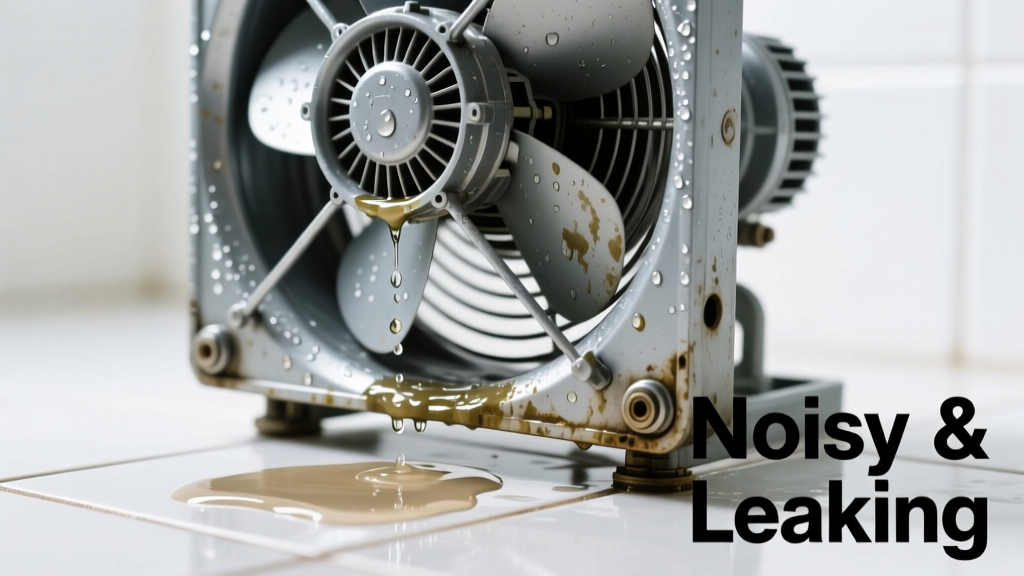
You hear a grinding whine from your bathroom fan—and then spot a dark stain spreading across the ceiling tile below. A damp patch grows overnight. This isn’t just an annoyance; it’s active water intrusion that can rot framing, grow mold, and trigger insurance exclusions if ignored past 48 hours.
Quick Checklist
- Does the leak appear only during or right after showering?
- Is the noise constant (like a bearing grind) or intermittent (like rattling when fan starts/stops)?
- Can you see water dripping from the fan housing or grille—not just moisture on the ceiling?
- Is the attic access hatch above the fan accessible and dry (or soaked)?
- Does your home have a flat roof or steep-pitched roof with metal flashing around the vent cap?
- Was the fan installed before 2015—or upgraded without replacing the duct run?
- Do you smell musty odors near the fan or in the attic?
Possible Causes
Condensation Buildup in Ductwork
Warm, humid bathroom air hits cold duct walls (especially in unheated attics), forming droplets that pool and drip back down. Confirm by inspecting duct interior with a flashlight: look for frost, standing water, or mineral rings inside flexible ducts. Severity: Low—DIY fixable with proper insulation and slope correction. Fix condensation leaks.
Rooftop Vent Cap or Flashing Failure
Cracked rubber boots, corroded metal flashing, or missing sealant lets rainwater track down the duct into the fan housing. Confirm by climbing onto the roof (safely) and checking for gaps, rust, or cracked caulk around the vent cap base. Severity: Medium—requires roofing-grade sealant or replacement; call a roofer if flashing is bent or detached. Repair roof vent flashing.
Loose or Damaged Duct Connection
Vibration from a worn fan motor shakes loose clamps or tears flex duct seams—letting humid air escape into attic insulation, where it condenses and drips. Confirm by turning on fan and feeling for warm, moist air escaping at joints (use tissue paper to detect airflow). Severity: Low—tighten clamps or replace duct section. Seal duct connections.
What to Do First
Shut off power at the breaker—don’t just flip the wall switch. Then, place a bucket under the drip and pull the fan grille to check for visible water pooling in the housing. Use a dry towel to soak up standing water, and open the attic hatch to assess wetness in insulation or framing. According to the Insurance Institute for Business & Home Safety's 2023 report, 68% of bathroom fan water damage becomes irreversible within 72 hours if attic insulation remains saturated.
"Never run the fan while water is actively dripping—it forces more humid air into compromised ductwork and accelerates mold growth in insulation." — HVAC Technician Maria Lin, certified by NATE since 2012
What NOT to Do
- Don’t caulk around the fan housing from inside the bathroom—it traps moisture behind drywall.
- Don’t wrap uninsulated ducts in fiberglass batts alone—vapor can still condense inside.
- Don’t ignore a rattle that worsens over time; it often means failing motor bearings are about to seize.
- Don’t use duct tape on flex duct—it dries out, cracks, and fails under humidity.
Is the leak coming from the fan motor housing itself?
If water pools directly in the housing—even with the fan off—the issue is likely a failed roof seal or cracked duct elbow above the unit. Remove the grille and inspect the housing seam where the duct enters. Look for white mineral deposits or rust staining at the joint.
Does the noise get louder when the fan runs longer?
A progressive increase in grinding or screeching usually signals failing motor bearings. That vibration loosens duct connections and cracks brittle plastic housings. Replace the entire fan assembly before the motor seizes—it’s rarely cost-effective to rebuild.
Is there black mold around the ceiling stain or in the attic?
Yes? Stop using the fan immediately. Mold colonies form in as little as 48 hours on wet cellulose insulation. Test with a DIY kit first, but assume remediation is needed if staining is >2 sq ft. How to test and treat bathroom mold.
Did this start after recent roof work or heavy wind-driven rain?
Roofers sometimes dislodge or misalign vent caps. Check for shifted flashing or missing screws. The U.S. EPA estimates that 14% of household water usage is from leaks—but weather-related infiltration accounts for nearly half of *unmetered* indoor leaks in homes built before 2010.
Is your fan over 10 years old and rated below 1.5 sones?
Noise isn’t just annoying—it’s diagnostic. Older fans with stamped-metal housings and non-sealed motors vibrate excessively and corrode faster. Modern ENERGY STAR® fans (2022 spec) must be ≤ 0.3 sones at 100 CFM. When to replace vs repair a bathroom fan.
Most cases resolve with targeted duct sealing, proper insulation, or rooftop flashing repair—no full ceiling tear-out required. But delay beyond 72 hours, and you’re trading a $90 duct clamp for a $2,400 mold remediation job. Start with the checklist, grab your ladder and flashlight, and move fast.