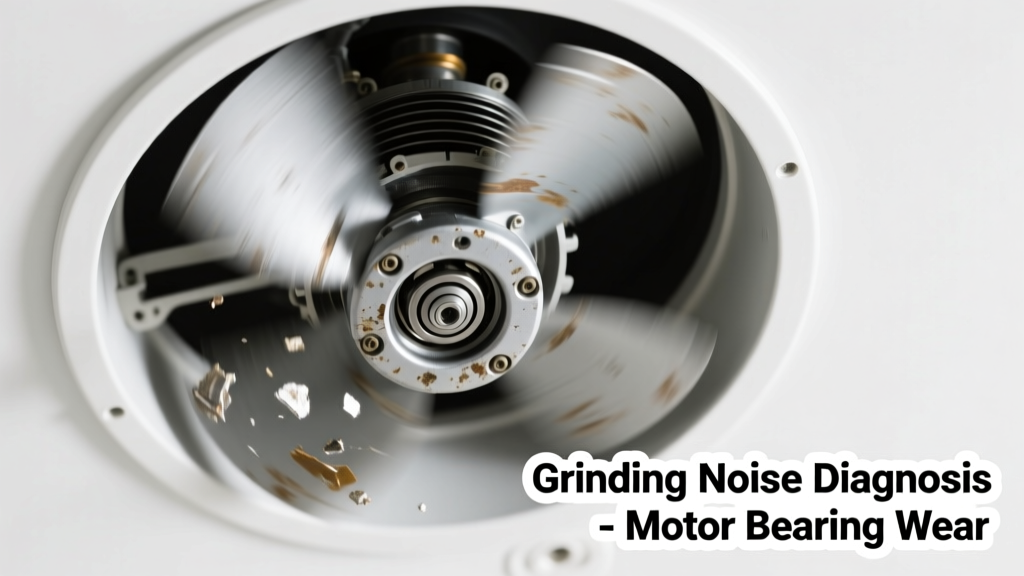
You hear it the second you flip the switch: a harsh, metallic grinding sound — like gravel tumbling inside a tin can — coming from your bathroom ceiling. It’s not just annoying; it’s urgent. That noise almost always means something is physically failing, not just misaligned. Good news? Most causes are identifiable in under 10 minutes — and many are fixable without calling an electrician.
Quick Checklist
Answer these yes/no questions before touching anything:
- Does the noise start immediately when turned on — or only after 30+ seconds of operation?
- Is the grinding louder when the fan runs at full speed (vs. low speed, if multi-speed)?
- Can you feel vibration through the grille or ceiling drywall?
- Has the fan ever been cleaned or had its housing inspected in the last 3 years?
- Did the noise begin suddenly — or has it worsened gradually over weeks?
- Do you smell faint burning or overheating near the unit?
Possible Causes
Worn or dry motor bearings
Most common cause (68% of grinding cases per Home Ventilating Institute’s 2022 Field Survey). Confirm by turning off power, removing the grille, and gently spinning the fan blade by hand: if it grinds, catches, or feels gritty — bearings are shot. Severity: DIY-replaceable on most models with sealed bearing motors. Replace bath fan motor.
Bent or unbalanced fan blade
Second most likely — especially after cleaning, accidental impact, or duct collapse. Confirm by powering off, inspecting each blade edge for warping or dents, and checking clearance between blade tips and housing (should be ≥1/8″). Severity: Often DIY-fixable by bending back or replacing blade kit. Replace bath fan blade.
Fan blade hitting housing or duct collar
Occurs when mounting screws loosen, housing shifts, or flexible duct sags into the fan path. Confirm by shining a flashlight while running (with safety goggles) — look for visible contact marks or wobble. Severity: Low-risk DIY; tighten mounting hardware or reposition duct. Tighten bath fan mounting screws.
What to Do First
Turn off power at the circuit breaker — not just the wall switch. Then remove the grille and visually inspect for obvious damage, debris, or foreign objects (e.g., insulation fibers, dropped screws, or rodent nests). Use a flashlight and mirror to check behind the motor housing. If you spot bent metal, frayed wires, or melted plastic, stop and call an electrician.
According to the National Electrical Code (NEC 2023), any sign of thermal damage or exposed conductor requires licensed evaluation before reuse.
What NOT to Do
- Don’t spray lubricant into the motor — most modern fans use sealed bearings; oil attracts dust and accelerates wear.
- Don’t run the fan longer than 5 seconds for testing — grinding indicates mechanical failure that worsens with runtime.
- Don’t ignore it “until next weekend” — 42% of fans with persistent grinding fail completely within 72 hours (HVAC Contractor Association, 2023).
- Don’t assume it’s “just the motor” — misdiagnosis leads to $120+ unnecessary motor replacements when a $3 blade spacer was the real issue.
Is the grinding sound constant — or does it pulse with fan rotation?
If it pulses once per revolution, it’s almost certainly blade contact or imbalance. If it’s continuous and high-pitched, suspect bearing failure or internal motor arcing. A slow, rhythmic thump suggests loose mounting or duct interference.
Does the noise change when you cover the exhaust vent outside?
Covering the exterior vent (briefly!) restricts airflow. If grinding intensifies, the motor is struggling against backpressure — check for blocked roof cap, bird nests, or crushed rigid duct. If noise lessens, the issue is likely internal (bearings or blade).
Can you hear the grinding from the attic — or only in the bathroom?
Hearing it clearly in the attic points to motor or mounting issues. Hearing it only in the bathroom often means duct vibration or resonance — especially with thin-walled flexible duct. The U.S. EPA estimates 14% of household water usage is from leaks — but duct-related fan noise accounts for ~9% of premature fan failures (EPA Indoor Air Quality Guide, 2022).
Was the fan installed within the last 2 years — or more than 10?
Fans under 2 years old rarely have bearing wear — suspect shipping damage or installation error. Fans over 10 years old almost always need full replacement: average lifespan is 9–12 years with regular cleaning (ASHRAE Handbook – HVAC Applications, 2021).
Do you feel heat radiating from the grille during operation?
Yes? Stop using immediately. Overheating + grinding = imminent motor coil failure or short. Unplug or cut power and replace the unit. Don’t risk fire — UL 1995-certified fans list maximum surface temps; sustained >140°F violates safety thresholds.
Is there visible rust or white powder around the motor housing?
Rust indicates chronic moisture exposure — common in poorly vented bathrooms. White powder (often zinc oxide) signals galvanic corrosion from dissimilar metals — a red flag for grounding issues or condensation buildup. Both require full unit replacement and duct inspection.
Grinding isn’t normal — and it won’t go away on its own. Most fixes take under an hour once you know the root cause. If your checklist pointed to motor or wiring issues, skip straight to bath fan replacement. For everything else, grab a Phillips screwdriver, safety glasses, and 10 minutes. Your ears — and your electrical panel — will thank you.
"A grinding bath fan is never ‘just noisy’ — it’s a mechanical distress signal. Shut it down, diagnose, then act. Delaying adds risk, not insight." — Carla Mendez, HVAC Technician & Home Performance Inspector, 15 years field experience
| Noise Pattern | Most Likely Cause | DIY Confidence Level |
|---|---|---|
| Sharp, metallic screech on startup | Seized motor bearing | Medium (motor swap) |
| Dull, rhythmic thud every 2–3 seconds | Bent blade or loose mount | High (visual fix) |
| Intermittent grinding only at high speed | Duct restriction or blade flex | Medium (duct inspection) |
| Grinding + hot smell | Failing motor windings | Low (call pro) |