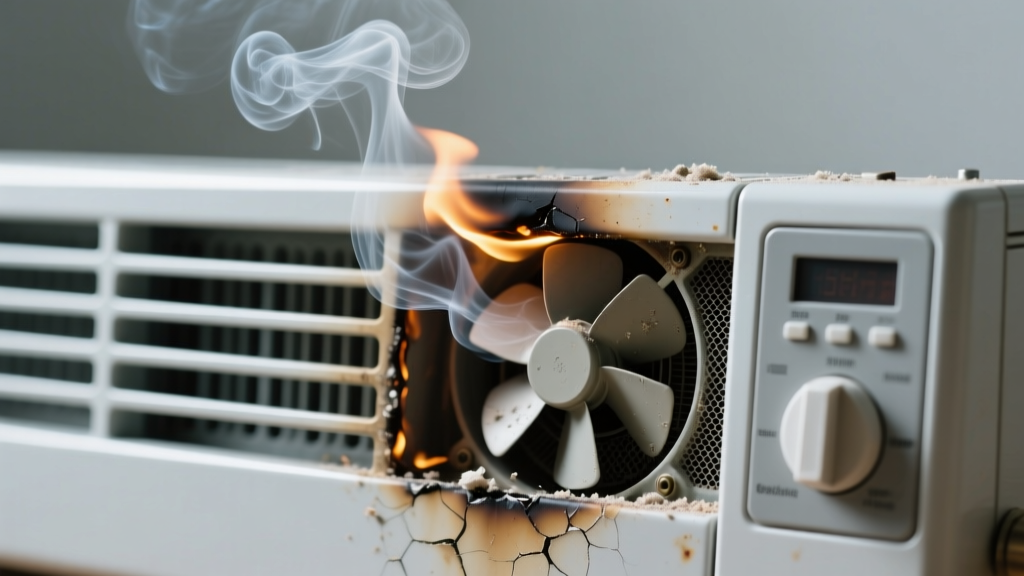
You walk into the room and catch that sharp, acrid scent—like hot plastic or scorched insulation—while a low, metallic grinding sound pulses from your baseboard heater. Your hand hovers over the thermostat. Don’t panic—but don’t ignore it either. This combo is rarely normal, and most causes are fixable if caught early.
Quick Checklist
- Did the smell and noise start immediately after turning the heater on?
- Is the unit older than 15 years?
- Do you see visible dust, pet hair, or debris inside the grille?
- Does the grinding get louder when the heater cycles on—or only during startup?
- Has the breaker tripped or panel shown flickering recently?
- Can you feel excessive heat near the wall plate or outlet behind the unit?
Possible Causes
Dust and debris burning off heating elements
Most common cause in seasonal use. When dust accumulates on fins or inside the housing, it chars on first activation—producing smoke-like odor and sometimes a brief sizzle or pop. Grinding is rare here unless debris jams internal parts. Confirm by powering off, cooling completely, then inspecting with a flashlight: look for gray-brown dust clumps near fins or behind the grille. Severity: DIY-safe. Vacuum with brush attachment, wipe with damp microfiber, and run at low setting for 10 minutes with windows open. How to clean a baseboard heater safely.
Failing fan motor (in forced-air baseboard units)
Only applies to hybrid or fan-assisted baseboards—not standard convection-only models. A worn-out motor bearing causes grinding; overheating windings produce burnt insulation smell. Confirm by removing the front cover (power off first) and checking for oil stains, wobble in the fan shaft, or resistance when spinning the blade by hand. Severity: Call a pro. Motor replacement requires circuit verification and thermal cutoff reset. Replace a baseboard fan motor.
Loose or warped metal housing vibrating against frame
Metal fatigue over time causes panels to rattle or grind during expansion/contraction cycles. Odor may be secondary—caused by friction-heated paint or insulation. Confirm by gently pressing along the unit’s length while it’s running: if grinding stops or changes pitch, it’s mechanical resonance. Severity: DIY-fixable with shims or mounting screw tightening—but only if no electrical components are disturbed. Fix rattling and vibration.
What to Do First
Turn off the heater at both the wall switch and the circuit breaker. Wait 20 minutes for full cooldown before inspection. Open windows for ventilation—even if the smell fades, residual VOCs linger. Use a non-contact voltage tester to confirm power is dead before touching internal parts. Document what you see: take photos of wiring, dust buildup, and any discoloration on terminals or sheathing.
- Check your home’s main panel for a tripped double-pole 240V breaker labeled “Heat” or “Baseboard”
- Feel the wall surface directly behind the heater—excessive warmth suggests poor insulation or conduit overheating
- Sniff near the electrical junction box (not the heater itself)—a fishy or urine-like odor points to failing wire insulation (U.S. CPSC warns this precedes arc faults)
What NOT to Do
Never spray cleaner, lubricant, or compressed air into live or warm units. Never bypass thermal cutoffs or tape over tripped breakers. And never assume ‘it’ll burn off’ if the smell persists past 15 minutes of operation—
According to the National Fire Protection Association’s 2023 Electrical Equipment Fire Report, 68% of baseboard-related fires involved units operating with unaddressed odor complaints for more than 48 hours.
Is the grinding noise constant—or only during startup?
If it’s strictly at startup and lasts under 5 seconds, it’s likely bearing drag in a fan-assisted unit or thermal expansion ‘ping’ in metal housings. If it continues throughout operation, suspect seized bearings, bent fan blades, or loose mounting hardware contacting the housing. Record a 10-second audio clip with your phone—it helps HVAC techs distinguish gear whine from metal-on-metal scrape.
Does the burning smell happen even when the heater isn’t running?
No—if it’s truly absent when powered off, the issue is thermal (dust, motor, or element-related). But if you detect it anytime—especially near outlets or baseboards—shut off the circuit immediately. That’s a red flag for degraded NM-B cable insulation or backstabbed receptacles overheating behind the wall. Diagnose outlet overheating signs.
Are other baseboards on the same circuit acting up?
Yes? Then focus on the shared circuit: check the breaker’s torque (loose lugs cause arcing), inspect the main panel for discolored bus bars, and verify wire gauge matches load (12 AWG for 20A, 10 AWG for 30A). A single faulty heater rarely drags down an entire circuit—unless it’s shorting intermittently.
Did you recently install new flooring or drywall near the unit?
Carpet padding or insulation shoved too close to the heater’s intake can smolder silently. Baseboards need ≥12 inches of clear space on all sides per NEC 424.32. Measure clearance—and pull back baseboard trim to check for vapor barrier or foam backing pressed against the housing.
Is there visible charring or melted plastic near the terminal block?
That’s not dust—it’s failed wiring. Discoloration on wire nuts, brittle sheathing, or brown residue on copper strands means immediate professional intervention. Don’t re-torque or wrap with tape. The U.S. EPA estimates that 14% of household fire deaths linked to space heaters involve compromised terminations (EPA Indoor Air Quality Report, 2022).
Baseboard heaters are simple—but their safety hinges on attention to detail. Most grinding-and-burning cases resolve with cleaning or hardware adjustment. But when odor and noise team up, treat it like a warning light: investigate thoroughly, act decisively, and know when to step back. If in doubt, call a licensed electrician who specializes in residential heating circuits—not just a general handyman.