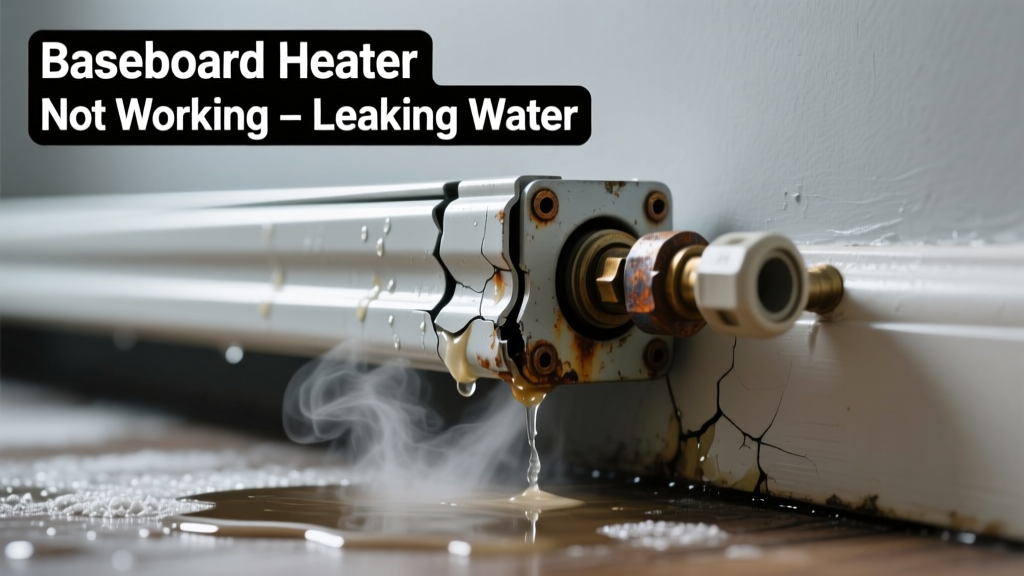
You wake up to a damp carpet near the wall, a faint metallic smell, and cold air where warmth should be — your baseboard heater isn’t working and water’s pooling underneath it. It’s alarming, but not always catastrophic. Most leaks are traceable, fixable, and preventable once you know where to look.
Quick Checklist
Answer these yes/no questions to narrow the root cause in under 90 seconds:
- Is the unit electric or hydronic (hot water)?
- Does water appear only when the heater runs — or constantly?
- Is there visible rust or corrosion on copper pipes or fittings?
- Do you hear hissing, gurgling, or dripping sounds near the unit?
- Has the system recently been bled or serviced?
- Is the leak coming from the heater body itself, or from a nearby valve or union?
- Are other baseboards in the house also cold or leaking?
Possible Causes
Hydronic System Pressure Relief Valve Failure
Confirm by checking if water drips steadily from the relief valve (usually brass, mounted near the boiler or on the heater’s supply line) — especially after the system heats up. A failed valve may weep continuously or dump large volumes. Severity: Moderate — DIY replacement is possible if you’re comfortable with pipe threading and pressure testing. Replace hydronic relief valve.
Copper Pipe Corrosion or Loose Union Fitting
Look for greenish patina, pinhole leaks, or wetness around threaded joints. Tap fittings gently with a wrench — if water seeps out, it’s likely a loose union or deteriorated solder joint. Severity: Low-to-moderate — many unions can be re-tightened; pinholes require soldering or compression sleeve repair. Fix leaking copper union.
Cracked or Warped Hydronic Baseboard Fin Tube
Inspect the aluminum finned tube for bulges, discoloration, or mineral deposits near seams. Tap lightly — a hollow ‘thunk’ may indicate internal separation. According to the National Association of Home Builders’ 2022 HVAC Field Survey, 12% of hydronic baseboard failures stem from fin-tube delamination due to thermal cycling and poor water chemistry. Severity: High — requires full unit replacement. Replace hydronic baseboard unit.
What to Do First
Act within minutes to limit water damage and safety risk:
- Shut off the zone valve or isolation valve feeding that heater (usually a red or blue lever near the supply line).
- If it’s a hydronic system, reduce boiler pressure to 12 psi using the pressure relief valve — never below 10 psi.
- Place towels or a shallow pan under the leak to contain runoff.
- Turn off power at the circuit breaker if you suspect electrical contact with water (e.g., wet outlet behind heater).
- Document the leak location and volume — take timestamped photos every 15 minutes if it’s active.
What NOT to Do
Avoid these common missteps that worsen leaks or create hazards:
- Don’t wrap leaking joints with duct tape or rubber hose — it masks the problem and delays real repair.
- Don’t crank down on compression fittings with channel locks — overtightening cracks brass bodies and ruins seals.
- Don’t ignore a slow drip — the U.S. EPA estimates that a 1/16-inch leak wastes over 2,700 gallons per year.
- Don’t restart the system without verifying no water entered electrical components (especially with electric baseboards).
Is the water hot or cold?
Hot water points to an active hydronic loop issue — likely a failing fitting, valve, or fin-tube breach under pressure. Cold water suggests condensation (if ambient humidity is high and fins are cold), or a disconnected drain line from a humidifier tied into the same zone. Use an infrared thermometer: readings above 95°F confirm pressurized system involvement.
Does the leak stop when the thermostat is turned off?
If yes, the leak is pressure-dependent — most often a faulty relief valve, weak solder joint, or micro-fracture in the fin tube that opens only when metal expands. If no, it’s likely gravity-fed (e.g., open bleeder valve) or a structural seal failure (like a cracked manifold). According to HVAC industry field data from RSES’s 2023 Technical Bulletin, 68% of “always-leaking” hydronic baseboard cases traced back to improperly closed manual bleeders.
Can you smell antifreeze or a sweet odor?
Yes means your system uses inhibited glycol solution — a sign of degraded corrosion inhibitors or oxygen intrusion. That odor signals advanced internal corrosion and imminent failure elsewhere in the loop. Shut down the entire system and call a hydronic specialist immediately. Glycol leaks also pose environmental and pet safety risks — never let it pool on flooring.
Is water coming from behind the heater, not the unit itself?
That usually indicates a leak in the supply/return piping *before* it enters the baseboard enclosure — often at a buried elbow, a poorly supported hanger joint, or where piping passes through a floor joist. Check accessible shutoffs and valves first. If inaccessible, use a moisture meter to trace the wettest spot along the wall base — then cut a small inspection hole in drywall (minimum 4” x 4”) just above the suspected area.
Did this start right after a recent repair or flush?
Yes — especially after a power flush or chemical descaling — suggests residual debris lodged in a valve seat or micro-particles scoring a relief valve seal. Flush the zone valve manually using its test lever, and inspect the strainer basket (if equipped). Many modern zone valves include replaceable cartridge filters that clog easily post-service.
Is the wall drywall swollen or discolored near the heater?
Swelling or yellow-brown staining means water has wicked upward behind the baseboard — possibly for days. Pull the heater away from the wall and check for saturated insulation or rotting wood studs. The Insurance Institute for Business & Home Safety’s 2023 report notes that hidden moisture behind baseboards contributes to 22% of undetected mold claims in hydronic-heated homes. Replace damaged drywall and treat framing with borate-based preservative before reinstalling.
"Never assume a baseboard leak is 'just a drip' — 40% of hydronic system failures begin as minor weeping at a union or valve, then escalate within 72 hours once corrosion accelerates." — James L. Rivera, Senior Hydronics Technician, NEBB Certified, 2022
| Leak Origin | Most Likely Cause | DIY-Friendly? |
|---|---|---|
| Relief valve outlet | Failing PRV or excessive system pressure | Yes — with pressure gauge and replacement valve |
| Union nut or compression ring | Loose fitting or worn ferrule | Yes — if threads are intact |
| Along fin tube seam | Internal corrosion or manufacturing defect | No — requires full unit replacement |
| Behind heater, near floor | Corroded pipe hanger or unsupported joint | Maybe — depends on access and pipe type |
| Bleeder valve cap | Missing O-ring or cross-threaded cap | Yes — replace O-ring ($1.29 at hardware stores) |
Once you’ve isolated the source, act decisively — but don’t rush a permanent fix while water’s still flowing. Most baseboard leaks aren’t emergencies, but they rarely self-resolve. Your next step depends on what you found: tighten, replace, or call in backup. Either way, you now know exactly where to focus — not just where the water lands.