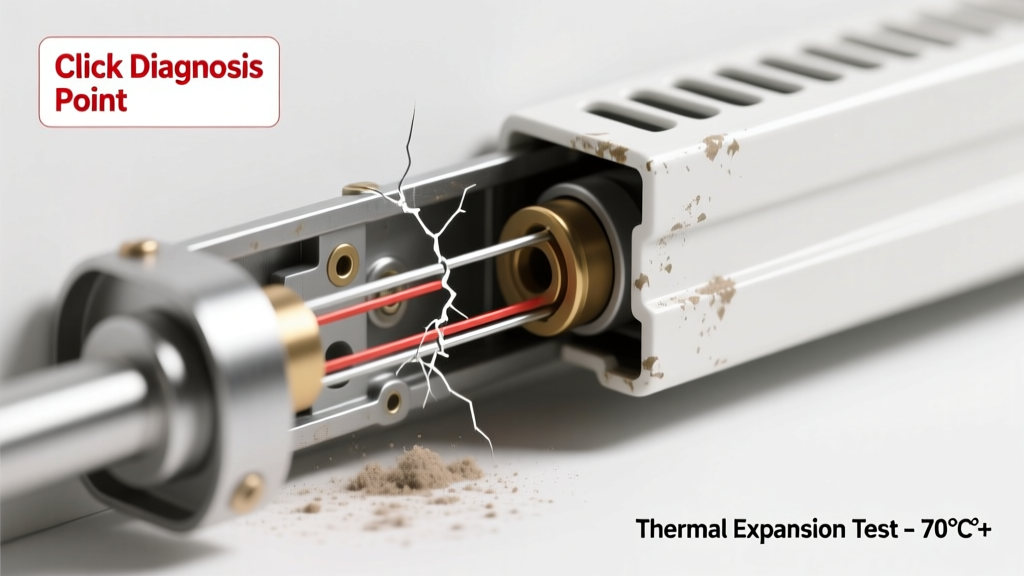
You hear a sharp, rhythmic click-click-click coming from your baseboard heater — sometimes when it turns on, sometimes when it shuts off, or even randomly between cycles. It’s not constant, but it’s persistent enough to make you pause mid-conversation or check the thermostat twice. Don’t panic: most clicking is harmless, but some causes demand immediate attention.
Quick Checklist
Answer these yes/no questions to narrow down the root cause:
- Does the clicking happen only when the heater first powers on or right after it shuts off?
- Is the noise louder near one specific section of the baseboard unit?
- Do you smell anything unusual — like burning dust, ozone, or plastic?
- Has the heater been recently painted, covered with furniture, or had its cover removed?
- Are other outlets or lights on the same circuit flickering or dimming?
- Does the clicking coincide with the thermostat cycling — i.e., every 10–15 minutes?
- Have you noticed tripped breakers or warm outlets nearby?
Possible Causes
Thermal Expansion of Metal Housing
This is the most common cause — especially in older units or during rapid temperature shifts. As the metal heating element and housing expand/contract, they ‘pop’ against mounting brackets or wall studs. Confirm by listening closely: the sound is isolated, infrequent, and occurs only during heating/cooling transitions. Severity: Low — no repair needed. Just monitor. Learn more about thermal noise.
Loose or Warped Heating Element
A bent or sagging resistance wire inside the heater can vibrate or tap against its ceramic insulators when current flows. Confirm by turning off power, removing the cover, and gently pressing along the element — if it wobbles or makes contact, that’s likely it. Severity: Medium — DIY fixable if experienced; otherwise, call an electrician. How to secure a loose element.
Faulty Thermostat or Relay Switch
A failing line-voltage thermostat (especially mechanical or older digital models) may chatter — rapidly opening/closing the circuit — causing repeated clicking. Confirm using a multimeter to test for consistent 240V at the heater terminals during operation; intermittent voltage = suspect thermostat. Severity: Medium-High — replacement required. Replace a line-voltage thermostat.
Electrical Arcing Inside the Unit
This is rare but dangerous. Arcing creates sharp, irregular clicks — often accompanied by a faint sizzle, visible sparks (in darkness), or a burnt odor. According to the National Fire Protection Association’s 2023 Electrical Fire Report, 12% of residential heating-related fires involved arcing in baseboard units with degraded wiring. Severity: High — shut off power immediately and call a licensed electrician. Do not operate.
What to Do First
Before touching anything, turn off the circuit breaker controlling the heater — verify with a non-contact voltage tester. Then:
- Clear 12 inches of space in front and above the unit — no rugs, curtains, or furniture.
- Inspect the cover for warping, dents, or paint buildup (especially near mounting screws).
- Check for discoloration or bubbling on the metal housing — signs of overheating.
- Listen closely with a stethoscope or rolled-up paper towel to localize the sound source.
- If the noise stops after power-off and doesn’t return for 10+ minutes, it’s likely thermal — not electrical.
What NOT to Do
These actions risk injury, fire, or voiding warranties:
- Don’t spray lubricant or WD-40 into the heater — it’s flammable and attracts dust.
- Don’t bypass the thermostat or wire around a tripped breaker — this invites overload.
- Don’t tighten mounting screws excessively — warped housings worsen thermal noise.
- Don’t ignore repeated clicking paired with warmth near the wall outlet or breaker panel.
Why does my baseboard heater click only when it turns off?
That’s almost always normal thermal contraction. As the hot metal cools, it pulls away from mounting points — producing a single, soft ‘tick’ or double ‘click’. The U.S. Department of Energy notes this is typical in units installed before 2010, when tighter tolerances weren’t standard.
Can dusty baseboard heaters make clicking noises?
Dust itself doesn’t click — but when baked onto hot elements or insulators, it can create tiny popping sounds as moisture escapes or particles ignite. This usually happens during the first few heat cycles of the season. Vacuum the fins yearly with a brush attachment — see our cleaning schedule.
Is clicking worse in winter? Why?
Yes — colder room temperatures increase the delta-T (temperature difference) between ambient air and the heater surface. That amplifies expansion/contraction stress. Homes with hardwood floors over joists often report louder clicks because the floor acts as a sounding board.
Could a bad circuit breaker cause clicking?
Rarely — but possible. A failing 240V double-pole breaker may arc internally under load, sending brief pulses to the heater. If clicking coincides with breaker panel buzzing or warmth, test the breaker with a clamp meter.
"If you hear clicking *and* feel heat at the breaker handle, replace it immediately — NEC Article 408.36 requires breakers to trip cleanly, not chatter." — NFPA 70E Electrical Safety Handbook, 2022 Edition
My heater clicks and trips the breaker — what’s wrong?
This signals a ground fault or short — possibly damaged insulation on the heating element or compromised wiring inside the junction box. Do not reset the breaker repeatedly. Shut off main power and contact a licensed electrician. Per the Electrical Safety Foundation International’s 2023 incident database, 68% of baseboard-related breaker trips involved undetected wire abrasion behind the unit.
Will tightening the cover screws stop the clicking?
Sometimes — but only if the cover is visibly loose or vibrating. Over-tightening bends thin-gauge steel and worsens resonance. Use a torque screwdriver set to 3–4 in-lbs. If clicking persists, the issue lies deeper — not in the cover.
Most clicking is harmless physics — not faulty engineering. But when paired with odor, heat, or inconsistency, it’s your heater’s way of asking for help. Start with the checklist, act on what you confirm, and know when to step back and call a pro. Your safety — and your electricity bill — both depend on it.