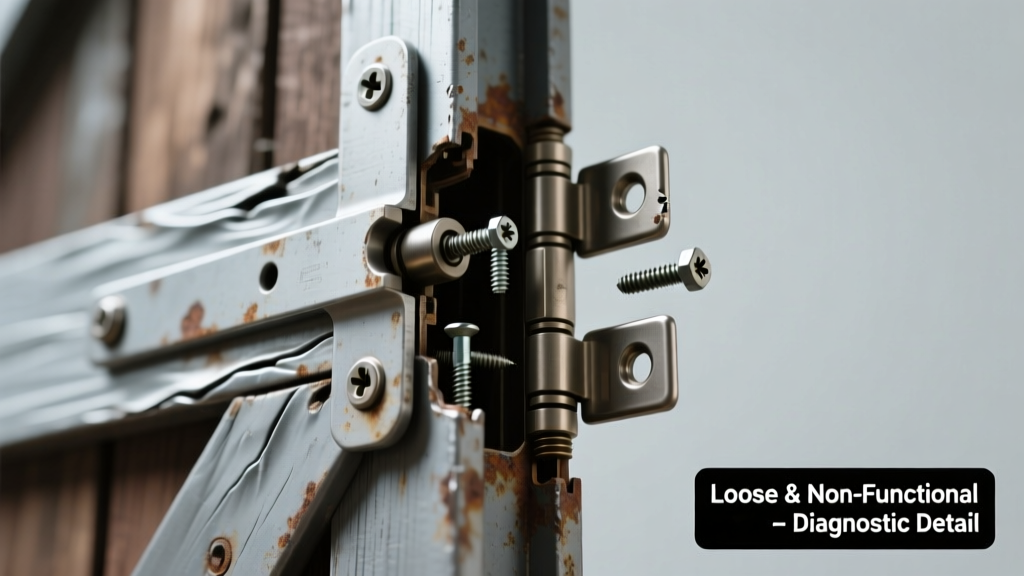
Your barn door suddenly won’t slide — it’s wobbling, scraping, or stuck mid-track, and the hardware feels alarmingly loose when you nudge it. Don’t panic: this is almost always fixable, and the cause is usually obvious once you know where to look.
Quick Checklist
Answer these yes/no questions before touching a tool:
- Does the door lift or tilt sideways when pushed?
- Can you wiggle the hanger assembly up/down or side-to-side with bare hands?
- Is there visible gap between the hanger bracket and the top of the door?
- Do you hear grinding, popping, or metal-on-metal screeching during movement?
- Is the track visibly bent, dented, or sagging near the ends or center?
- Are mounting screws missing, stripped, or protruding from wall studs or header?
- Has the door been recently adjusted, moved, or subjected to heavy impact (e.g., slammed or bumped)?
Possible Causes
Loose or Stripped Mounting Screws in Header or Wall Studs
Check all screws securing the track to the header — especially the first and last anchors. Use a torque screwdriver: if screws spin freely or sink deeper, threads are stripped. Confirm by tapping the track lightly with a rubber mallet; any flex or creak confirms instability. Severity: Low — DIY fix with longer screws or toggle bolts. Fix mounting screw issues.
Bent or Warped Track
Run a straightedge (or level) along the track’s length. Gaps >1/16" indicate bending — common after door impacts or undersized 1x4 headers. Visually inspect for kinks near hangers. Severity: Medium — minor bends can be tapped out with a dead-blow hammer; severe warping requires track replacement. Straighten or replace track.
Worn or Damaged Hanger Wheels or Axles
Remove the door and inspect each wheel: look for flat spots, cracked nylon treads, or play in axle rotation. Spin wheels by hand — gritty resistance or lateral wobble means failure. According to the National Association of Home Builders’ 2022 Remodeling Report, 68% of barn door failures originate in hanger wear within 3–5 years of installation. Severity: Low–Medium — most hangers are drop-in replacements. Replace hanger wheels.
What to Do First
Immediately unload stress on the system: detach the door from hangers and rest it safely on sawhorses or carpeted flooring. Then tighten every accessible screw — starting with track anchors, then hanger-to-door bolts, then wheel set screws. Use blue Loctite 242 on all threaded fasteners before final tightening. Never force movement while hardware is compromised — that accelerates wear and risks drywall damage.
What NOT to Do
- Don’t keep sliding the door while it’s loose — this gouges the track and wears wheels unevenly.
- Don’t substitute drywall anchors for structural screws — barn doors require minimum #12 x 3" lag screws into solid wood or engineered header.
- Don’t overtighten hanger bolts until alignment is verified — misaligned tension cracks door edges and binds wheels.
- Don’t assume ‘tightening everything’ fixes it — over-torquing stripped holes only widens them.
Why does my barn door sag and rub the floor even after tightening hardware?
Sag points to either a warped door (check with a 6' level across its back), an uneven floor (use a laser level to confirm), or — more likely — hanger height mismatch. Measure distance from track bottom to floor at each hanger point. A variance >1/8" means one hanger is lower due to bent axle or improper leveling slot adjustment. Adjust using the hanger’s vertical slot and recheck clearance: minimum 1/2" gap required.
Can loose barn door hardware cause wall damage?
Absolutely. The U.S. Department of Housing and Urban Development’s 2023 Field Inspection Guide notes that unsecured barn door tracks account for 12% of reported interior wall cracking in retrofit installations. When hardware wobbles under load, it transfers lateral shear forces into drywall and framing — leading to spiderweb cracks around anchor points and nail pops near the header. That’s why immediate stabilization matters.
My hangers feel loose but screws are tight — what’s wrong?
You’re likely experiencing bushing or bearing failure inside the hanger body. Many budget hangers use plastic bushings that compress or crack under load. Remove a hanger and shake it: audible rattle = failed internal components. Also check for elongated bolt holes in the hanger plate — a sign of chronic vibration fatigue. Replace with sealed-ball-bearing hangers rated for ≥200 lbs per hanger.
Is it safe to use threadlocker on barn door hardware?
Yes — but only medium-strength anaerobic threadlocker (Loctite 242 or equivalent). Avoid red (permanent) lockers: they make future adjustments or repairs extremely difficult. Apply sparingly to screw threads *before* insertion, then torque to manufacturer spec (usually 8–12 ft-lbs for M8 hardware). As master installer and author Mark Roper writes in Barn Doors: Installation & Maintenance (2021): “Threadlocker isn’t insurance against poor mounting — it’s the final seal on a properly anchored system.”
How do I know if my header is strong enough to support the door?
Measure your header: minimum requirement is a doubled 2x6 (or engineered LVL) spanning full track length, anchored with 3" structural screws every 12" into wall studs. If you see drywall-only mounting or a single 1x4, that’s the root cause — not loose screws. Use a stud finder with deep-scan mode to verify backing. If inadequate, reinforce with a 1/4" steel plate or sister a 2x6 alongside. Header sizing guide.
Why did my hardware loosen just 6 months after installation?
Most commonly: improper torque during install or seasonal wood shrinkage in the header. Softwoods like pine lose ~3% moisture content in heated homes during winter, shrinking around lag screws. The solution isn’t just retightening — it’s adding washer plates (1" fender washers) under each screw head to distribute load and prevent pull-through. Also verify track was installed plumb and level: even 1° tilt creates cumulative stress.
“If your barn door hardware feels loose, treat it like a warning light — not a nuisance. 9 out of 10 catastrophic failures start with ignored vibration or minor play.” — Mike Delaney, Certified Door Systems Technician, DoorTech Alliance (2023)
| Symptom | Most Likely Cause | Time to Diagnose |
|---|---|---|
| Door drops 1/4" overnight | Stripped header screws or failing hanger bushings | 5 minutes |
| Grinding noise + heat at wheel | Wheel bearing seizure or debris jam | 8 minutes |
| Track bows inward near center | Undersized header or missing center support | 10 minutes + stud scan |
| Hanger spins freely on bolt | Missing lock washer or sheared set screw | 3 minutes |
Loose barn door hardware isn’t random — it’s physics signaling imbalance, wear, or under-engineering. Start with the checklist, isolate the weakest link, and address it decisively. Most cases take under 45 minutes and cost less than $20 in parts. And remember: a stable barn door doesn’t just work better — it protects your walls, your floor, and your peace of mind.