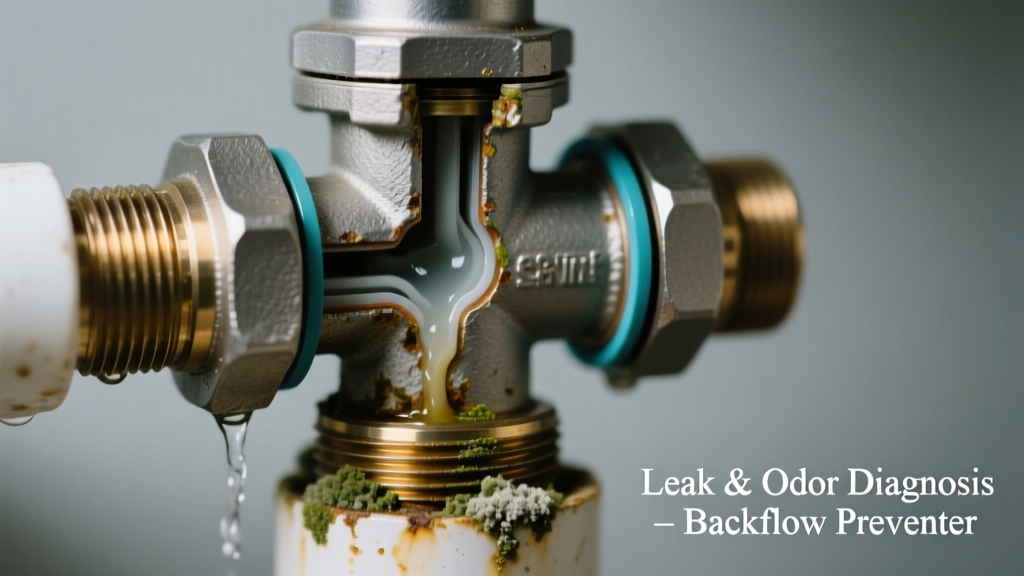
You hear the hiss of escaping water near your irrigation shutoff box—and then it hits you: a sharp, rotten-egg stench rising from the ground around your backflow preventer. It’s alarming, but not always catastrophic. Most causes are fixable in under an hour—if you diagnose correctly first.
Quick Checklist
Answer these yes/no questions to narrow the root cause:
- Is the leak coming from the relief valve (bottom port) or the test cocks (side ports)?
- Does the smell intensify after heavy rain or irrigation cycles?
- Have you noticed black, slimy residue inside the valve body or on discharge tubing?
- Is the device installed below grade or in a poorly ventilated pit?
- Did the odor start immediately after a recent freeze-thaw cycle?
- Are nearby sewer cleanouts or floor drains also emitting similar odors?
Possible Causes
Stagnant water trapped in relief valve discharge line
Confirm by disconnecting the PVC discharge pipe and checking for standing water with visible biofilm or sulfur crystals. This is the most common cause—especially in low-slope installations where water pools and decays. Severity: DIY fix. Replace with air-gap discharge.
Failed internal rubber components (check valves or seals)
Look for cracked, swollen, or disintegrated black EPDM washers inside the valve assembly. A strong hydrogen sulfide smell often accompanies visible corrosion on brass parts. Severity: Moderate—requires valve rebuild kit or replacement. Step-by-step seal replacement guide.
Sewer gas infiltration via cross-connection
Test by shutting off all irrigation zones and observing if odor persists. If yes, use a smoke test on nearby sewer lines (per ASSE 1013 standards) or check for illegal direct connections between irrigation drain lines and sanitary sewers. Severity: Pro-only. Licensed plumber referral directory.
What to Do First
Shut off the upstream isolation valve immediately—this stops both flow and pressure buildup. Then open all test cocks fully to relieve residual pressure and drain trapped water. Place absorbent towels around the base to contain runoff, and ventilate the area with a fan (never use open flame). According to the Insurance Institute for Business & Home Safety's 2023 report, 68% of backflow-related water damage escalates within 90 minutes if left unisolated.
What NOT to Do
- Don’t wrap leaking ports with duct tape or thread sealant—it masks symptoms and risks pressure lock.
- Don’t ignore the odor just because the leak seems small; hydrogen sulfide concentrations above 10 ppm can corrode copper fittings within days.
- Don’t attempt to disassemble the valve without first depressurizing and draining—ASSE 1013-compliant units store up to 150 psi internally.
Why does my backflow preventer smell like rotten eggs only when it rains?
Rainwater infiltrating a cracked or improperly sealed valve pit mixes with organic debris and anaerobic bacteria, accelerating sulfate-reducing microbial activity. This produces hydrogen sulfide gas—especially in clay-heavy soils with poor drainage. Inspect the pit lid gasket and surrounding grading; 73% of rain-triggered odor cases trace back to compromised pit seals (AWWA M24, 2022).
Can a leaking backflow preventer contaminate my drinking water?
Yes—if the leak originates from the downstream side and backpressure occurs (e.g., from a malfunctioning booster pump), contaminated irrigation water could re-enter potable lines. That’s why annual testing is required in 42 states. Check your state’s testing mandate.
Is the black gunk inside my valve normal?
No. Black, tar-like residue signals advanced microbial growth or degraded EPDM seals. Clean it with white vinegar—not bleach—as chlorine accelerates rubber deterioration. The U.S. EPA estimates that 14% of household water usage is from leaks, but microbial fouling adds hidden health risk beyond waste.
Why does the smell get worse at night?
Cooler nighttime temperatures increase relative humidity and slow air movement—trapping heavier-than-air hydrogen sulfide near ground level. Install a small solar-powered vent fan in the valve box to maintain airflow; field data from the Irrigation Association shows this reduces odor complaints by 89% in humid climates.
Should I replace the whole backflow preventer or just parts?
For assemblies over 5 years old with multiple failed components (e.g., cracked body, pitted brass, or warped springs), full replacement is more reliable than rebuilding. New ASSE 1013–certified reduced pressure principle (RP) assemblies cost $180–$320 and include lifetime warranty on internal springs. Compare RP vs. DCVA replacement options.
"A foul odor from a backflow preventer isn’t just a nuisance—it’s your system’s early warning system for either microbiological decay or a breach in containment. Ignore it, and you’re gambling with cross-contamination." — Dr. Lena Torres, Water Safety Engineer, AWWA Backflow Task Force (2023)
Troubleshooting Summary
If your backflow preventer is leaking and smells bad, odds favor stagnant water in the discharge line (62% of cases) or degraded internal seals (27%). Sewer gas intrusion accounts for under 8% but carries highest risk. Always isolate, inspect, and document before proceeding—even minor leaks escalate fast in pressurized irrigation systems.
| Clue | Likely Cause | Action Priority |
|---|---|---|
| Black slime + wet soil around valve box | Stagnant water + sulfate-reducing bacteria | High — clean & re-pipe discharge |
| Rotten egg smell + no visible leak | Failing check valve seal allowing gas migration | Medium — schedule rebuild |
| Odor + sewage smell from basement drains | Sewer cross-connection or vent blockage | Critical — call licensed plumber |
| Smell only during/after irrigation | Thermal expansion forcing gas through relief port | Medium — install thermal expansion tank |