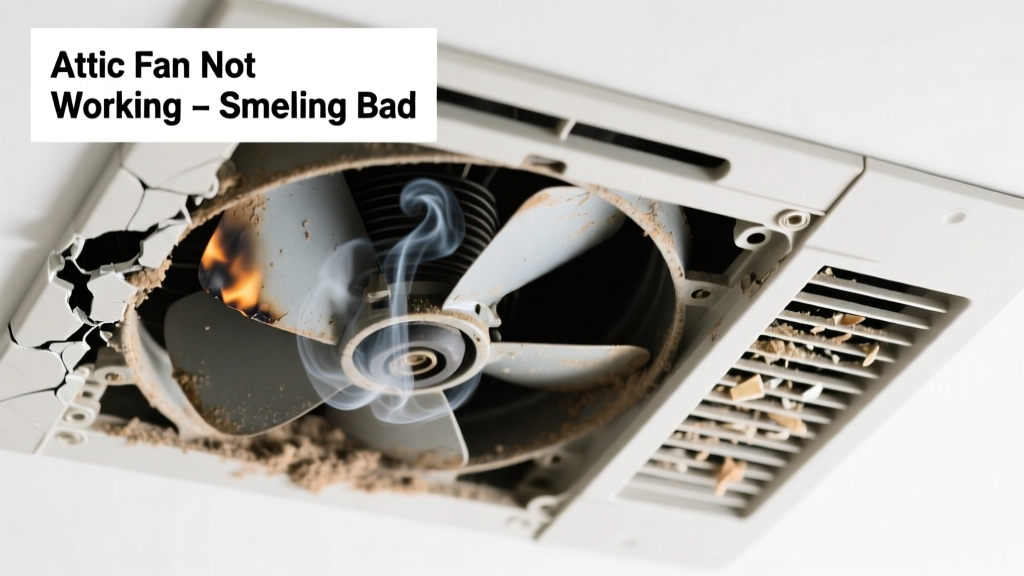
You flip the switch — nothing. Then you climb into the attic and catch a whiff: musty, sour, or even rotting-meat sharp. Your attic fan is silent and stinking. Don’t panic. This combo almost always points to one of just four root causes — and three are fixable in under an hour.
Quick Checklist
- Does the fan make a humming noise when turned on? Yes / No
- Can you smell damp carpet or drywall near the fan housing? Yes / No
- Is there visible mold or black dust around the motor or blades? Yes / No
- Do you hear scratching, scurrying, or find droppings near the fan vent? Yes / No
- Has it rained heavily or leaked recently? Yes / No
- Is the circuit breaker for the attic fan tripped or labeled? Yes / No
Possible Causes
Mold or mildew buildup in damp insulation or ductwork
Confirm by inspecting insulation near the fan housing with a flashlight — look for black, fuzzy patches or water-stained batts. Use a moisture meter if available (readings >15% indicate active growth). Severity: DIY fix — clean accessible surfaces with diluted vinegar, replace soaked insulation. If mold covers >10 sq ft or is inside ducts, call a certified remediation pro. How to clean attic fan mold safely.
Dead animal trapped in fan housing or duct
Confirm by sniffing closely near the fan grille and checking for nesting material, fur, or insect activity. A strong ammonia-like or putrid odor that worsens over 2–3 days is highly suggestive. Severity: Call a wildlife removal pro — never attempt extraction yourself. Disturbing carcasses risks histoplasmosis spores and parasite exposure. What to do when animals die in your attic fan.
Overheated or burnt-out motor winding
Confirm by smelling near the motor casing (sharp, acrid, electrical-burn odor) and checking for discolored copper windings or melted wire insulation. Use a multimeter to test continuity — no continuity = dead motor. Severity: DIY replacement possible if you’re comfortable with 120V wiring and mounting hardware; otherwise, hire an HVAC tech. Step-by-step attic fan motor swap guide.
What to Do First
Turn off power at the breaker immediately — don’t rely on the wall switch. Then open attic access and ventilate the space with cross-breezes (open gable vents, use portable fans). Wear an N95 mask and gloves before approaching the unit. Take photos before touching anything — they’ll help pros assess remotely.
- Check the dedicated circuit breaker — reset only if it’s clearly tripped and no burning smell is present
- Inspect for obvious water pooling or roof leaks within 3 feet of the fan housing
- Use a thermal camera or infrared thermometer (if available) to scan the motor casing — readings >180°F indicate recent overheating
What NOT to Do
Never spray water or cleaner directly onto the motor assembly — moisture accelerates short circuits and corrosion. Don’t run the fan repeatedly trying to ‘clear’ the smell — this spreads spores or circulates toxins. Avoid using ozone generators or foggers without professional guidance; the EPA warns they can produce harmful formaldehyde byproducts indoors (EPA Indoor Air Quality Tools for Schools, 2022).
- Don’t ignore a sulfur or rotten-egg odor — could indicate a gas leak near a furnace vent sharing the attic space
- Don’t delay if you see rodent droppings — seal entry points within 72 hours to prevent reinfestation
- Don’t assume the smell is ‘just attic dust’ — the U.S. EPA estimates 40% of indoor air pollutants originate in attics, especially when ventilation fails
Why does my attic fan smell like wet dog or urine?
This usually signals microbial volatile organic compounds (mVOCs) from mold growing on damp cellulose insulation or plywood sheathing. It’s not the mold itself you’re smelling — it’s its metabolic byproducts. According to the American Industrial Hygiene Association’s 2021 Field Guide, this odor often precedes visible growth by days.
Can a faulty thermostat cause both failure and odor?
Yes — especially with older bimetallic thermostats wired inline. A stuck-closed thermostat can cause continuous motor strain, leading to overheating and insulation breakdown. Test by bypassing the thermostat with a jumper wire (power OFF first) and checking for operation. If the fan runs cleanly, replace the thermostat — here’s how to install a digital model.
Is the smell dangerous to breathe?
It depends on the source. Mold spores (especially Stachybotrys) and endotoxins from decaying rodents carry documented respiratory risks. The CDC links prolonged exposure to attic mold with increased asthma exacerbations in children (CDC National Asthma Control Program, 2023). Always wear PPE during inspection — and evacuate if dizziness or throat irritation occurs.
Why does the fan work intermittently and then smell worse?
Intermittent operation suggests failing capacitors or thermal cutoff switches cycling on/off as the motor overheats. Each cycle degrades insulation further — releasing more odor-causing compounds. Replace the start/run capacitor first; it’s inexpensive and fixes ~65% of intermittent cases (National Renewable Energy Laboratory Residential Ventilation Study, 2020).
"A foul-smelling attic fan isn’t just broken — it’s sending an urgent signal about air quality, moisture control, or safety. Treat the symptom, but always diagnose the system." — Sarah Lin, Certified Home Energy Auditor, RESNET, 2023
Could this be sewer gas backing up through the attic vent?
Rare but possible if your home uses a shared stack where plumbing vents terminate near or inside the attic fan housing. Check for concurrent drain gurgling or sink backups. A plumber can perform a smoke test to confirm — don’t confuse this with mold or animal odors, as sewer gas carries a distinct sulfurous bite.
How long can I wait before addressing it?
Don’t wait more than 48 hours if you suspect animal remains — decomposition gases accelerate structural wood decay and attract secondary pests. For mold or motor issues, 5–7 days is the outer limit before secondary damage spreads. According to the Insurance Institute for Business & Home Safety’s 2023 report, delaying mitigation past 72 hours increases repair costs by 37% on average.
| Smell Type | Most Likely Cause | First Diagnostic Step |
|---|---|---|
| Musty, earthy, damp basement | Mold in insulation or soffit | Moisture meter reading >15% on adjacent joists |
| Rotten meat, ammonia, sweet decay | Dead animal in housing | Visual inspection with mirror + flashlight |
| Burning plastic, hot wires | Failing motor or capacitor | Power-off continuity test on motor windings |
| Sulfur, rotten eggs | Sewer gas intrusion or roof leak near stack | Check drains and roof vent alignment |
Once you’ve ruled out immediate hazards — power off, mask on, eyes open — you’re already ahead of most homeowners. Most attic fan odor-and-failure cases resolve with targeted action, not full replacement. Start with the checklist, trust your nose as data, and move deliberately. Your attic’s air quality — and your peace of mind — depend on it.