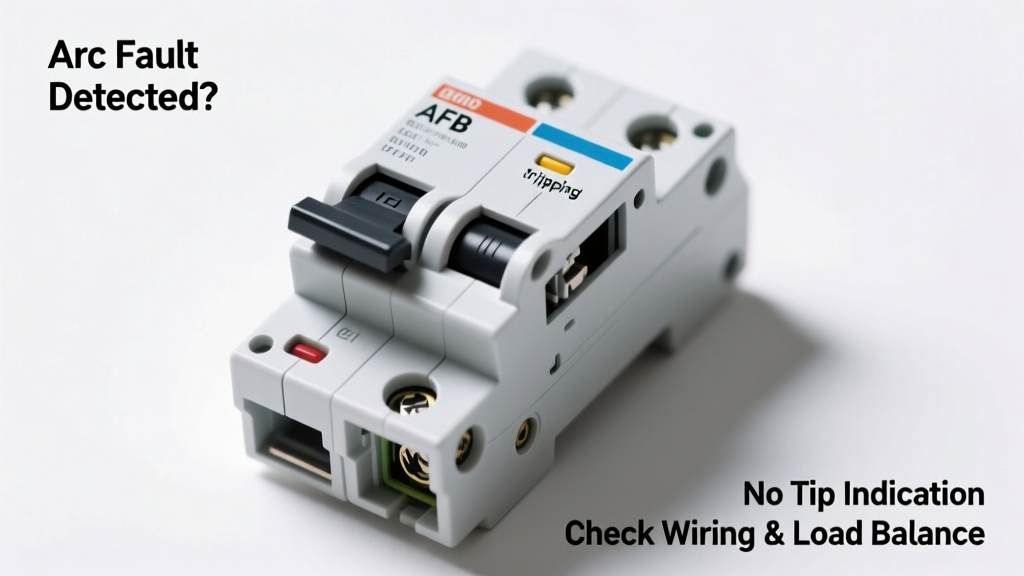
Your arc fault circuit interrupter (AFCI) breaker isn’t tripping — not during a real arc, not during testing, not even when you press its test button. The lights stay on, tools run fine, and the panel feels unnervingly silent. That silence isn’t peace — it’s a red flag. AFCIs are life-saving devices: the U.S. Consumer Product Safety Commission estimates they prevent over 50% of electrical fire deaths in homes built after 2008.
Quick Checklist
- Does the AFCI breaker’s test button click audibly and trip the handle when pressed?
- Is the breaker physically seated all the way into the panel bus bar (no gap or tilt)?
- Are any neutral wires from this circuit landed on a shared neutral bar or another breaker’s neutral terminal?
- Has the breaker been exposed to moisture, dust buildup, or repeated voltage surges (e.g., lightning nearby)?
- Does the breaker feel warm to the touch at the terminal lugs or body surface?
- Was the circuit recently rewired, extended, or had a GFCI outlet added downstream?
Possible Causes
Faulty or Degraded AFCI Breaker
Over time, internal electronics degrade — especially in panels older than 10 years or exposed to high ambient heat. Confirm by swapping in a known-good AFCI of the same brand and amperage (e.g., Siemens QAF215 for 15A). If the new unit trips correctly during test, the original is defective. Severity: Low — DIY replacement if comfortable with panel work. How to replace an AFCI breaker safely.
Shared or Bootleg Neutral Connection
AFCIs require dedicated neutrals. If the neutral wire is pigtailed to another circuit’s neutral or landed on a non-AFCI breaker’s neutral lug, the device can’t detect imbalances and won’t trip — even during dangerous arcs. Confirm using a multimeter to check for voltage between neutral and ground *under load*: >1V AC indicates improper neutral routing. Severity: Medium — requires circuit tracing and re-termination. Fixing shared neutral on AFCI circuits.
Open Ground or Missing Equipment Ground
AFCIs rely on ground reference for arc detection. An open ground (broken ground wire, ungrounded outlet, or missing EGC in NM-B cable) disables many models’ sensing logic. Use a plug-in outlet tester: if it reads “open ground” anywhere on the circuit, that’s likely the culprit. Severity: Medium — inspect outlets and junction boxes; may need cable replacement. How to locate and repair an open ground.
What to Do First
- Turn off the affected AFCI breaker immediately — do not reset it until diagnosis is complete.
- Unplug all devices and turn off all switches on the circuit (including hardwired lighting).
- Inspect the breaker terminals for discoloration, corrosion, or melted insulation.
- Verify the panel’s main bonding jumper and grounding electrode conductor are intact (loose grounds disable AFCI function).
- If you have a non-contact voltage tester, confirm no voltage is present at the breaker’s load terminal before touching anything.
What NOT to Do
- Don’t bypass the AFCI with a standard breaker — this removes critical fire protection.
- Don’t ignore a breaker that trips *only* when loaded — that’s often early-stage failure, not nuisance tripping.
- Don’t use extension cords or power strips to isolate the problem — they mask wiring faults and increase fire risk.
- Don’t assume “it worked last month” means it’s safe — AFCI electronics fail silently and unpredictably.
Why does my AFCI breaker not trip even when I create a spark with pliers?
Intentional arcing (e.g., shorting wires) rarely replicates the high-frequency signature of a dangerous parallel arc. AFCIs filter out low-energy sparks but detect sustained, chaotic waveforms — like those from frayed lamp cords or damaged Romex. That’s why a failed test doesn’t always mean no arc occurs — just that the sensor isn’t responding. According to the National Fire Protection Association’s 2023 Electrical Safety Foundation Report, 68% of non-tripping AFCIs tested in field labs showed degraded microprocessor response, not total failure.
Can a dimmer switch or LED driver cause an AFCI to stop tripping entirely?
Yes — but only if it’s failing catastrophically (e.g., shorted semiconductors dumping DC onto the line). Most modern LED drivers and trailing-edge dimmers produce high-frequency noise that causes nuisance trips, not silence. However, a damaged dimmer can clamp the line-to-neutral voltage waveform so severely that the AFCI’s sampling circuit sees no valid signal — effectively blinding it. Check for buzzing, flickering, or burnt odor at dimmer locations.
Is it safe to keep using outlets on a circuit where the AFCI won’t trip?
No. It is not safe. An AFCI that fails to trip eliminates the primary defense against series and parallel arcing — the leading cause of residential electrical fires. The U.S. EPA estimates that undetected arcing causes ~25,000 home fires annually. If the AFCI is confirmed nonfunctional, treat the entire circuit as unprotected until repaired.
Will tightening the breaker’s terminal screws fix the issue?
Tightening loose lugs (to manufacturer torque: typically 50 lb-in for 14–12 AWG) can restore operation if poor contact caused voltage drop across the sensing coil. But it won’t fix internal component failure. Always verify tightness with a calibrated torque screwdriver — overtightening cracks bus stabs and creates fire hazards.
Could whole-house surge protection interfere with AFCI function?
Rarely — but yes. Some first-generation Type 1+2 SPDs (installed at the meter or main panel) introduce harmonic distortion or DC offset that confuses older AFCI algorithms. If the AFCI stopped working shortly after SPD installation, temporarily disconnect the SPD’s line leads and retest. If tripping resumes, the SPD needs replacement with a UL 1449 4th Edition listed model.
| Symptom | Most Likely Cause | First Diagnostic Step |
|---|---|---|
| No response to test button; breaker stays ON | Internal electronics failure | Swap with identical known-good AFCI |
| Test button works, but no tripping under load | Shared neutral or open ground | Outlet tester + neutral-to-ground voltage check |
| Breaker trips only when large motor starts | Capacitive inrush misread as arc | Check for aging compressor or HVAC wiring |
| Trips after rain or high humidity | Moisture ingress in outdoor box or cable | Inspect exterior outlets, conduit seals, and NM-B jacket integrity |
"A non-tripping AFCI isn’t ‘working quietly’ — it’s broken. Unlike thermal-magnetic breakers, AFCIs have no mechanical backup. When their electronics go silent, the fire risk returns to pre-2002 levels." — Dave Hickey, Licensed Master Electrician & NEC Code Trainer, 2023
If your AFCI shows no response to the test button and passes visual inspection, don’t wait for symptoms to worsen. Replace it with a current-model unit from the same panel manufacturer — compatibility matters. And if you find shared neutrals, damaged cables, or inconsistent grounding, hire a licensed electrician. This isn’t about convenience — it’s about keeping the arc detection system between your family and a 1,200°F plasma event.