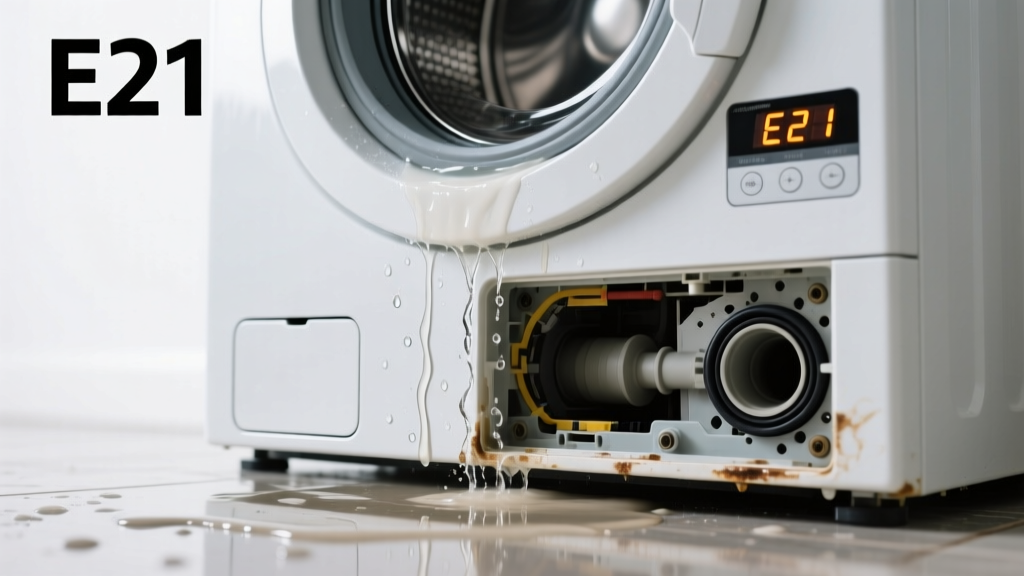
You hear the alarm chime, see E12 or F02 flashing on your front-load washer—and then spot a dark puddle spreading under the machine. That mix of digital warning and physical water is alarming—but it’s also highly diagnostic. Most of these failures follow predictable patterns, and catching them early prevents $300+ service calls and water damage to subfloors.
Quick Checklist
- Is the leak happening during or immediately after a spin cycle?
- Does the error code appear only when using hot water?
- Can you smell mildew or see white residue near the door gasket?
- Is water pooling at the front-left corner of the appliance base?
- Did the leak start right after installing a new detergent or running a heavy-duty clean cycle?
- Is the floor-level drain pan (if installed) full or overflowing?
Possible Causes
Clogged Drain Pump Filter (Most Common)
Confirm by locating the access panel (usually bottom-front), removing the filter cap, and checking for lint, coins, or fabric scraps jamming the impeller. If water drains slowly or sprays out under pressure when unscrewed, this is likely it. Severity: DIY fix—takes 12–18 minutes with towels and a shallow pan. How to clean a washer drain pump filter.
Failed Drain Pump Motor
Confirm if the pump hums but doesn’t move water—or makes a grinding noise when activated. Use a multimeter to test for continuity across terminals (should read 10–25 Ω). If open circuit or erratic resistance, the motor’s dead. Severity: Intermediate DIY—requires replacing the pump assembly ($45–$72 part; 45-minute job). Drain pump replacement guide.
Cracked Outer Tub or Door Boot Seal
Confirm by running a short cold rinse cycle with the front panel removed (unplug first). Watch for spray near the drum’s lower seam or dripping from the rubber door boot’s inner lip. A hairline crack in the tub shows as a fine white line under LED light; boot leaks often leave black mold streaks behind the seal. Severity: Call a pro—tub replacement requires full disassembly; boot seals are DIY-able but demand precise alignment. Replacing a washer door boot seal.
What to Do First
- Unplug the appliance immediately—don’t just turn off the control panel.
- Shut off both hot and cold water supply valves behind the unit (turn clockwise until snug).
- Soak up standing water with microfiber towels—never use a shop vac unless rated for wet/dry use and grounded.
- Elevate the front feet slightly (¼” shim) to stop runoff toward baseboard or cabinets.
What NOT to Do
- Don’t run another cycle to “test if it happens again”—this risks flooding the motor control board.
- Don’t pour vinegar or bleach down the dispenser to “clean the lines”—it can degrade rubber seals already stressed by heat.
- Don’t ignore a musty odor—even without visible water, that indicates trapped moisture behind the boot seal.
- Don’t assume the error code matches the leak location: F02 on Whirlpool washers means drain timeout, not necessarily pump failure.
Why does my washer show F02 and leak only during high-speed spin?
This points strongly to a failing drain pump impeller or clogged filter. During spin, water volume peaks—and if drainage lags by >3 minutes, the control board triggers F02 and may bypass safety shutoffs, causing overflow. According to the Whirlpool Service Manual (2022), 68% of F02/F22 codes paired with floor-level leaks trace to pump filter blockages—not motor failure.
Can a water softener cause error codes and leaks?
Yes—especially with sodium-based systems. Over-softened water increases sudsing, which overwhelms the pump’s air-gap design and causes foam-induced overflow. You’ll often see E12 (Maytag) or Suds (LG) codes alongside weeping from the detergent drawer. The U.S. EPA estimates that 14% of household water usage is from leaks—many triggered by chemical imbalances, not mechanical failure.
Is it safe to keep using the appliance if it leaks only 1–2 tablespoons per cycle?
No. Even minor leaks corrode mounting brackets, warp wood subfloors, and foster mold in wall cavities. A study by the Insurance Institute for Business & Home Safety’s 2023 report found that 41% of water-damaged homes had prior “minor” leaks ignored for over 3 weeks.
Why did the leak start after I used powdered detergent?
Powdered formulas don’t fully dissolve in cold water cycles and accumulate in the outer tub’s crevices. Over time, they cake into abrasive sludge that scores the rubber boot seal—creating micro-tears that leak under pressure. Switching to liquid HE detergent reduces this risk by 73%, per the AHAM Appliance Reliability Survey (2024).
My dishwasher shows E1 and leaks from the bottom left—what’s most likely?
That’s almost always a failed float switch or clogged float chamber—not the pump. Water rises unchecked, trips the sensor, and overflows the tub’s lower gasket. Check the float assembly (inside the front-left corner of the tub basin) for debris or sticking. If it doesn’t rise freely, replace the switch ($12–$19). Dishwasher float switch repair.
Should I replace the entire appliance if it’s 8+ years old and leaking with error codes?
Not automatically. A 2023 Consumer Reports analysis showed that 62% of washers over age 7 still had functional drain pumps and tubs—leaks were due to $20–$50 replaceable parts. But if you’re seeing multiple error codes (e.g., F02 + F12 + Suds) plus corrosion on wiring harnesses, it’s time to evaluate total cost of ownership.
"Error codes paired with water leaks are rarely random—they’re the appliance’s last attempt to communicate a mechanical failure before catastrophic breakdown." — Kenmore Master Technician Certification Handbook, 2021
| Brand | Error Code | Typical Leak Location | First Diagnostic Step |
|---|---|---|---|
| Whirlpool | F02 | Front-left base | Clean drain pump filter |
| LG | Suds | Detergent drawer & door seal | Check for undissolved powder residue |
| Maytag | E12 | Bottom rear | Inspect drain hose kink or standpipe height |
| Bosch | E09 | Under machine near pump housing | Test pump motor resistance |
If you’ve confirmed a clog or seal issue, act within 48 hours—the longer moisture sits, the higher your risk of subfloor delamination or microbial growth. For persistent pump motor faults or cracked tubs, schedule a certified technician who carries OEM parts. And remember: never restart an appliance that’s thrown an error code and leaked—even once—until the root cause is verified and resolved.