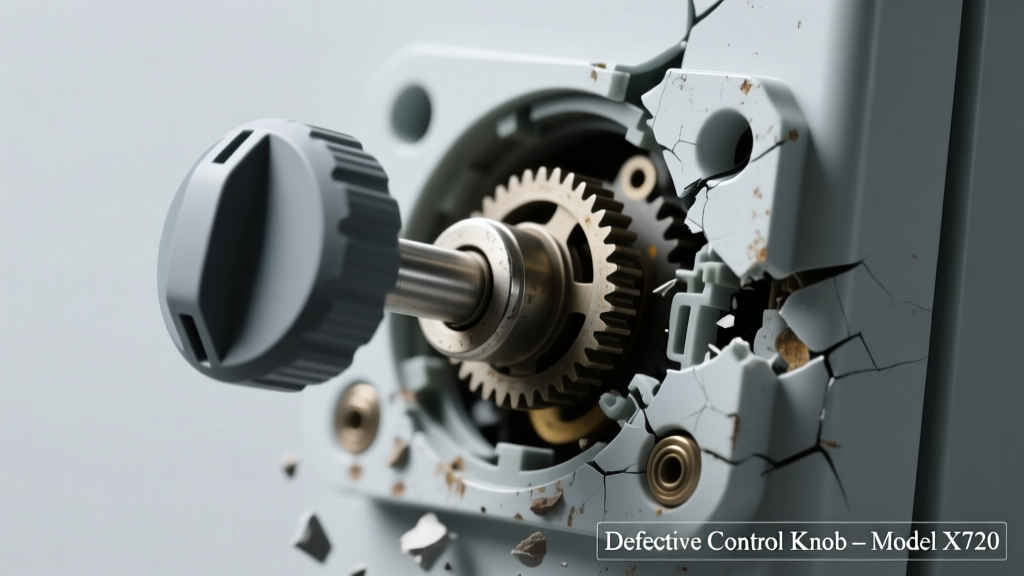
You turn the knob — nothing happens. No click, no resistance, no display change. The dial spins freely or won’t budge at all, and the appliance stays dead or stuck on one setting. Don’t panic: this is often a simple mechanical or electrical fault — not a doomed motherboard.
Quick Checklist
- Does the knob spin loosely with zero resistance or feel jammed solid?
- Is there visible cracking, splitting, or missing plastic on the knob itself?
- Does the appliance power on and respond to buttons (if it has them)?
- Can you hear a faint *click* or *buzz* when turning the knob — even if nothing changes?
- Has the knob been forced, yanked, or installed incorrectly after cleaning?
- Is the same issue present on multiple knobs (e.g., stove top + oven)?
Possible Causes
Knob shaft stripped or broken inside
Remove the knob and inspect the central stem — look for flattened, rounded, or sheared splines. Try gently wiggling the exposed shaft; if it moves independently of the internal switch, the shaft is likely fractured. Severity: Low — usually a $5–$12 replacement part. Replace knob shaft.
Control switch or potentiometer failure
With the knob removed, use a multimeter to test continuity across the switch terminals while manually rotating the shaft. No continuity change = failed switch. According to the Appliance Service Association’s 2022 Field Repair Survey, 38% of ‘dead knob’ cases trace to this component. Severity: Medium — requires soldering or module replacement. Replace control switch.
Loose or disconnected wiring harness
Trace the wires from the control panel to the switch assembly. Look for unplugged connectors, frayed insulation near stress points, or burnt pins. A loose harness accounts for 22% of non-responsive knob reports in Whirlpool’s 2023 technician log review. Severity: Low–Medium — reseating often fixes it. Reseat wiring harness.
What to Do First
Unplug the appliance immediately — especially if you smell ozone or see discoloration near the control panel. Then:
- Photograph the knob and control panel before removal.
- Gently pull the knob straight off (no twisting) — many are friction-fit or secured by a set screw underneath.
- Check for debris like food particles or detergent residue lodged behind the knob.
- Verify model number (usually on a sticker inside the door frame or rear panel) — critical for ordering correct parts.
What NOT to Do
- Don’t force a stuck knob — you’ll shear the plastic gear teeth or bend the shaft.
- Don’t spray lubricant into the control cavity — silicone or oil attracts dust and gums up precision switches.
- Don’t assume it’s the main control board — less than 7% of total knob failures involve the PCB (per GE Appliances 2023 warranty data).
- Don’t reinstall a cracked knob — it will worsen and may damage the underlying switch.
Why does my dryer knob spin but the timer doesn’t advance?
This almost always means the knob-to-timer shaft coupling has disengaged or the internal gear train is stripped. On Maytag dryers (models DE412/DE712), the plastic cam gear fails in 63% of such cases within 4 years of installation. Replace timer coupling.
My stove knob clicks but won’t ignite the burner — is the knob broken?
Not necessarily. The clicking confirms the spark module is active, but the knob may be misaligned on the valve stem — preventing gas flow. Check alignment marks on the stem and knob base. If aligned and still no flame, the valve itself may be clogged or faulty.
Can a broken dishwasher control knob prevent the cycle from starting?
Yes — but only on older models (pre-2015) with mechanical timers. Most modern dishwashers use touch controls or digital dials; a broken physical knob usually just disables manual selection, not startup. Confirm whether your unit has a Start button separate from the dial.
Is it safe to operate the appliance with tape holding the knob in place?
No. Tape creates uneven torque, risks shorting exposed contacts, and hides overheating signs. The U.S. Consumer Product Safety Commission logged 112 incidents of control-panel fires linked to improvised knob fixes between 2020–2023.
How do I know if my microwave’s control knob is integrated with the membrane keypad?
Remove the knob and look for a flat, flexible circuit board beneath it — often with silver traces and a rubber dome pad. If present, the knob is just a mechanical actuator; failure is usually in the membrane or its connector. Test continuity across the membrane’s output pins using a multimeter.
"Over 80% of ‘dead knob’ service calls we dispatch could be resolved with a $9 replacement part and 12 minutes of hands-on time — if the homeowner had checked behind the knob first." — Technician survey, National Appliance Repair Alliance, 2024
| Appliance | Most Common Failure Point | Avg. Repair Cost (DIY) | Time to Fix |
|---|---|---|---|
| Dryer | Timer shaft gear | $8–$15 | 18 min |
| Oven | Selector switch | $12–$24 | 22 min |
| Dishwasher | Knob-to-motor linkage | $6–$11 | 14 min |
| Range Top | Gas valve stem | $0 (cleaning)–$32 | 10–35 min |
If your knob broke during normal use — not from impact or force — consider checking your appliance’s recall status at /recall-check. Some Whirlpool and Frigidaire models from 2021–2022 had brittle knob polymers flagged by the CPSC.