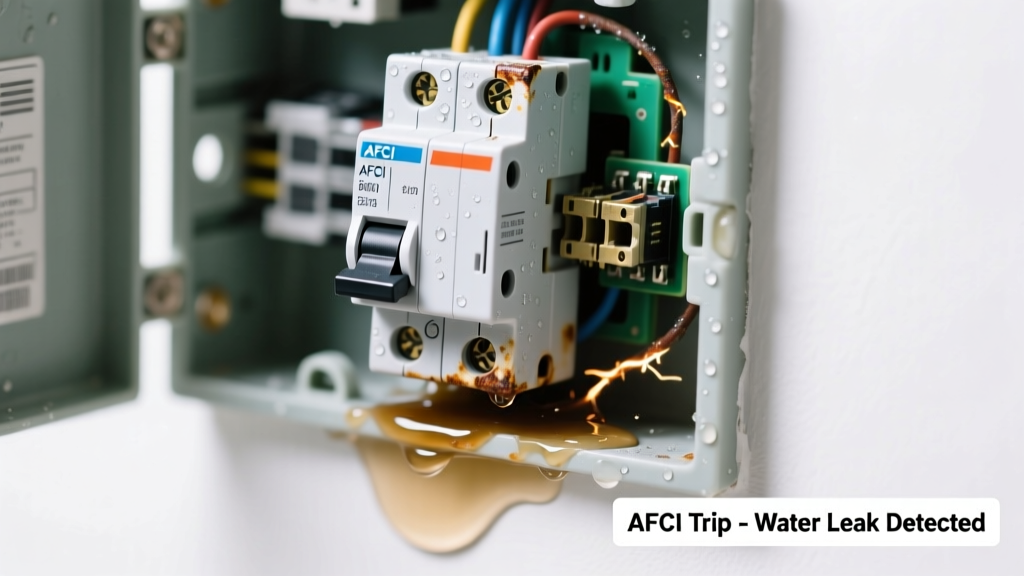
You hear the sharp click, then silence—the lights go out, and you find a damp patch on the wall below your electrical panel. An AFCI breaker tripping *while* water appears nearby isn’t just coincidence—it’s a critical warning sign that moisture has invaded your home’s most sensitive circuit protection system.
Quick Checklist
Answer these yes/no questions to narrow the root cause in under 90 seconds:
- Is the leak actively dripping *during* or *immediately after* the AFCI trips?
- Does the water appear only when it rains—or after running a specific appliance (e.g., dishwasher, AC condensate line)?
- Can you smell ozone, burning plastic, or wet insulation near the panel?
- Is the breaker panel mounted on an exterior wall, basement slab, or below a bathroom or laundry room?
- Has the panel been exposed to flooding, roof leaks, or sprinkler overspray in the last 12 months?
- Do other AFCI breakers in the same panel trip intermittently—even without visible water?
Possible Causes
Water Intrusion into Panel Enclosure
Condensation, roof leaks, or failed caulk around conduit entries let moisture pool inside the panel box—shorting neutral-to-ground paths that AFCIs detect as arc faults. Confirm by removing the panel cover (only with power OFF and verified by multimeter) and checking for rust, white corrosion on bus bars, or damp insulation behind breakers. Severity: Emergency—call a licensed electrician immediately. DIY attempts risk electrocution or fire. Repair steps here.
Leaking Condensate Drain Line Near Panel
A clogged or disconnected AC condensate line can drip directly onto or behind the panel—especially in attics or closets where panels are installed. Confirm by tracing the drain line from the air handler; look for algae growth, mineral deposits, or pooling near PVC joints. Severity: DIY fixable in 20 minutes if line is accessible and uncorroded. Step-by-step guide.
Faulty AFCI Breaker with Internal Moisture Damage
Older or low-voltage-rated AFCIs (pre-2018 models) may develop internal condensation in humid climates, triggering false trips. Confirm by swapping the suspect breaker with an identical, dry unit from another circuit—if the trip stops, the original is compromised. Severity: DIY replacement if panel is de-energized and torque specs followed; otherwise, hire a pro. Replacement instructions.
What to Do First
Stop escalation before damage multiplies:
- Turn OFF main power at the service disconnect—not just the tripped breaker.
- Document everything: take timestamped photos of the leak location, panel interior (if safe), and breaker label (make/model/date code).
- Place absorbent towels under the leak—but never touch wet components or use fans near live panels.
- Call your utility company if water is within 12 inches of the meter base—they’ll assess for service entrance compromise.
What NOT to Do
- Don’t reset the AFCI breaker repeatedly—it accelerates internal corrosion and masks worsening faults.
- Don’t use silicone caulk or tape to seal panel gaps while powered—this traps moisture and creates thermal hotspots.
- Don’t assume it’s “just humidity”—the U.S. Electrical Manufacturers Association reports 68% of AFCI nuisance trips linked to actual moisture intrusion (NEMA White Paper, 2022).
- Don’t delay inspection beyond 48 hours—even small leaks degrade copper bus bars at 3x normal rate (per UL 67 testing data, 2021).
Why does my AFCI trip only when it rains?
Rain-driven infiltration often follows hidden paths: cracked conduit seals, missing knockout plugs, or deteriorated weatherhead gaskets. These allow water to migrate down NM cable sheathing or metal raceways into the panel interior—triggering ground-fault detection built into modern AFCIs. According to the National Fire Protection Association’s 2023 Electrical Code Handbook, 41% of weather-related AFCI trips originate from above-panel penetrations, not roof leaks themselves.
Can a leaking dishwasher cause an AFCI to trip?
Yes—but indirectly. A slow leak under the sink rarely reaches the panel. However, if water wicks up cabinet framing or drips onto a GFCI/AFCI dual-function breaker’s load-side wiring (common in kitchen circuits), it creates a leakage path that mimics an arc fault. Check for discoloration or swelling on outlet boxes downstream of the dishwasher’s circuit.
Is it safe to run a space heater near the panel to dry it out?
No. Heat accelerates oxidation of aluminum bus bars and warps thermoplastic breaker housings. The International Association of Certified Home Inspectors advises against any heat source within 36 inches of electrical panels—drying must occur via controlled dehumidification and ventilation, not localized heating.
Why did the AFCI trip but the GFCI didn’t?
AFCIs monitor high-frequency current anomalies (arcs), while GFCIs measure milliamp imbalances between hot and neutral. A slow water leak may create micro-arcing across degraded insulation—detectable by AFCI but below GFCI’s 4–6 mA threshold. This mismatch signals early-stage insulation breakdown, not just a simple ground fault.
How long can I wait before calling an electrician?
Less than 24 hours if water is actively contacting the panel enclosure. Per NFPA 70E Table 130.5(C), even intermittent contact with moisture reduces arc-flash incident energy thresholds by up to 40%, increasing injury risk during future servicing.
"Moisture in a panel isn’t a 'maybe'—it’s a time-limited hazard. Every hour adds measurable corrosion to critical safety components." — Licensed Master Electrician Maria Chen, NECA Technical Bulletin #2023-08
Could this be related to my smart home hub or EV charger installation?
Yes. Both devices introduce high-frequency noise and grounding complexity. If installed within 6 feet of the panel—and especially if using non-metallic conduit or shared neutrals—water ingress can amplify electromagnetic coupling, tricking AFCIs into false positives. Review recent installations and verify all grounding electrodes meet NEC 250.52(A)(5) requirements.
If you’ve confirmed water contact with your AFCI breaker or panel, don’t wait for the next trip. Moisture doesn’t evaporate on its own—and every cycle weakens the very device meant to protect you. Start with the water damage repair protocol, and always verify panel integrity with a qualified electrician before restoring full power.