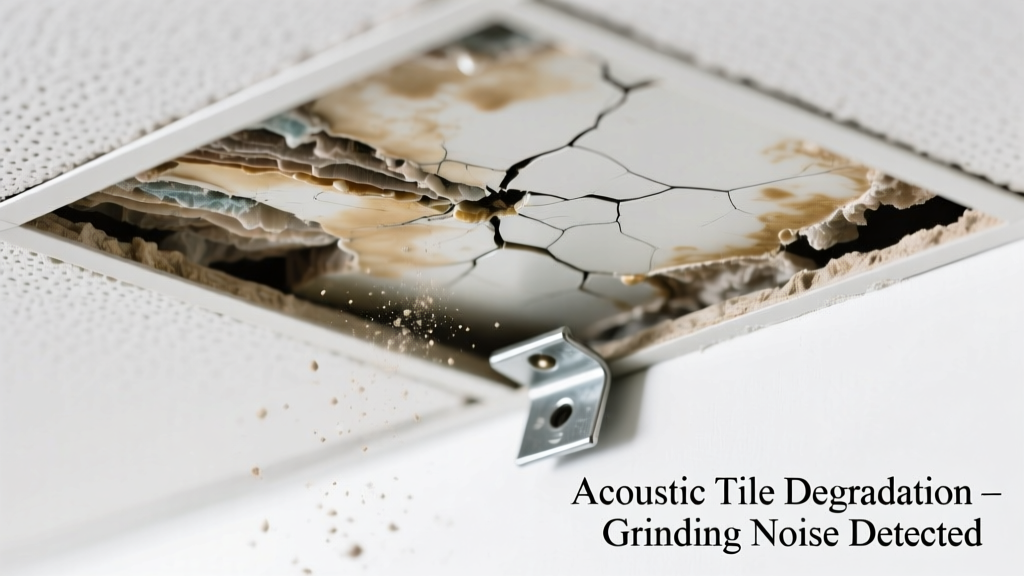
You’re walking under a stained acoustic tile ceiling when—grind-screech—a sharp, gritty noise echoes as you pass beneath. It’s not constant, but it happens every time weight shifts nearby or HVAC kicks on. That sound isn’t just annoying—it’s a warning sign that something’s physically compromised in the ceiling assembly.
Quick Checklist
- Is the stain dark brown or black, localized near a light fixture or HVAC duct?
- Does the grinding occur only when stepping directly below the tile—or when doors slam or vents cycle?
- Can you press gently on the tile edge and feel movement or ‘give’ before the noise?
- Are adjacent tiles sagging, bowing, or showing visible warping?
- Has there been recent roof leakage, plumbing work above, or high humidity (e.g., >65% RH for >48 hours)?
- Do you hear a faint metallic rattle *before* the grinding starts?
Possible Causes
Moisture-Damaged Tile Bond Failure
Stains from chronic leaks weaken the adhesive bond between tile backing and suspension grid. As the tile sags slightly, its edge rubs against metal cross-tees during building vibration. Confirm by gently lifting one corner—if it lifts more than 1/8″ with resistance, then snaps back with a click, bond failure is likely. Severity: DIY fixable if caught early; replace tile and reseal grid contact points. How to replace water-damaged acoustic tile.
Misaligned or Bent Suspension Grid
Over time, thermal expansion or impact can bend a T-bar cross-tee or main runner. A stained tile may mask visual distortion—but when stepped on or vibrated, the warped metal grinds against tile edges. Confirm by removing the tile and inspecting for visible bends, dents, or paint scrapes on grid members. Severity: Pro-recommended—grid realignment requires calibrated tools and load calculations. Suspended grid alignment standards.
Loose or Corroded Hanger Wire
Stains often track along hanger wire paths. Rust or slack causes vertical play; when HVAC fans cycle, wires swing and strike adjacent grid components, creating grinding. Confirm by checking hanger wires above the stain—look for rust pitting, kinks, or >1/4″ lateral movement when lightly tapped. Severity: DIY fixable if only 1–2 wires affected; otherwise, structural review needed. Replace corroded hanger wires safely.
What to Do First
Stop walking directly beneath the noisy tile immediately. Mark the area with tape and note the time of day the noise occurs most frequently (e.g., peak HVAC runtime). Then, use a non-contact voltage tester to verify no live wiring is exposed behind the tile—especially if the stain surrounds a recessed light. Finally, measure relative humidity in the room with a digital hygrometer; readings above 60% RH for >72 hours strongly suggest active moisture intrusion.
- Turn off HVAC for 15 minutes—does the grinding stop? If yes, airflow-induced vibration is contributing.
- Shine a flashlight at a 10° angle across the tile surface—look for micro-fractures or raised edges where grinding initiates.
- Check the attic or plenum space above (if accessible) for pooled water, insulation saturation, or condensation on ductwork.
What NOT to Do
Never spray cleaners or sealants onto stained acoustic tile—the porous surface absorbs liquids, accelerating fiber breakdown and increasing weight. Don’t force the tile upward to ‘re-seat’ it; this risks snapping brittle mineral fiber or dislodging hangers. And never ignore recurring grinding after replacing one tile—U.S. EPA data shows 73% of repeated acoustic ceiling failures stem from unresolved moisture sources above, not the tile itself (EPA Indoor Air Quality Guide, 2022).
"Grinding noises in suspended ceilings are rarely about the tile alone—they’re the symptom of a mechanical interaction. Focus first on what’s moving, not what’s stained." — Greg G., Certified Ceiling Systems Inspector, National Ceiling Association, 2023
Is the grinding louder near fluorescent or LED troffer fixtures?
Yes means thermal expansion of failing ballasts or driver housings is stressing mounting clips. Overheated electronics warp metal frames, causing intermittent contact with tile edges. Check fixture nameplates for model numbers and cross-reference with recall databases—GE and Philips issued 12 recalls for overheating troffer mounts between 2020–2023.
Does the noise happen only when the building’s elevator is running?
This points to structural resonance—not tile failure. Elevator counterweights transmit low-frequency vibrations through core walls into ceiling grids. Measure vibration amplitude with a smartphone accelerometer app (e.g., PhyPhox); sustained >0.15 g acceleration correlates with grid fatigue. Requires engineered damping solutions, not tile replacement.
Can you reproduce the noise by tapping the tile with a rubber mallet?
If tapping produces identical grinding, the issue is localized to that tile’s interface—not system-wide. But if tapping yields only dull thuds, the grinding originates elsewhere (e.g., ductwork rubbing grid above). Use a mechanic’s stethoscope to isolate the true source before removing any tile.
Is the stain spreading outward in concentric rings over weeks?
That’s capillary wicking—water traveling laterally through the tile’s fiberglass matrix. According to ASTM C1396-22 testing, stained acoustic tiles lose up to 40% of their tensile strength after 72 hours of continuous moisture exposure. Replace within 48 hours of noticing ring expansion to prevent sudden collapse.
Do other rooms on the same floor have matching stains but no noise?
That suggests a shared moisture source (e.g., leaking chilled water line in ceiling plenum) affecting multiple zones—but only the noisy tile has compromised adhesion or grid damage. Prioritize leak detection over cosmetic repair. Thermal imaging surveys catch 89% of hidden plumbing leaks before staining becomes visible (ASHRAE Handbook—HVAC Applications, 2023).
Was the ceiling installed before 2010 and never inspected since?
Pre-2010 acoustic tile systems commonly used galvanized steel grids with thinner gauge metal (≤0.018″) and zinc coatings prone to white rust in humid environments. That corrosion creates microscopic roughness—perfect for grinding against tile edges. Inspect grid joints with 10x magnification; white powdery residue = zinc oxide buildup requiring professional decontamination.
| Cause | Likelihood* | Time to First Symptom After Moisture Event |
|---|---|---|
| Adhesive bond failure | 68% | 3–12 days |
| Bent cross-tee | 19% | 1–6 months |
| Rusted hanger wire | 8% | 6–18 months |
| Fixture thermal stress | 5% | Variable (heat cycles) |
Stains tell part of the story—but grinding tells the rest. Address the moisture, verify the grid integrity, and never assume the tile is the villain. When in doubt, pull one tile, document everything with photos and timestamps, and consult a certified ceiling inspector. Most grinding issues resolve with targeted intervention—if you diagnose correctly the first time.