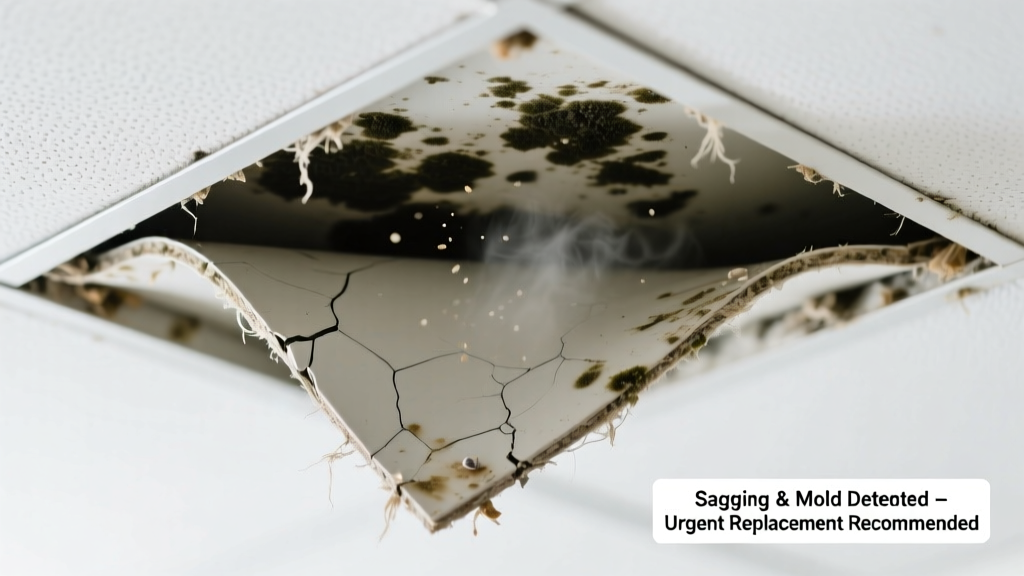
You walk into the office breakroom—or your basement ceiling—and catch that unmistakable musty, sour, or ammonia-like odor just as you notice one or two acoustic tiles drooping from the grid. It’s unsettling, but not hopeless: this combo of sagging + odor almost always points to a specific, fixable problem beneath the surface.
Quick Checklist
Answer these yes/no questions to narrow the cause in under 90 seconds:
- Has there been recent roof leakage, plumbing drip, or HVAC condensate overflow above the ceiling?
- Do the sagging tiles feel damp, cool, or squishy when gently pressed?
- Is the odor strongest near air vents, light fixtures, or corners where moisture pools?
- Are tiles discolored—yellow, green, black, or pink—especially along edges or seams?
- Has the space had poor ventilation or high humidity (>60% RH) for more than 48 hours?
- Did the smell start within 3–7 days after a known water event?
Possible Causes
Mold Growth Behind or Within Tiles
Confirm with a flashlight and mirror: look for fuzzy, velvety, or powdery discoloration on tile backs, hanger wires, or joists. Use a non-contact IR thermometer—if substrate reads >5°F cooler than surrounding dry areas, moisture is likely trapped. Severity: Moderate—DIY removal possible only if <10 sq ft affected and no visible structural rot. For larger areas or HVAC involvement, call an IICRC-certified mold remediator. How to safely remove mold behind acoustic tiles.
Trapped Condensation in Insulation or Grid
Check attic or plenum access: pull back fiberglass insulation above the grid—look for wet clumping or dark streaks. A hygrometer reading >70% RH in the plenum confirms chronic condensation. Severity: Low–Moderate—often fixable by sealing duct joints and adding vapor barrier tape to chilled ducts. Fix condensation in drop ceiling plenums.
Decomposing Organic Debris (Rodent Nesting or Insect Accumulation)
Look for nesting material (shredded paper, insulation fibers), droppings, or insect husks behind tiles. Smell intensifies near vents or wall-ceiling junctions. Confirm with a borescope or flashlight probe. Severity: Low—DIY cleanup with N95 mask and HEPA vacuum; seal entry points. Remove organic debris from ceiling cavities.
What to Do First
Act within 24 hours to prevent irreversible damage:
- Turn off HVAC systems serving the area to avoid spreading spores or odors.
- Wear an N95 respirator and gloves before removing any sagging tiles.
- Use a digital moisture meter (e.g., Protimeter Surveymaster) to test tile backs and adjacent joists—record readings above 18% MC as suspect.
- Photograph all findings—including timestamps—for insurance or contractor review.
- Place a dehumidifier (set to 45–50% RH) in the room, aimed upward toward the ceiling grid.
What NOT to Do
Avoid these actions—they accelerate damage or expose you to health risks:
- Don’t spray bleach or disinfectant directly onto wet tiles—it masks odor but doesn’t kill deep mold and can corrode metal grids.
- Don’t re-install sagging tiles without verifying dryness—mold will regrow within 48 hours if substrate remains damp.
- Don’t ignore HVAC condensate pan overflows—even small leaks cause rapid microbial growth in ceiling cavities.
- Don’t use fans alone to dry the area without dehumidification; they spread spores and redistribute moisture.
Is the smell worse after running the AC?
If yes, condensate drain lines are likely clogged or disconnected. The U.S. EPA estimates that 30% of HVAC-related indoor air quality complaints stem from stagnant condensate reservoirs breeding bacteria like Legionella and Stenotrophomonas. Check the drain line at the air handler—look for algae slime or standing water in the pan.
Do you see black spots on tile edges or grid tracks?
Black spotting often indicates Stachybotrys chartarum—a toxigenic mold requiring professional remediation if covering >3 sq ft. According to the New York City Department of Health’s 2022 Mold Remediation Guidelines, visible mold on porous substrates like acoustic tile should never be wiped or sanded—it must be removed and discarded.
Does the odor resemble rotten eggs or sewage?
This strongly suggests sewer gas infiltration—not mold. Check floor drains in the same room for dry traps, and inspect cleanout caps in nearby walls. Sewer gas contains hydrogen sulfide, which corrodes metal hangers and accelerates tile sagging via chemical degradation.
Are tiles sagging only in rooms with exterior walls or windows?
Cold bridging causes condensation on interior surfaces during winter. Thermal imaging shows surface temps dropping below dew point—especially where insulation is missing or compressed. This creates ideal conditions for Aspergillus growth, which emits a sweet-musty odor. How to insulate cold ceiling bridges.
Did the problem start after installing new carpet or painting?
VOCs from adhesives or low-quality paints can off-gas through ceiling tiles—but won’t cause sagging. If tiles are dry and level, the odor is likely temporary. However, if sagging coincides, suspect hidden water intrusion from improper subfloor prep or wall-to-floor sealing failures.
Can you hear dripping or feel dampness behind the tile?
That’s definitive evidence of active leakage—not just residual moisture. Shut off water supply to nearby fixtures immediately. According to the Insurance Institute for Business & Home Safety’s 2023 report, 68% of water-damaged acoustic ceilings show visible sagging within 72 hours of leak onset.
"Sagging acoustic tiles are never just 'old'—they’re always telling you something’s wrong behind the grid. Smell + sag = moisture + time. Every hour counts." — Carla M., Certified Indoor Environmental Consultant (CIEC), 2024
| Material | Dry Range (% MC) | Concern Threshold | Action Required |
|---|---|---|---|
| Mineral fiber tile | 5–12% | >15% | Replace tile; investigate source |
| Wood joist | 6–12% | >19% | Probe for rot; assess structural integrity |
| Steel hanger wire | N/A | Rust or white powder residue | Replace; check for chronic condensation |
| Fiberglass insulation | Dry to touch | Clumped, dark, or damp-feeling | Remove and replace; add vapor barrier |
Once you’ve ruled out active leaks and confirmed dryness, replace damaged tiles with mold-resistant options (look for ASTM E136 Class A fire rating and >95% moisture resistance). But don’t rush—address the root cause first. Most sag-and-smell cases resolve fully when moisture is eliminated and airflow restored. If odor persists after 72 hours of dehumidification and HVAC shutdown, it’s time to bring in a certified building analyst.