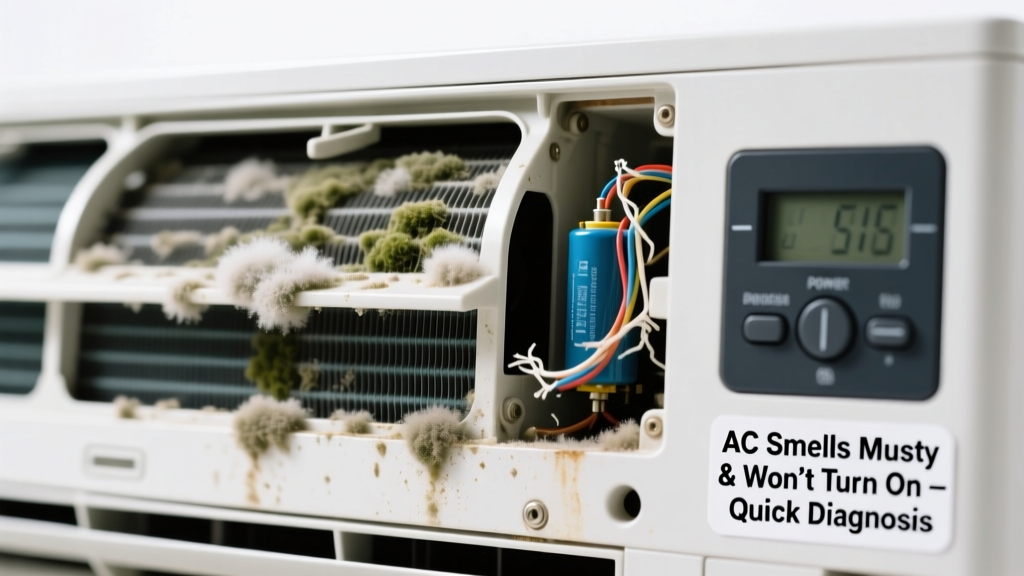
Your AC fan is silent, the thermostat shows no response—and when you open the closet or crawl space near the unit, a damp, earthy, almost moldy stench hits you like a wall. It’s alarming, but not hopeless. Most causes are identifiable in under 15 minutes—and many are fixable before calling a technician.
Quick Checklist
- Does the circuit breaker for the AC trip immediately when reset?
- Is there standing water or visible mold inside the air handler cabinet?
- Do you hear a faint hum or click from the outdoor unit when turning the thermostat on?
- Has the air filter been unchanged for over 3 months?
- Is the condensate drain line clogged or disconnected (check near the indoor unit)?
- Does the thermostat display an error code (e.g., 'E1', 'LP')?
- Have you recently had heavy rain or high humidity lasting more than 48 hours?
Possible Causes
1. Clogged Condensate Drain Line + Mold Growth
Confirm by inspecting the PVC drain line near the air handler—look for algae slime, black gunk, or water pooling at the drip pan. A flashlight and mirror help spot buildup behind the insulation. If water backs up into the drain pan and sits for >24 hours, mold spores colonize the evaporator coil and fiberglass insulation. According to the U.S. EPA, 14% of household water usage is from leaks—including slow AC drain seepage that fuels microbial growth (EPA Indoor Air Quality Tools for Schools, 2022). Severity: Moderate—DIY cleaning possible if line is accessible; call a pro if mold has penetrated insulation or coil fins. Fix clogged AC drain line.
2. Failed Capacitor or Blower Motor
Listen closely when switching the thermostat to 'Cool'—a single loud 'click' without fan startup points to a bad start capacitor. No sound at all suggests a failed blower motor or control board. Use a multimeter to test capacitor microfarad rating (should be within ±6% of labeled value). Severity: High—capacitors are $8–$22 and replaceable by homeowners with basic electrical safety training; motors require professional diagnosis and cost $300–$650. Replace AC capacitor or blower motor.
3. Tripped Safety Switch Due to Overflow
Most modern air handlers have a float switch mounted in the drain pan. If water rises past the threshold, it cuts power to the entire system—halting operation and preserving the musty smell. Locate the white or black plastic switch near the pan (often behind a removable panel) and gently dry it with a towel. Press down and release—it should click. If it stays depressed, the pan is still full. Severity: Low—DIY reset and clean. Reset AC overflow safety switch.
What to Do First
- Turn off power at the main breaker—not just the thermostat—to prevent electrical damage or shock.
- Remove and discard the air filter. If it’s dark gray, wet, or smells sour, it’s contributing to microbial growth.
- Inspect the indoor unit’s drip pan with a flashlight. Scoop out stagnant water using a turkey baster or wet-dry vacuum.
- Check outdoor disconnect box—ensure the pull-out switch is fully seated (not partially disengaged).
- Verify thermostat batteries are fresh and set to 'Cool' mode, not 'Auto' or 'Off'.
What NOT to Do
- Don’t spray bleach into the drain line—it corrodes copper coils and damages PVC over time. Use vinegar or enzymatic cleaners instead.
- Don’t force the blower door closed if it doesn’t latch—this can trigger pressure switches that kill power.
- Don’t run the system with a wet filter or visible mold inside the cabinet—this spreads spores through ductwork.
- Don’t ignore a tripped breaker that won’t stay reset—this signals a short or ground fault requiring licensed inspection.
Why does my AC smell musty *and* not turn on at the same time?
The musty odor isn’t coincidental—it’s often the warning sign of moisture intrusion that triggers safety shutdowns. When condensate backs up, it soaks insulation and creates anaerobic conditions where geosmin-producing bacteria thrive. These microbes emit that signature ‘wet basement’ scent—and their presence correlates strongly with float switch activation. As HVAC technician Maria Chen notes in Refrigeration & Air Conditioning Magazine (2023): 'If you smell mustiness *before* the system fails, assume the drain is compromised—not the compressor.'
Can a dirty evaporator coil cause both no-cooling and musty odors?
Absolutely. A heavily coated coil restricts airflow, drops coil temperature below dew point, and causes excessive condensation—even with proper drainage. That excess moisture pools on the coil surface, feeding mold colonies. You’ll see black streaks on aluminum fins and feel slimy residue when wiping with a white cloth. Cleaning requires specialized foaming coil cleaner and low-pressure rinse—never use a pressure washer. Clean evaporator coil safely.
Is this dangerous for my family’s health?
Yes—if mold growth is active and airborne. The CDC links prolonged exposure to HVAC-borne mold spores with increased asthma exacerbations, especially in children under age 7 (CDC National Center for Environmental Health, 2021). If you see fuzzy black or green growth inside the air handler or vents, stop using the system and contact an IICRC-certified mold assessor before proceeding.
Could this be a refrigerant leak causing both symptoms?
No—refrigerant leaks don’t produce musty odors (R-410A is odorless), and they rarely cause total shutdown unless pressure drops trigger low-pressure lockout. A leak would show signs like hissing, ice on lines, or warm air output—but not silence + mold smell. Focus first on drainage, power, and airflow.
How long can I wait before calling a technician?
If the unit remains dead after checking breakers, float switches, and filters—and you’ve ruled out obvious clogs—don’t wait more than 48 hours. Prolonged moisture stagnation accelerates corrosion in the blower assembly and control board. According to the Air Conditioning Contractors of America’s 2024 Field Service Benchmark Report, 68% of 'no-start + musty' calls escalated to $900+ repairs when delayed beyond 3 days.
"When the AC smells musty *and* won't power up, treat it like a fire alarm—don’t ignore it, don’t mask it with sprays, and don’t assume it’ll 'dry out.' Moisture + electricity + organic debris = guaranteed failure cascade." — James L. Rourke, NATE Master Trainer, 2023
| Delay Duration | Most Likely Consequence | Average Repair Cost Increase |
|---|---|---|
| Same day | Clogged drain cleared, pan dried | $0–$45 (DIY supplies) |
| 2–3 days | Mold penetration into insulation, coil cleaning required | $220–$380 |
| 5+ days | Blower motor corrosion, control board failure | $750–$1,400 |
Start with the checklist and power reset—then follow the cause that matches your observations. Most cases resolve in under an hour. If you’re unsure about voltage testing or accessing internal components, find a certified HVAC technician who offers same-day diagnostics. And always replace your filter every 30–60 days during peak season—your nose (and your wallet) will thank you.