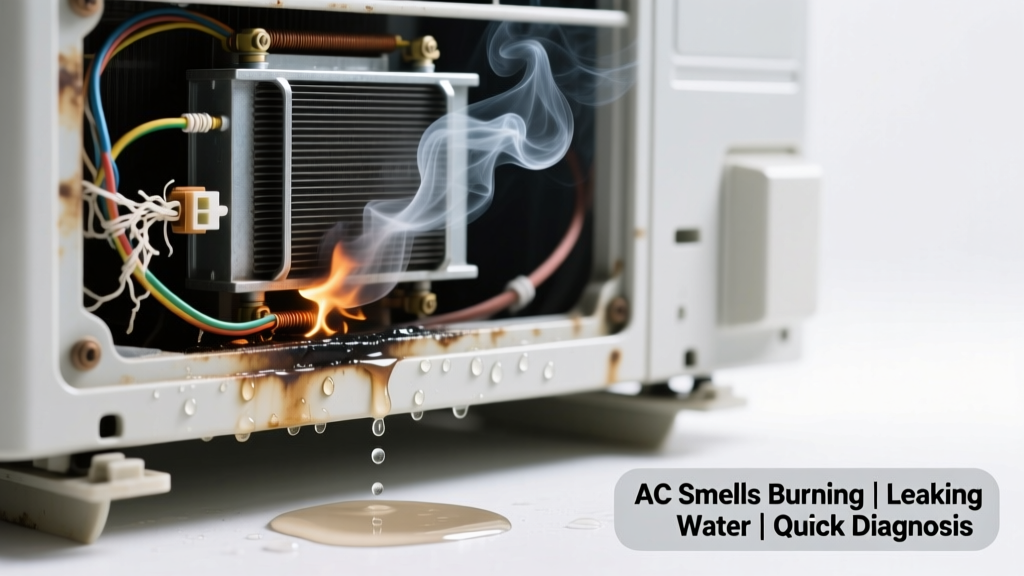
Your AC kicks on—and instead of cool air, you get a sharp, acrid burning odor, plus puddles forming near the indoor unit or dripping from the ceiling. It’s alarming, yes—but most causes are identifiable within 10 minutes, and many are fixable before emergency service is needed.
Quick Checklist
- Is the burning smell strongest near the indoor air handler (not the outdoor unit)?
- Does water pool directly beneath the air handler or drip from supply vents?
- Did the smell start *immediately* after turning the AC on—or only after it ran for 5+ minutes?
- Is the condensate drain line visibly clogged, cracked, or disconnected?
- Do you hear buzzing, sizzling, or popping sounds coming from the unit?
- Is the air filter completely blackened or soaked with debris?
- Has the unit been running nonstop for more than 48 hours during high humidity?
Possible Causes
1. Clogged or Disconnected Condensate Drain Line
This is the #1 cause of simultaneous water leaks and faint burning smells (from mold/mildew buildup inside saturated insulation or overheated drain pan heaters). Confirm by checking the PVC drain line behind the air handler—look for algae slime, standing water, or a disconnected elbow. Severity: DIY fix if line is accessible and unclogging with vinegar + compressed air works. If mold has penetrated insulation or the pan heater is shorting, call a pro. Fix clogged AC drain line.
2. Overheating Blower Motor or Capacitor
A failing blower motor winding or bulging capacitor emits a distinct hot-wire or ozone-like burn smell—and reduced airflow causes evaporator coil icing, which melts and overflows the drain pan. Confirm by turning off power, removing the access panel, and sniffing near the motor housing (don’t touch!). Look for brown residue or bulging capacitors. Severity: Call a pro immediately—electrical faults can ignite. Blower motor replacement guide.
3. Refrigerant Leak + Insulation Breakdown
R-22 or R-410A leaks rarely smell—but when refrigerant contacts degraded wiring insulation (common in units >12 years old), it accelerates breakdown and releases chlorinated hydrocarbon odors that mimic burning plastic. Confirm by checking copper lines for oil stains, frost patterns on coils, and unusually high head pressure readings. Severity: Pro-only—refrigerant handling requires EPA 608 certification. Refrigerant leak repair steps.
What to Do First
Shut off power at the furnace disconnect switch *and* the outdoor breaker—not just the thermostat. Then, place towels under the leak and use a shop vac to remove standing water from the drain pan. Next, inspect the primary drain line exit point outside—does water flow freely when you pour a cup of water into the indoor drain opening? If not, it’s clogged.
- Turn off power at both indoor and outdoor disconnects
- Vacuum water from the drain pan and surrounding area
- Check drain line flow using 1 cup of warm vinegar poured slowly
- Replace or clean the air filter—even if it looks okay (restricted airflow worsens icing)
- Open attic access panels to assess ceiling drywall for sagging or staining
What NOT to Do
Don’t run the AC again until the source is confirmed. Don’t spray water near electrical components—even mist from a hose can cause shorts. And don’t assume ‘just a little water’ is harmless: The U.S. EPA estimates that 14% of household water damage stems from ignored HVAC leaks, often escalating to $5,000+ in mold remediation (EPA Indoor Air Quality Guide, 2022).
"A burning smell paired with water leakage is never 'just a clog.' It’s your system signaling two failures—one mechanical, one electrical—often feeding each other." — HVAC Technician Marco Lin, NATE-certified since 2009
Is the burning smell coming from the outdoor unit?
No—this strongly rules out compressor or contactor failure. Focus your inspection indoors: air handler cabinet, drain pan, and blower compartment. Outdoor-unit burns usually accompany loud bangs or tripped breakers, not steady water leakage.
Does the water smell musty or sour—not chemical?
That points to microbial growth in stagnant condensate. Clean the drain line and pan with 1 part bleach to 10 parts water, then install an algaecide tablet. But if the burning odor remains after cleaning, suspect electrical overheating—not biological growth.
Did this start right after a technician serviced your unit?
Yes? Check if the drain line was reattached properly and if the secondary drain pan float switch was reset. A misaligned float switch disables the safety shutoff—allowing overflow while the unit runs. Also verify refrigerant charge levels weren’t overfilled (causes high-pressure trips and coil sweating).
Is there visible rust or white powder near the drain pan?
Rust means prolonged water exposure; white powder (efflorescence) signals chronic moisture wicking into sheet metal. Both indicate the leak has existed for weeks—not hours. At this stage, inspect the pan for pinholes and check if the pan heater’s thermal fuse has blown (common in older Goodman and Carrier units).
Can I test the drain pan heater myself?
Only with a multimeter. Power off, disconnect wires, and check continuity across terminals—if open circuit, replace the heater ($22–$48). But if the heater tests good and still no heat, the issue is likely a failed control board relay. That’s a control board replacement job.
Why does my AC leak only on humid days?
High humidity increases condensate volume by up to 300% (ASHRAE Fundamentals Handbook, 2021). A marginal drain line or undersized pan may handle dry-day loads but fail when dew point exceeds 65°F. Install a condensate pump with alarm or upgrade to a 1.5" PVC drain line if leaks recur above 60% RH.
| Cause | Burning Smell Type | Water Pattern | Time to Escalation |
|---|---|---|---|
| Clogged drain line | Moldy, damp paper | Steady drip from pan overflow | 24–72 hrs to ceiling damage |
| Failing blower motor | Hot wire, ozone | Intermittent pooling (after icing) | Under 2 hrs to fire hazard |
| Refrigerant + insulation | Chlorine, burnt plastic | No leak—just wet insulation | Days to conductor failure |
| Shorted drain pan heater | Electrical, acrid | Dry pan + tripped breaker | Minutes to ground fault |
If water is actively dripping onto electrical components or the smell intensifies within 5 minutes of powering on, stop troubleshooting and call a licensed HVAC technician—this isn’t a wait-and-see situation. Most local codes require immediate shutdown for any HVAC unit emitting smoke or sustained burning odors. Your safety—and your home’s structural integrity—depends on acting now, not tomorrow.