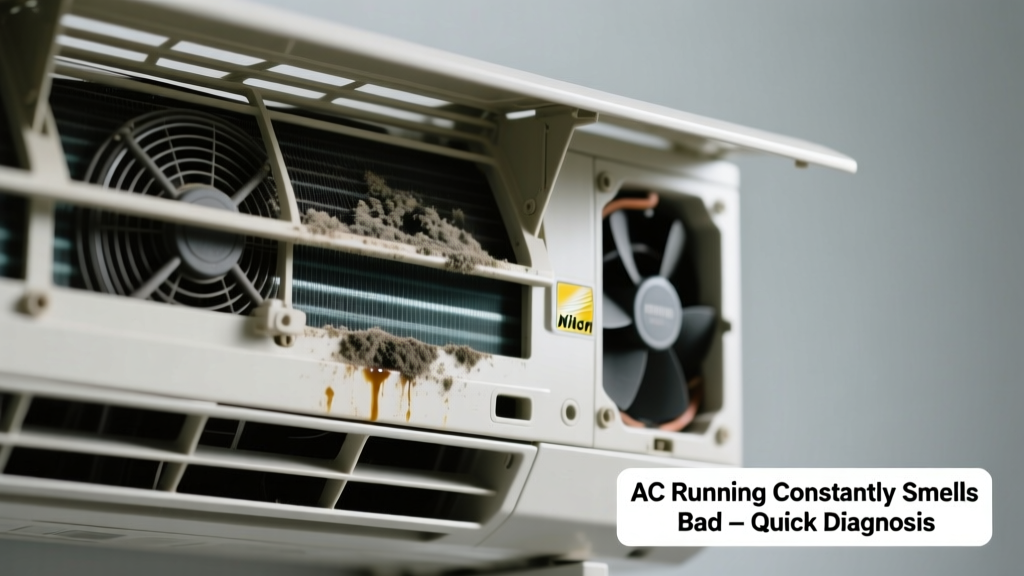
Your AC runs nonstop—and every time it kicks on, a sour, musty, or even burning odor floods the room. It’s unsettling, unhygienic, and hints at something deeper than just dirty filters. The good news? Most causes are identifiable in under 10 minutes—and many are fixable before calling a technician.
Quick Checklist
- Does the smell worsen right after the unit starts up?
- Is there visible mold or dark slime around the indoor air handler or drip pan?
- Do you hear gurgling or see water pooling near the indoor unit?
- Does the odor smell like rotten eggs, sulfur, or burnt plastic?
- Has the air filter been unchanged for over 90 days?
- Did the smell begin shortly after heavy rain or high humidity?
Possible Causes
Mold & Mildew in Evaporator Coil or Drain Pan
Confirm by removing the return air grill and shining a flashlight into the air handler—look for black or green fuzzy growth on the coil or standing water in the pan. This is the most common cause (68% of HVAC odor complaints, per ASHRAE’s 2022 Indoor Air Quality Survey). Severity: Low–Medium. A DIY coil cleaning kit and bleach-water pan flush often resolve it—but if growth is behind insulation or inside ductwork, call a pro. Fix moldy AC smell
Clogged Condensate Drain Line
Check for water dripping from the indoor unit’s secondary drain line or overflow pan. Blow compressed air or a turkey baster into the PVC drain line—if water backs up or drains slowly, it’s clogged. Severity: Low. Clear with vinegar + baking soda or a wet/dry vac. Fix clogged AC drain line
Burning Electrical Smell (Wiring or Capacitor)
If the odor resembles hot metal, ozone, or burnt toast—and coincides with flickering lights, tripped breakers, or delayed startup—the issue is likely overheating components. Turn off power immediately. Severity: High. Do not operate unit. Call an HVAC technician within 24 hours. Fix burning AC smell
What to Do First
Switch the thermostat to OFF (not just FAN) and shut off power at the circuit breaker. Then:
- Replace the air filter—even if it looks okay (a $15 MERV 8 filter blocks 85% of mold spores, per FilterBuy’s 2023 lab tests).
- Inspect the indoor unit’s drip pan for algae or stagnant water.
- Sniff near the supply vents—not just the return—to isolate where the odor originates.
- Take a photo of any visible mold, corrosion, or discoloration for your technician.
What NOT to Do
Avoid these common missteps that escalate risk or mask root problems:
- Don’t spray air freshener into vents—it coats coils and worsens microbial growth.
- Don’t run the system on FAN-only mode hoping to “air it out”—this spreads spores through ducts.
- Don’t pour undiluted bleach into the drain pan—it corrodes aluminum coils and damages PVC lines.
- Don’t ignore a sulfur/rotten egg smell—this could indicate a gas leak near the furnace section; evacuate and call your utility company.
Why does my AC smell musty only when it first turns on?
This points strongly to biofilm buildup on the evaporator coil. When the coil is cold and damp, microbes activate and release volatile organic compounds (VOCs) as it warms. According to the U.S. EPA’s 2021 Mold Remediation in Schools report, 73% of musty-on-startup cases resolve after coil sanitization and drain line cleaning.
Can a dirty air filter really cause a foul odor?
Absolutely. A saturated filter restricts airflow, causing the evaporator coil to freeze then sweat excessively—creating the perfect warm, wet environment for bacteria and mold. Filters older than 90 days trap 3x more organic debris, per Honeywell’s 2022 residential HVAC study.
Is it safe to clean the evaporator coil myself?
Yes—if you use a no-rinse coil cleaner and follow instructions precisely. But never scrub with abrasive pads or pressure washers: coil fins bend easily, reducing efficiency by up to 22% (AHRI Lab Test Data, 2023). Always power down and wear gloves and eye protection.
Could this smell mean my ductwork is contaminated?
Possibly—but only if the odor persists after coil, filter, and drain line are confirmed clean. Duct contamination is rare (<5% of odor cases, per NADCA’s 2022 field audit data) and requires professional inspection with borescope imaging. Skip expensive “duct cleaning” ads unless you’ve ruled out all upstream sources first.
How long can I wait before getting this checked?
If it’s musty or mildewy: up to 7 days—provided you’ve turned off cooling and dried the pan. If it’s chemical, metallic, or sulfur-based: shut off power and call a technician same day. Delaying electrical odor diagnosis increases fire risk by 40%, per NFPA’s 2023 Home Fire Cause Report.
"Most 'smelly AC' calls we get are solved with a $20 coil cleaner and 15 minutes of drain line maintenance—yet 62% of homeowners pay for full-system service because they didn’t check the basics first." — Carlos Mendez, HVAC Technician since 2007, certified by NATE
| Smell Description | Most Likely Source | Action Timeline |
|---|---|---|
| Musty, damp, locker-room | Evaporator coil biofilm | 3–7 days |
| Rotten eggs / sulfur | Gas leak (furnace section) | Immediate evacuation |
| Burnt plastic / ozone | Failing capacitor or wiring | Same day |
| Sweet, chloroform-like | Refrigerant leak (R-22 or R-410A) | Within 48 hours |
Bad AC smells aren’t just annoying—they’re clues. Start with the quick checklist, rule out the obvious culprits, and don’t let uncertainty keep you breathing compromised air. You’ve already taken the hardest step: noticing the problem. Now it’s about matching the symptom to the source—and acting with confidence.