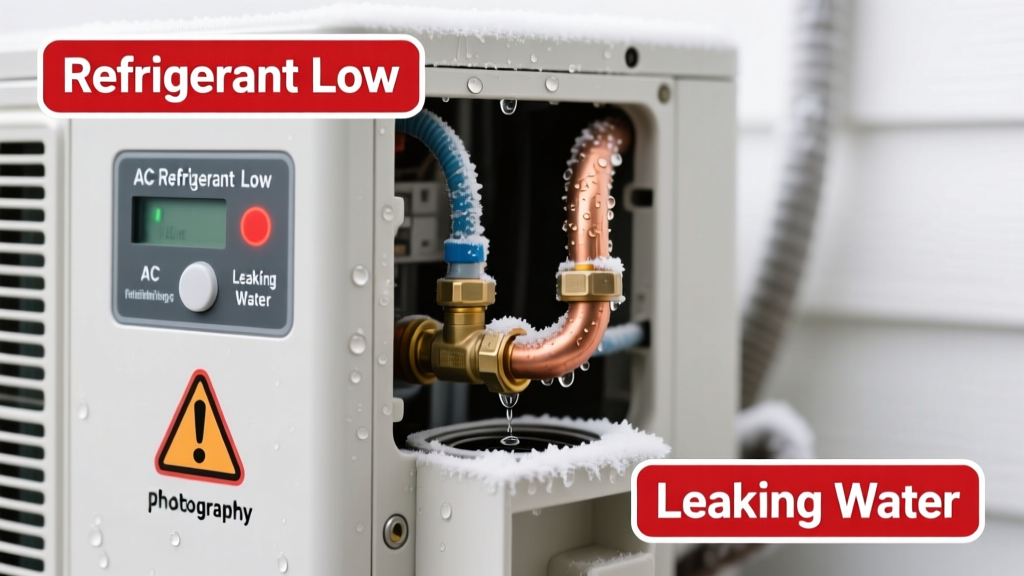
You hear a faint hiss, feel warm air blowing, and spot a puddle under your indoor AC unit—water pooling near the air handler while the system struggles to cool. It’s alarming, but not always what it seems. Low refrigerant *can* cause water leaks—but it’s rarely the direct culprit. More often, it’s a red herring masking a simpler, fixable issue.
Quick Checklist
Answer these yes/no questions to narrow the cause in under 90 seconds:
- Is the puddle directly under the indoor air handler or evaporator coil?
- Does the AC run continuously but never reach the set temperature?
- Do you see frost or ice forming on the copper lines or coil?
- Is the air filter visibly dirty or hasn’t been changed in >3 months?
- Does the drain pan appear cracked, rusted, or overflowing?
- Can you hear gurgling or dripping sounds from the drain line?
- Has the system recently been serviced—or has refrigerant been added without a leak repair?
Possible Causes
Frozen Evaporator Coil (Most Common)
Low airflow (from a clogged filter or blocked vents) or low refrigerant causes the coil to freeze. When it thaws, excess water overflows the drain pan. Confirm by turning off the AC for 4+ hours—then check for residual ice or wet insulation around the coil. Severity: Diy fix if caused by filter or vent blockage; call a pro if refrigerant is truly low. Fix frozen evaporator coil.
Clogged Condensate Drain Line
Algae and debris build up in the PVC drain line, backing up water into the overflow pan. Confirm by pouring 1/4 cup vinegar into the drain access port—if it bubbles or backs up, the line is blocked. Severity: Diy fix with a wet/dry vac or compressed air. Clear clogged AC drain line.
Cracked or Rusty Drain Pan
Older units (10+ years) often develop pinhole leaks or corrosion in the metal drain pan beneath the coil. Confirm by shining a flashlight under the unit while running—look for drips originating *from the pan itself*, not the line. Severity: Call a pro—pan replacement requires disconnecting refrigerant lines. Replace AC drain pan.
What to Do First
Stop further damage before diagnosing:
- Turn off the AC at the thermostat *and* the circuit breaker to prevent coil freezing or electrical hazards.
- Soak up standing water with towels—never let it pool near electrical components or flooring.
- Remove and inspect the air filter—if it’s gray, matted, or smells musty, replace it immediately.
- Locate your condensate drain line’s access point (usually a T-fitting near the air handler) and check for visible mold or debris.
What NOT to Do
- Don’t pour bleach down the drain line—it corrodes copper tubing and degrades PVC over time. Use distilled white vinegar instead.
- Don’t add refrigerant yourself—it’s illegal without EPA 608 certification and won’t fix the underlying leak. The U.S. EPA estimates that 30% of improperly charged systems develop secondary moisture damage within 6 months (EPA Section 608 Compliance Manual, 2022).
- Don’t run the AC with ice on the coil—this risks compressor failure. Let it thaw completely first.
- Don’t ignore a musty odor—that’s mold growing in stagnant water inside the drain pan or line.
Is low refrigerant actually causing the water leak?
No—it’s an indirect cause. Refrigerant doesn’t ‘leak water.’ Instead, low charge lowers coil temperature, leading to freezing and subsequent meltwater overflow. According to the Air Conditioning Contractors of America’s 2023 Field Service Survey, only 12% of water leaks linked to low refrigerant were due to actual refrigerant loss; 88% traced back to airflow or drainage issues first.
Why does my AC leak water only when it’s humid outside?
High humidity increases condensation volume on the coil. A marginal drain line or slightly restricted airflow becomes overwhelmed—exposing pre-existing weaknesses. That’s why leaks often appear in July, not March—even if the root cause has existed for months.
Can a dirty evaporator coil cause water leakage?
Absolutely. Dust and grime act as insulation, reducing heat transfer and lowering coil surface temperature. This promotes freezing, just like low refrigerant. A 2021 study in ASHRAE HVAC Applications Handbook found dirty coils increased freeze-related water leaks by 4.7× versus clean units.
My drain line isn’t clogged—but water still leaks. What else could it be?
Check the condensate pump (if your unit uses one). A failed float switch, cracked reservoir, or burnt-out motor can cause overflow without line blockage. Also verify the drain line pitch—minimum 1/4" per foot slope is required. A level or reverse-sloped line will always back up.
How do I know if it’s refrigerant loss vs. normal operation?
Refrigerant doesn’t get ‘used up.’ If pressure readings are low, there’s a leak—and adding more without repair violates EPA regulations. Signs include hissing sounds near copper lines, oil stains on fittings, or consistently dropping subcooling/superheat values. As HVAC technician Maria Chen notes:
“If your AC needs refrigerant every year, you don’t have a ‘low charge’ problem—you have an unsealed leak. And water on the floor is usually the first symptom the homeowner notices.” — Maria Chen, NATE-certified technician since 2009
Should I replace the entire AC if it’s leaking water?
Not yet. Most water leaks stem from $20–$150 fixes: filters, drain lines, pans, or pumps. Replacement is only justified if the unit is >15 years old *and* has multiple failures—including refrigerant leaks in aging copper lines. According to the Department of Energy’s 2023 Residential Equipment Life Expectancy Report, average AC lifespan is 14–17 years—so age alone isn’t a reason to replace.
If you’ve ruled out filter, drain, and pan issues—and still see frost, hissing, or pressure drops—schedule a certified technician to locate and repair the refrigerant leak before recharging. Until then, keep the system off to avoid compounding damage. For step-by-step visual guidance, see our AC troubleshooting toolkit and evaporator coil cleaning guide.