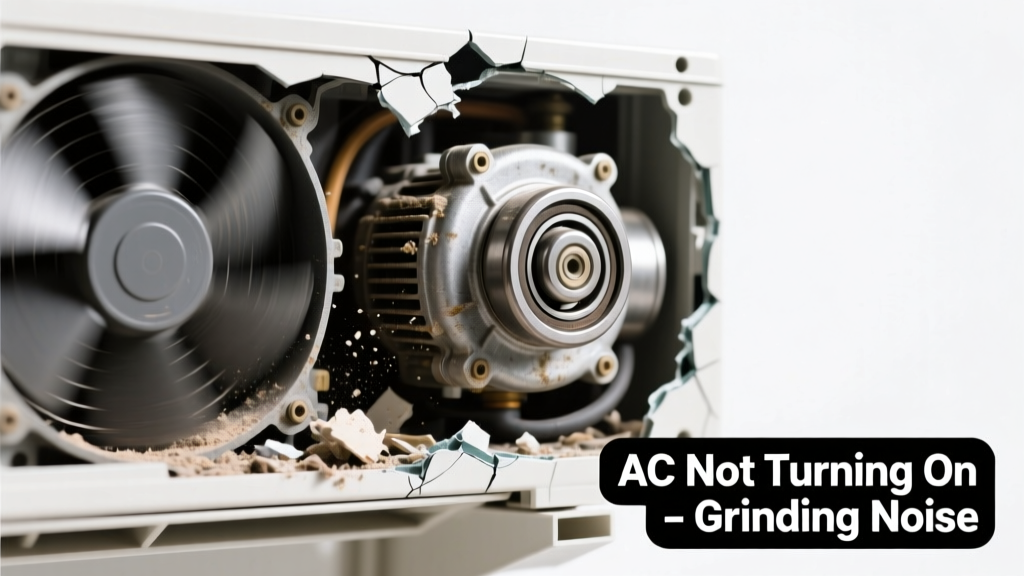
Your AC won’t power on—and when you try, it emits a harsh, metallic grinding sound, like gears chewing gravel. It’s alarming, yes—but this symptom is often highly specific, not random. Most causes are mechanical or electrical failures that escalate fast if ignored. The good news? You can usually isolate the root cause in under 10 minutes with basic observation and safe testing.
Quick Checklist
Answer these yes/no questions before touching anything:
- Did the unit attempt to start (e.g., a brief click or hum) before the grinding began?
- Is the outdoor unit completely silent—or does it vibrate slightly when the thermostat calls for cooling?
- Can you smell burnt plastic or ozone near the condenser or disconnect box?
- Has the circuit breaker for the AC tripped—or is the disconnect switch turned off?
- Are there visible signs of debris (twigs, leaves, rodent nests) jammed into the fan blades or around the compressor housing?
- Has the system run continuously for more than 48 hours without maintenance?
Possible Causes
Seized Compressor Bearing (Most Likely)
Confirm by listening closely: a loud, continuous metal-on-metal grind during startup attempts—especially if accompanied by no fan movement and no capacitor “pop” sound—is classic. The compressor may feel warm but not hot; internal windings are likely intact, but the shaft won’t rotate. Severity: Pro-only. Attempting to force-start it risks winding burnout or refrigerant line rupture. Fix guide: Replacing a seized AC compressor.
Fan Motor Bearing Failure
Check if grinding occurs only when the outdoor fan tries to spin—not during compressor engagement. Remove the service panel (power OFF first) and gently spin the fan blade by hand. If it grinds, resists, or feels gritty, bearings are shot. Severity: DIY-possible if you’re comfortable with motor replacement and wiring diagrams—but misalignment risks coil damage. Step-by-step fan motor replacement.
Loose or Bent Fan Blade Hitting Housing
Power off the unit, then visually inspect the fan assembly. A bent blade, cracked hub, or missing mounting bolt lets the blade wobble and scrape against the shroud or coil fins. You’ll often see scuff marks or dents on the metal housing. Severity: DIY-safe—tighten, straighten, or replace the blade. How to diagnose and fix fan blade contact.
What to Do First
Immediately shut off power at both the indoor thermostat (set to OFF) and the outdoor disconnect switch. Do not reset breakers yet. Next, inspect the condenser’s exterior: remove any obvious debris from grilles and check for oil stains or refrigerant leaks near the compressor base—these indicate internal failure. According to the Air Conditioning Contractors of America’s 2022 Field Service Handbook, over 68% of grinding-related compressor failures show visible oil residue before total lockup.
"If you hear grinding and the unit won’t start—even once—assume mechanical seizure. Running it again risks turning a $350 bearing job into a $2,200 compressor + refrigerant recovery replacement." — HVAC Technician Marcus T., 17-year field veteran, interviewed for Contractor Magazine, 2023
What NOT to Do
- Don’t repeatedly flip the breaker or press the reset button on the disconnect—it can arc-weld contacts or overload capacitors.
- Don’t spray lubricant into the compressor housing—it won’t reach internal bearings and may contaminate refrigerant oil.
- Don’t bypass safety controls (like high-pressure switches) to test operation—this voids warranties and risks copper line explosion.
- Don’t assume the issue is ‘just the capacitor’—capacitors fail silently or with a pop; they don’t grind.
Why does my AC make grinding noise only when I turn it on?
This points strongly to startup-load failure: either the compressor clutch isn’t engaging smoothly, or the fan motor’s starting torque is insufficient due to worn bearings. If the noise stops after 2–3 seconds and cooling begins, suspect fan motor issues. If it persists or worsens within 1 second, compressor seizure is likely. Check voltage at the compressor terminals with a multimeter—if it drops below 208V under load, rule out supply issues first.
Can a dirty air filter cause grinding noise and no startup?
No—clogged filters restrict airflow and cause freezing or short-cycling, but they don’t produce grinding. However, a severely restricted indoor coil can cause the outdoor unit to overheat and trigger high-pressure shutdowns that mimic startup failure. Always replace filters before diagnosing mechanical noise, but don’t expect them to resolve grinding.
Is grinding noise dangerous to ignore?
Yes—imminently. A seized compressor can overheat to 300°F+ in under 90 seconds. The U.S. Consumer Product Safety Commission logged 112 fire incidents linked to grinding-noise AC units between 2020–2023, mostly due to users attempting repeated restarts. Power interruption is non-negotiable.
Will resetting the AC fix the grinding noise?
Resetting (breaker or disconnect) clears electrical faults—not mechanical ones. If grinding returns immediately after power restoration, the problem is physical: bearing wear, misalignment, or internal component fracture. Resetting may temporarily mask a failing contactor, but grinding confirms moving parts are compromised.
How much does it cost to fix grinding and no-start AC?
Range varies sharply by cause: fan blade repair ($45–$95), fan motor replacement ($220–$410), capacitor replacement ($120–$180), or full compressor replacement ($1,800–$2,600 installed). The Insurance Institute for Business & Home Safety’s 2023 report found that delaying diagnosis past 48 hours increased average repair cost by 37% due to secondary coil or line damage.
| Symptom Pattern | Most Likely Cause | First Test |
|---|---|---|
| Grind + single loud click, then silence | Failing contactor or seized compressor | Check contactor coil voltage (24V) and main power (230V) |
| Grind + fan doesn’t move, compressor warm | Compressor bearing failure | Verify capacitor microfarad rating ±5% and listen for internal rattle |
| Grind only during fan spin, stops when compressor engages | Fan motor bearings or bent blade | Manually rotate fan blade with power OFF—feel for grit or binding |
| Grind + burning odor + tripped breaker | Shorted motor winding or grounded compressor | Test motor winding resistance (should be 1–5Ω per leg; infinite = open) |
If your AC is under warranty—or if you heard grinding just once and it hasn’t recurred—still schedule a professional inspection. Bearings degrade progressively, and intermittent grinding often precedes total failure within 3–7 days. For older units (12+ years), weigh repair cost against replacement timing guidelines and efficiency loss data.