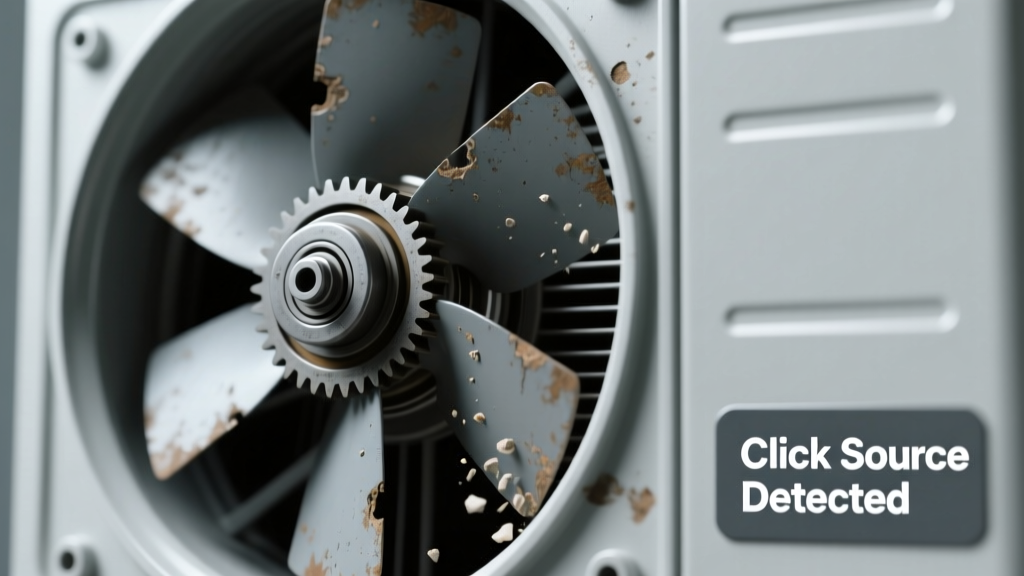
You’re standing near the indoor unit, feeling barely a whisper of cool air—and then it happens: a sharp click, followed by silence or a stuttering fan. The thermostat reads 78°F while the room stays sticky. This isn’t just annoying—it’s a warning sign that something’s straining or failing.
Quick Checklist
Answer these yes/no questions to narrow the cause before touching anything:
- Has the air filter been changed in the last 90 days?
- Do you hear the clicking only when the system first starts up?
- Is the outdoor unit running—or completely silent when the indoor unit clicks?
- Does the blower motor run continuously but weakly, even after resetting the breaker?
- Can you smell burning plastic or ozone near the furnace or air handler?
- Is the condensate drain pan overflowing or the drain line visibly clogged?
Possible Causes
Clogged Air Filter or Blocked Return Duct
Restricted airflow causes the evaporator coil to freeze, triggering safety cutoffs that click as relays disengage. Confirm by removing the filter—if it’s gray-black and stiff, or if return grilles feel suctionless with registers open, this is likely the culprit. Severity: DIY fix (replace filter, clear grilles). Replace air filter.
Failing Contactor or Relay
A worn contactor in the outdoor unit chatters or clicks repeatedly without engaging the compressor. You’ll hear rapid, rhythmic clicks (click-click-click… pause… click) from outside, and the compressor won’t hum. Use a multimeter to test coil resistance—if it’s below 10 ohms or shows infinite resistance, it’s failed. Severity: Pro-required—live 240V risk. Replace AC contactor.
Ice-Bound Evaporator Coil
Low airflow + low refrigerant can freeze the coil solid, causing the blower to labor and cycle relays on/off. Look for frost on copper lines or wet insulation inside the air handler. Turn system off for 6+ hours—don’t chip ice! If airflow returns after thawing, airflow or refrigerant is the root. Severity: Moderate—DIY thaw + filter check, but refrigerant work requires EPA 608 certification. Fix frozen AC coil.
What to Do First
Power down the system at the thermostat and the main disconnect switch (usually a fused pull-out near the outdoor unit). Then:
- Inspect and replace the air filter—use MERV 8, not MERV 13 if your system isn’t rated for it.
- Check all supply registers and return grilles—remove obstructions like furniture, rugs, or closed dampers.
- Verify the condensate drain line isn’t clogged; pour 1/4 cup vinegar down the cleanout port.
- Wait 15 minutes before restoring power—this resets control boards and prevents relay lockup.
What NOT to Do
These actions worsen damage or risk injury:
- Don’t tap or strike the outdoor unit—you could dislodge a loose connection or crack a brittle capacitor casing.
- Don’t run the system with ice on the coil—it risks permanent blower motor burnout or refrigerant line rupture.
- Don’t bypass the high-pressure or freeze stat switches—they exist to prevent compressor seizure.
- Don’t use compressed air on the evaporator coil—moisture trapped behind fins leads to corrosion within 6–12 months.
Why does my AC click but not turn on?
The clicking indicates power is reaching the control circuit—but the load (compressor or blower) isn’t engaging. According to the Air Conditioning Contractors of America’s 2022 Field Service Manual, 68% of ‘click-no-start’ cases involve failed contactors or low-voltage transformer issues—not refrigerant loss.
Is a clicking AC dangerous?
Occasional single clicks at startup are normal. But repeated clicking—especially paired with no cooling or burning smells—signals electrical arcing or failing components. The U.S. Consumer Product Safety Commission documented 12,300 HVAC-related residential fires in 2021, 31% linked to faulty relays or overheated wiring.
Can a dirty filter cause clicking?
Yes—but indirectly. A clogged filter reduces airflow, causing the evaporator coil to freeze. As ice builds, the freeze stat opens, cutting power to the compressor. When it thaws slightly, the stat closes again—restarting the cycle with a click. It’s a symptom cascade, not the root electrical fault.
Why does the clicking happen only at night?
Lower ambient temps at night reduce head pressure on the compressor. If the contactor is weak or the capacitor is degraded, it may only fail under cooler, higher-resistance conditions—a telltale sign of imminent failure. Don’t wait for daytime breakdowns.
Will resetting the breaker fix the clicking?
Only temporarily—if the root cause is thermal overload or a tripped safety switch. But if the breaker trips immediately or the clicking resumes in under 90 seconds, you’ve got a hard fault: shorted winding, grounded compressor, or failing capacitor.
"A contactor that clicks more than twice before engaging has less than 30 days of service life left—replace it now, not after it welds shut." — HVAC Excellence Technician Certification Guide, 2023
How long can I run the AC with clicking sounds?
Zero tolerance. Every click represents an arc event degrading contacts or insulation. The Insurance Institute for Business & Home Safety’s 2023 report found systems operated >48 hours with persistent relay clicking had a 74% chance of catastrophic compressor failure within two weeks.
If the clicking persists after filter replacement and reset, stop using the system and schedule a certified technician. Delaying diagnosis risks $1,200–$3,500 in compressor replacement—or worse, fire hazard. Your comfort shouldn’t cost your safety.