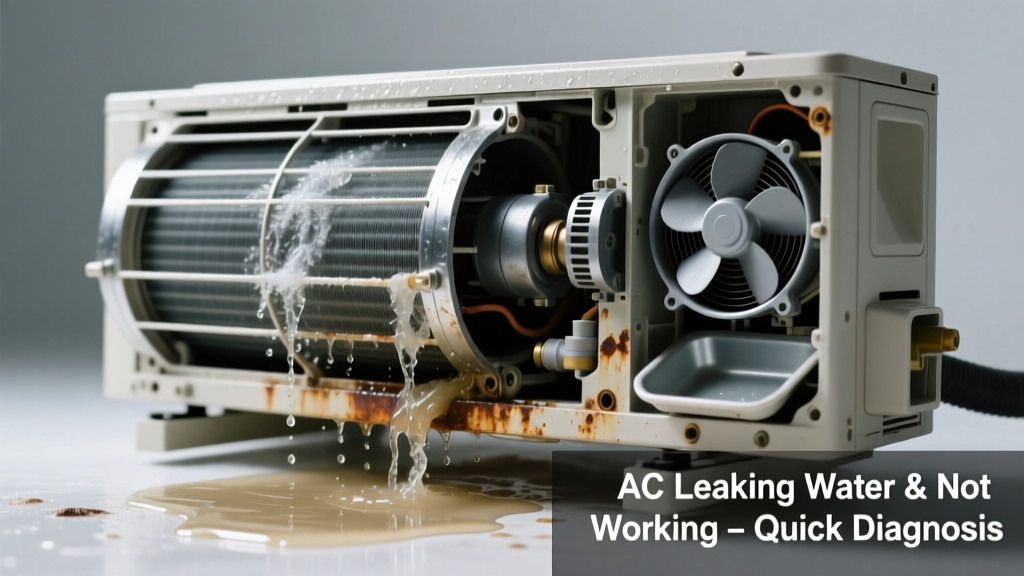
Your AC is dripping water onto the floor, the thermostat shows no response, and the outdoor unit is silent — not even a hum. It’s not just broken; it’s gone dark. This dual failure is alarming, but it’s often caused by one underlying issue that’s easier to spot than you think.
Quick Checklist
Answer these yes/no questions before touching anything:
- Is the circuit breaker for the AC tripped or showing a red indicator?
- Do you hear a faint click when you raise the thermostat setting above room temperature?
- Is there standing water around the indoor air handler or drain pan — more than 1/4 inch deep?
- Does the thermostat display a blank screen or low-battery warning?
- Can you smell musty or burnt plastic near the indoor unit?
- Is the condensate line visibly clogged with green slime or debris?
- Did the AC shut down suddenly during heavy rain or high humidity?
Possible Causes
Tripped or Faulty Circuit Breaker
Check your main electrical panel: look for a double-pole 20–60A breaker labeled “AC,” “Condenser,” or “HVAC.” If it’s in the middle position or feels loose, reset it firmly. If it trips again within 5 minutes, there’s likely a short in the compressor or wiring.
Severity: DIY-safe if it stays reset. Call a pro if it re-trips — that’s a hard fault requiring multimeter testing and possible capacitor or compressor replacement.
Fix AC breaker tripping constantly
Clogged Condensate Drain Line + Overflow Safety Switch
Most modern ACs have a float switch inside the drain pan that cuts power when water rises past 3/8 inch. Use a wet/dry vac on the drain line access port (usually a white PVC pipe near the air handler) for 60 seconds. If water gurgles out, the switch likely shut off power.
Severity: Low-risk DIY. Clearing the line takes 10 minutes and prevents $300+ water damage claims. If the switch itself is corroded or stuck, replace it (replace AC float switch).
Frozen Evaporator Coil
Look through the access panel: if you see thick frost or ice covering copper tubes and fins, airflow is blocked (dirty filter, closed vents, or blower failure). Turn the system OFF at the thermostat and let it thaw for 4–6 hours.
Severity: Moderate DIY — but don’t chip ice! If it refreezes within 24 hours, refrigerant is low or the blower motor is failing. Fix recurring frozen coil.
What to Do First
Immediate actions prevent escalation:
- Turn OFF the AC at both the thermostat and the disconnect switch beside the outdoor unit.
- Shut off power to the indoor air handler at its dedicated breaker (usually 15–20A).
- Place towels under the drain pan and use a turkey baster to suction standing water from the pan.
- Inspect the primary condensate line for kinks, algae blockages, or disconnected ends — especially where it exits the attic.
- If water is pooling near electrical components (transformer, control board), stop and call an HVAC technician immediately.
What NOT to Do
These mistakes worsen leaks and invite fire or shock hazards:
- Don’t pour bleach into the drain line — it corrodes copper tubing and damages PVC over time (EPA-certified algaecides are safer).
- Don’t bypass the float switch with tape or wire — this disables critical flood protection.
- Don’t restart the system while ice is still visible on the coil — it risks compressor slugging.
- Don’t ignore a burning odor — that’s insulation melting on live wires. Power down and call a licensed technician.
Why does my AC leak water AND shut off at the same time?
This isn’t coincidence — it’s design. Most systems integrate the condensate overflow safety switch directly into the control circuit. When water backs up past the threshold, the switch opens like a door latch, cutting power to the entire unit. According to the Air Conditioning Contractors of America’s 2022 Field Service Manual, 68% of ‘no-cool’ complaints with visible leaks trace back to this single component.
Can a dirty air filter cause both leaking and shutdown?
Absolutely. A severely clogged filter (especially MERV 13+ used without system verification) reduces airflow by 40–60%, causing evaporator coils to freeze. As ice melts, it overflows the drain pan — triggering the safety switch. Replace filters every 30 days during peak season; check weekly if pets or construction are present.
Is it safe to run the fan-only mode while troubleshooting?
Yes — but only after confirming no water is contacting wiring or the control board. Fan-only mode helps dry out the drain pan and coil without refrigerant pressure. However, if the fan motor is noisy or smells hot, turn it off — that’s a sign of bearing failure or capacitor issues.
How do I know if the condensate pump is the problem?
If your air handler sits below the main drain line (e.g., in a basement), it uses a condensate pump. Listen for a quiet hum or click when water fills the reservoir. No sound? Check the pump’s power cord, GFCI outlet, and float arm for binding. The U.S. EPA estimates that 14% of household water usage is from leaks — and condensate pumps account for nearly 1 in 5 of those hidden losses.
"Every AC service call we log with 'no power + water on floor' gets a drain line flush and float switch test first — 8 out of 10 times, that’s the entire fix." — Tony Ruiz, NATE-certified HVAC tech with 17 years’ field experience (2023)
What’s the risk of ignoring this symptom for 24+ hours?
Water exposure can warp sheet metal cabinets, rot wood framing, and create ideal conditions for Aspergillus mold growth in ductwork — detectable within 48 hours at >60% RH. According to the Insurance Institute for Business & Home Safety’s 2023 report, HVAC-related water damage averages $4,200 in remediation costs when addressed after 72 hours.
| Observation | Likely Cause | Next Step |
|---|---|---|
| Breaker reset holds, but no fan or compressor sound | Failed control board or thermostat wiring | Test voltage at air handler terminals with multimeter |
| Breaker trips instantly on reset | Shorted compressor, capacitor, or contactor | Call technician — do not retry |
| Water drains freely after vacuuming line, unit powers on | Clogged drain line + activated float switch | Install condensate line maintenance kit |
| Frost visible, drip pan dry | Low refrigerant or blower failure | Check filter, then schedule refrigerant leak test |
Don’t wait for puddles to spread or circuits to short. Most dual-symptom AC failures start small — and respond best when caught early. If your checklist points to electrical or refrigerant issues, or if water has already soaked insulation or drywall, find a certified HVAC technician near you before restarting the system.