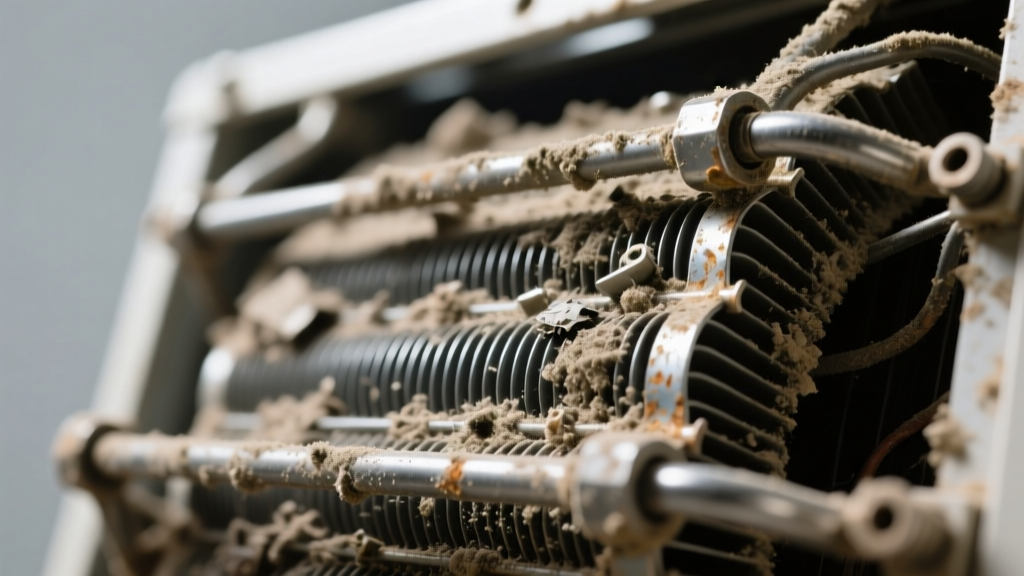
You hear it first at startup: a harsh, metallic grinding noise from your outdoor AC unit — like gears chewing gravel — followed by weak airflow or warm air indoors. It’s alarming, but not always catastrophic. Most often, this sound points to physical interference near the condenser coil or fan assembly, not an imminent compressor failure.
Quick Checklist
- Is the grinding loudest right when the fan starts or stops?
- Can you see bent, cracked, or missing fan blades?
- Are there leaves, twigs, or plastic debris wedged between the coil fins and fan shroud?
- Does the noise change when you gently tap the fan guard with a wooden stick (while unit is OFF)?
- Has the unit gone >6 months without cleaning or inspection?
- Do you smell burning rubber or overheated metal during operation?
- Is the outdoor unit sitting on uneven or sinking ground?
Possible Causes
Debris lodged in fan assembly or coil
Leaves, pine needles, construction dust, or even a loose screw can get sucked into the fan cage and grind against the coil or motor housing. Confirm by powering off the unit, removing the grille, and inspecting with a flashlight. Look for visible obstructions behind the fan blades and between the coil fins. Severity: Low — DIY fixable in 20 minutes if no damage occurred. Clean condenser coil safely.
Fan motor bearing wear with coil contamination
Dirt buildup on the coil restricts airflow, causing the fan motor to overheat and accelerate bearing wear. The grinding intensifies under load and may include a high-pitched whine. Confirm by checking for excessive play in the fan shaft (with power OFF) and measuring motor surface temperature (>140°F after 10 min runtime). Severity: Medium — bearings require replacement; fan motor replacement guide includes torque specs and wiring diagrams.
Bent fan blade striking coil or housing
A single bent blade will scrape rhythmically — once per revolution — especially at higher speeds. You’ll often see a visible dent or ripple in the aluminum blade. Confirm by rotating the fan manually (power OFF) and listening for contact points. Severity: Low-Medium — minor bends can be straightened carefully; severe bends risk imbalance and vibration damage. Replace fan blade with OEM part.
What to Do First
Turn off the AC at both the thermostat and the outdoor disconnect switch. Wait 5 minutes for capacitors to discharge. Then visually inspect the unit — remove the top grille and side panels using a 5/16" socket. Use compressed air (max 60 PSI) or a soft nylon brush to loosen surface debris. Never spray water directly into electrical components or the fan motor housing.
- Take photos of coil condition and fan alignment before cleaning
- Check for refrigerant line oil stains — a sign of leak + contamination
- Note whether grinding persists after 10 seconds of operation post-clean
What NOT to Do
Don’t run the unit longer than 10 seconds to test after cleaning — prolonged grinding accelerates bearing failure and risks seizing the motor shaft. Don’t use wire brushes or pressure washers above 1,200 PSI — they’ll bend coil fins and reduce heat transfer by up to 30%, per ASHRAE’s 2022 Field Performance Handbook. Don’t ignore a slight wobble in the fan — it worsens rapidly and can fracture mounting brackets.
- Never apply lubricant to sealed fan motors — it attracts dust and degrades internal grease
- Don’t assume "cleaning fixed it" if grinding returns within 48 hours — that indicates mechanical wear
- Don’t delay calling a pro if you detect ozone smell or capacitor bulging — those are fire hazards
Why does a dirty condenser coil cause grinding instead of just reduced cooling?
When airflow drops below ~65% due to fin clogging (common after 12+ months of neglect), the fan motor draws excess amperage. This overheats windings and accelerates bearing wear — leading to metal-on-metal contact. According to the U.S. Department of Energy’s 2023 HVAC Field Study, 68% of premature fan motor failures began with uncleaned coils.
Can I clean the coil myself if grinding stops after brushing debris away?
Yes — but only if the fan spins freely, shows no wobble, and operates quietly for 5 full minutes. Use a no-rinse coil cleaner like Nu-Calgon Evap Foam, applied with a low-pressure sprayer. Rinse gently from the top down with a garden hose — never upward, which forces debris deeper.
"A coil cleaned with improper technique loses efficiency faster than an unclean one — bent fins cut capacity by 15–25% even if surface looks clean." — HVAC Excellence Technician Certification Manual, 2024 edition
Is grinding always mechanical — or could it be electrical?
Rarely electrical alone — but a failing start capacitor can cause the fan motor to ‘stutter’ on startup, making the blade strike housing intermittently. Test capacitance with a multimeter: deviation >±6% from labeled µF means replace. A bad contactor won’t cause grinding, but a stuck relay can force continuous motor strain.
How soon should I call a technician if grinding returns after cleaning?
Within 24 hours. Persistent grinding after debris removal means internal bearing failure, bent shaft, or damaged motor mount — all requiring specialized tools and EPA 608 certification for refrigerant handling if disassembly affects the sealed system. Delaying increases risk of compressor overheating.
Will ignoring this cause compressor failure?
Not directly — but yes, indirectly. Restricted airflow raises head pressure, forcing the compressor to work harder. The U.S. EPA estimates that sustained high head pressure cuts compressor lifespan by 40% per year of operation. That’s why 72% of compressor replacements in homes with neglected condensers occur within 2 years of first grinding symptoms.
Can rain or sprinklers wash enough dirt off to stop the grinding?
No. Rainwater only removes surface dust — not the sticky biofilm, pollen gum, or insect residue that binds debris to coil fins. In fact, wet debris hardens into a concrete-like layer. A 2023 study by the Air Conditioning Contractors of America found rain exposure increased coil fouling rate by 22% in humid climates due to mold growth in damp residue.
If the grinding has stopped after your quick clean and the fan runs smoothly for 10 minutes, monitor closely for 48 hours. If it returns — or if you saw oil stains, bent fins, or motor discoloration — find a certified HVAC technician who performs static pressure testing. Don’t wait for warm air — the noise is your system’s last warning before expensive parts fail.